Home > Press > Using light-force to study single molecules
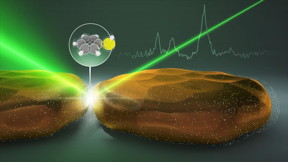 |
| This is an illustration of light-mediated detection of a molecule. CREDIT: N. Antille, EPFL |
Abstract:
Scientists at EPFL show how a light-induced force can amplify the sensitivity and resolution of a technique used to study single molecules.
Using light-force to study single molecules
Lausanne, Switzerland | Posted on November 23rd, 2015When it comes to studying single molecules, scientists use a powerful technique called "surface-enhanced Raman scattering" (SERS). An extremely sensitive tool, SERS detects the vibrations within the atoms of the illuminated molecule as a change in light color. But the sensitivity of SERS is limited at room temperature because molecules vibrate too weakly. Publishing in Nature Nanotechnology, EPFL scientists now show that this obstacle can be overcome with the tools of cavity optomechanics - the interaction between light and mechanical objects. The work has significant practical applications, as it can push the capabilities of SERS even further.
Raman spectroscopy and weak vibrations
SERS is based on the principles of Raman spectroscopy, an old technique used to probe molecules: When laser light shines on them, it interacts with their vibrations (e.g. the stretching of a bond between two atoms). As a result, the wavelength of the light shifts, changing its color. This shift becomes the unique fingerprint of the type of molecule being probed.
However, Raman spectroscopy is limited when it comes to single molecules because they interact very weakly with light. This happens mainly for two reasons: First, a single molecule is about a thousand times smaller than the wavelength of incoming light. Developed about forty years ago, SERS overcame this problem by exploiting a tiny cloud of oscillating electrons in metallic nanoparticles that were excited with laser light. The cloud is known as a "plasmon" and it can be localized to nanometer-size gaps where molecules can be placed.
In other words, the metallic nanoparticles act as nano-antennas that focus light down to molecular dimensions; this approach enhanced the sensitivity of SERS by more than 10 orders of magnitude. However, the second limitation of Raman has persisted without solution: molecules vibrate very weakly at room temperature - or, in technical terms, "the relevant vibrational modes are frozen".
Amplifying molecular vibrations with light
Two members of Tobias J. Kippenberg's lab at EPFL have now found a theoretical solution to this problem, showing that SERS can actually be pushed even further in sensitivity and resolution. The key in overcoming the weak vibrations is the cloud of oscillating electrons, the plasmon, which can exert a force on the vibrations of the tested molecule.
Researchers Philippe Roelli and Christophe Galland, were able to determine the exact conditions needed for this light-induced force to drive the molecule's vibrations to large amplitudes. As the scientific community has set specific guidelines for this field, the researchers chose laser wavelengths and properties of the plasmonic structures against these.
Getting more signal out of a molecule
As the light-force amplifies the vibrations of the molecule, the interaction between the molecule and the confined laser light grows stronger as well. This can dramatically increase the signal that SERS picks up, well beyond what can be reached by previously known mechanisms.
"Our work offers specific guidelines for designing more efficient metallic nanostructures and excitation schemes for SERS," says Philippe Roelli. "It can push the limits of the technique in sensitivity and resolution." By doing so, the study opens new research directions in the control of molecular vibrations with light, with potential applications ranging from biology and chemistry to quantum technologies.
###
This work was funded by the European Research Committee, the NCCR of Quantum Engineering (QSIT), the Swiss National Science Foundation, the Curie Institute and the Max Planck-EPFL Center for Molecular Nanoscience and Technology.
Reference
Roelli P, Galland C, Piro N, Kippenberg T J. Molecular cavity optomechanics: a theory of plasmon-enhanced Raman scattering. Nature Nanotechnology 23 November 2015. DOI: 10.1038/nnano.2015.264.
####
For more information, please click here
Contacts:
Nik Papageorgiou
41-216-932-105
Copyright © Ecole Polytechnique Fédérale de Lausanne
If you have a comment, please Contact us.Issuers of news releases, not 7th Wave, Inc. or Nanotechnology Now, are solely responsible for the accuracy of the content.
Bookmark:


| Related News Press |
News and information
 Quantum computer improves AI predictions April 17th, 2026
Flexible sensor gains sensitivity under pressure April 17th, 2026
A reusable chip for particulate matter sensing April 17th, 2026
Detecting vibrational quantum beating in the predissociation dynamics of SF6 using time-resolved photoelectron spectroscopy April 17th, 2026
Imaging
Chemistry
Projecting light to dispense liquids: A new route to ultra-precise microdroplets January 30th, 2026
From sensors to smart systems: the rise of AI-driven photonic noses January 30th, 2026
"Nanoreactor" cage uses visible light for catalytic and ultra-selective cross-cycloadditions October 3rd, 2025
Nanomedicine
A fundamentally new therapeutic approach to cystic fibrosis: Nanobody repairs cellular defect April 17th, 2026
New molecular technology targets tumors and simultaneously silences two ‘undruggable’ cancer genes August 8th, 2025
New imaging approach transforms study of bacterial biofilms August 8th, 2025
Electrifying results shed light on graphene foam as a potential material for lab grown cartilage June 6th, 2025
Discoveries
Quantum computer improves AI predictions April 17th, 2026
Flexible sensor gains sensitivity under pressure April 17th, 2026
A reusable chip for particulate matter sensing April 17th, 2026
Detecting vibrational quantum beating in the predissociation dynamics of SF6 using time-resolved photoelectron spectroscopy April 17th, 2026
Announcements
A fundamentally new therapeutic approach to cystic fibrosis: Nanobody repairs cellular defect April 17th, 2026
UC Irvine physicists discover method to reverse ‘quantum scrambling’ : The work addresses the problem of information loss in quantum computing system April 17th, 2026
Interviews/Book Reviews/Essays/Reports/Podcasts/Journals/White papers/Posters
A fundamentally new therapeutic approach to cystic fibrosis: Nanobody repairs cellular defect April 17th, 2026
UC Irvine physicists discover method to reverse ‘quantum scrambling’ : The work addresses the problem of information loss in quantum computing system April 17th, 2026
Tools
Metasurfaces smooth light to boost magnetic sensing precision January 30th, 2026
From sensors to smart systems: the rise of AI-driven photonic noses January 30th, 2026
Japan launches fully domestically produced quantum computer: Expo visitors to experience quantum computing firsthand August 8th, 2025
Nanobiotechnology
A fundamentally new therapeutic approach to cystic fibrosis: Nanobody repairs cellular defect April 17th, 2026
New molecular technology targets tumors and simultaneously silences two ‘undruggable’ cancer genes August 8th, 2025
New imaging approach transforms study of bacterial biofilms August 8th, 2025
Electrifying results shed light on graphene foam as a potential material for lab grown cartilage June 6th, 2025
Quantum nanoscience
Beyond silicon: Electronics at the scale of a single molecule January 30th, 2026
MXene nanomaterials enter a new dimension Multilayer nanomaterial: MXene flakes created at Drexel University show new promise as 1D scrolls January 30th, 2026
ICFO researchers overcome long-standing bottleneck in single photon detection with twisted 2D materials August 8th, 2025
 |
||
 |
||
| The latest news from around the world, FREE | ||
 |
||
|
|
||
| Premium Products | ||
 |
||
|
Only the news you want to read!
Learn More |
||
 |
||
|
Full-service, expert consulting
Learn More |
||
|
|
||