Home > Press > Magneto-optics on the edge
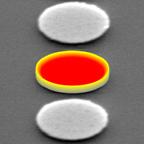 |
| The figure shows a secondary electron microscopy image of one of the nano-scale engineered samples consisting of 400 nm diameter permalloy disks that were fabricated by means of electron beam lithography. The center disk has the lateral distribution of the magneto-optical response superimposed as a color-coded image. The strongly enhanced edge-excitation of the magneto-optical response is visible as a yellow rim structure here. Credit: CIC nanoGUNE |
Abstract:
Magneto-optics is a crucial characterization and detection technique for materials and devices. Hereby, the technique benefits from its high sensitivity and its compatibility with almost any environment due to its contact-free nature. Recently, numerous efforts (also at nanoGUNE, see e.g. PRL 111, 167401 (2013) & Nat. Commun. 6, 6150(2015)) have been made to pair magneto-optics with plasmonics to achieve even higher sensitivities in designer materials or applications. The present work now demonstrates that nanofabrication and nano-shape design allow for an increase and tunability of magneto-optical effects that is completely independent from optical or plasmonic resonances and thus not dependent on the photon energy of the exciting radiation, making it widely applicable. Specifically, this combined experimental and modeling study shows that in disk shaped samples, a magneto-optical response can be generated that is massively enhanced at the edges, leading to a "ring of fire" for the magneto-optical effect, as being shown in the figure below.
Magneto-optics on the edge
Usurbil, Spain | Posted on November 2nd, 2015In general, magneto-optical effects are caused by the quantum mechanical spin-orbit interaction and its influence on the electronic band structure. Correspondingly, magneto-optics is strongly associated with materials properties that result from the electronic structure. The influence of sample geometry onto magneto-optical effects on the other hand has so far only been associated with optical resonances, but resonance independent effects that originate from the specific self-interaction of the magneto-optically induced radiation pattern have not been observed. The reason for this is the fact that such behavior is extremely localized and thus only observable for small nano-scale structures. The work led by the nanoGUNE team has now succeeded in demonstrating that in such nano-scale structures, geometry induced effects can be extremely strong and they even can result in a doubling of the area averaged magneto-optical signal for a 100 nm diameter disk. Therefore, this new work opens up excellent nano-engineering opportunities towards enhanced and generally designed magneto-optical properties in nano-materials.
###
Authors:
A. Berger, R. Alcaraz de la Osa, A. K. Suszka, M. Pancaldi, J. M. Saiz, F. Moreno, H. P. Oepen, and P. Vavassori (nanoGUNE authors are underlined)
Acknowledgments:
We acknowledge funding from the Basque Government (Program No. PI2012-47) and the Spanish Government (Project No. MAT2012-36844). Work at the University of Cantabria has been supported by MICINN under Project No. FIS2013-45854-P.
####
For more information, please click here
Contacts:
Irati Kortabitarte
34-943-363-040
Copyright © Elhuyar Fundazioa
If you have a comment, please Contact us.Issuers of news releases, not 7th Wave, Inc. or Nanotechnology Now, are solely responsible for the accuracy of the content.
Bookmark:


| Related News Press |
News and information
 Quantum computer improves AI predictions April 17th, 2026
Flexible sensor gains sensitivity under pressure April 17th, 2026
A reusable chip for particulate matter sensing April 17th, 2026
Detecting vibrational quantum beating in the predissociation dynamics of SF6 using time-resolved photoelectron spectroscopy April 17th, 2026
Govt.-Legislation/Regulation/Funding/Policy
Quantum computer improves AI predictions April 17th, 2026
Metasurfaces smooth light to boost magnetic sensing precision January 30th, 2026
New imaging approach transforms study of bacterial biofilms August 8th, 2025
Discoveries
Quantum computer improves AI predictions April 17th, 2026
Flexible sensor gains sensitivity under pressure April 17th, 2026
A reusable chip for particulate matter sensing April 17th, 2026
Detecting vibrational quantum beating in the predissociation dynamics of SF6 using time-resolved photoelectron spectroscopy April 17th, 2026
Materials/Metamaterials/Magnetoresistance
First real-time observation of two-dimensional melting process: Researchers at Mainz University unveil new insights into magnetic vortex structures August 8th, 2025
Researchers unveil a groundbreaking clay-based solution to capture carbon dioxide and combat climate change June 6th, 2025
A 1960s idea inspires NBI researchers to study hitherto inaccessible quantum states June 6th, 2025
Institute for Nanoscience hosts annual proposal planning meeting May 16th, 2025
Announcements
A fundamentally new therapeutic approach to cystic fibrosis: Nanobody repairs cellular defect April 17th, 2026
UC Irvine physicists discover method to reverse ‘quantum scrambling’ : The work addresses the problem of information loss in quantum computing system April 17th, 2026
Interviews/Book Reviews/Essays/Reports/Podcasts/Journals/White papers/Posters
A fundamentally new therapeutic approach to cystic fibrosis: Nanobody repairs cellular defect April 17th, 2026
UC Irvine physicists discover method to reverse ‘quantum scrambling’ : The work addresses the problem of information loss in quantum computing system April 17th, 2026
Photonics/Optics/Lasers
Metasurfaces smooth light to boost magnetic sensing precision January 30th, 2026
From sensors to smart systems: the rise of AI-driven photonic noses January 30th, 2026
 |
||
 |
||
| The latest news from around the world, FREE | ||
 |
||
|
|
||
| Premium Products | ||
 |
||
|
Only the news you want to read!
Learn More |
||
 |
||
|
Full-service, expert consulting
Learn More |
||
|
|
||