Home > Press > Scientists pave way for diamonds to trace early cancers
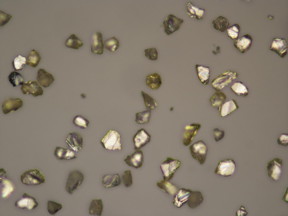 |
| This is a photo of nano-diamonds using an optical microscope. The purpose is to characterize the size of nano-diamonds.
Photo by Ewa Rej, the University of Sydney |
Abstract:
Physicists from the University of Sydney have devised a way to use diamonds to identify cancerous tumours before they become life threatening.
Scientists pave way for diamonds to trace early cancers
Sydney, Australia | Posted on October 10th, 2015Their findings, published today in Nature Communications, reveal how a nanoscale, synthetic version of the precious gem can light up early-stage cancers in non-toxic, non-invasive Magnetic Resonance Imaging (MRI) scans.
Targeting cancers with tailored chemicals is not new but scientists struggle to detect where these chemicals go since, short of a biopsy, there are few ways to see if a treatment has been taken-up by a cancer.
Led by Professor David Reilly from the School of Physics, researchers from the University investigated how nanoscale diamonds could help identify cancers in their earliest stages.
"We knew nano diamonds were of interest for delivering drugs during chemotherapy because they are largely non-toxic and non-reactive," says Professor Reilly.
"We thought we could build on these non-toxic properties realising that diamonds have magnetic characteristics enabling them to act as beacons in MRIs. We effectively turned a pharmaceutical problem into a physics problem."
Professor Reilly's team turned its attention to hyperpolarising nano-diamonds, a process of aligning atoms inside a diamond so they create a signal detectable by an MRI scanner.
"By attaching hyperpolarised diamonds to molecules targeting cancers the technique can allow tracking of the molecules' movement in the body," says Ewa Rej, the paper's lead author.
"This is a great example of how quantum physics research tackles real-world problems, in this case opening the way for us to image and target cancers long before they become life-threatening," says Professor Reilly.
The next stage of the team's work involves working with medical researchers to test the new technology on animals. Also on the horizon is research using scorpion venom to target brain tumours with MRI scanning.
###
The research documented in the paper Hyperpolarized Nanodiamond with Long Spin Relaxation Times was done by the ARC Centre of Excellence for Engineered Quantum Systems at the University's School of Physics.
####
For more information, please click here
Contacts:
Vivienne Reiner
61-432-352-132
Verity Leatherdale
+61 403 067 342
Copyright © University of Sydney
If you have a comment, please Contact us.Issuers of news releases, not 7th Wave, Inc. or Nanotechnology Now, are solely responsible for the accuracy of the content.
Bookmark:


| Related News Press |
News and information
 Quantum computer improves AI predictions April 17th, 2026
Flexible sensor gains sensitivity under pressure April 17th, 2026
A reusable chip for particulate matter sensing April 17th, 2026
Detecting vibrational quantum beating in the predissociation dynamics of SF6 using time-resolved photoelectron spectroscopy April 17th, 2026
Imaging
Simple algorithm paired with standard imaging tool could predict failure in lithium metal batteries August 8th, 2025
First real-time observation of two-dimensional melting process: Researchers at Mainz University unveil new insights into magnetic vortex structures August 8th, 2025
Physics
UC Irvine physicists discover method to reverse ‘quantum scrambling’ : The work addresses the problem of information loss in quantum computing system April 17th, 2026
Cancer
New molecular technology targets tumors and simultaneously silences two ‘undruggable’ cancer genes August 8th, 2025
Nanomedicine
A fundamentally new therapeutic approach to cystic fibrosis: Nanobody repairs cellular defect April 17th, 2026
New molecular technology targets tumors and simultaneously silences two ‘undruggable’ cancer genes August 8th, 2025
New imaging approach transforms study of bacterial biofilms August 8th, 2025
Electrifying results shed light on graphene foam as a potential material for lab grown cartilage June 6th, 2025
Discoveries
Quantum computer improves AI predictions April 17th, 2026
Flexible sensor gains sensitivity under pressure April 17th, 2026
A reusable chip for particulate matter sensing April 17th, 2026
Detecting vibrational quantum beating in the predissociation dynamics of SF6 using time-resolved photoelectron spectroscopy April 17th, 2026
Materials/Metamaterials/Magnetoresistance
First real-time observation of two-dimensional melting process: Researchers at Mainz University unveil new insights into magnetic vortex structures August 8th, 2025
Researchers unveil a groundbreaking clay-based solution to capture carbon dioxide and combat climate change June 6th, 2025
A 1960s idea inspires NBI researchers to study hitherto inaccessible quantum states June 6th, 2025
Institute for Nanoscience hosts annual proposal planning meeting May 16th, 2025
Announcements
A fundamentally new therapeutic approach to cystic fibrosis: Nanobody repairs cellular defect April 17th, 2026
UC Irvine physicists discover method to reverse ‘quantum scrambling’ : The work addresses the problem of information loss in quantum computing system April 17th, 2026
Interviews/Book Reviews/Essays/Reports/Podcasts/Journals/White papers/Posters
A fundamentally new therapeutic approach to cystic fibrosis: Nanobody repairs cellular defect April 17th, 2026
UC Irvine physicists discover method to reverse ‘quantum scrambling’ : The work addresses the problem of information loss in quantum computing system April 17th, 2026
Tools
Metasurfaces smooth light to boost magnetic sensing precision January 30th, 2026
From sensors to smart systems: the rise of AI-driven photonic noses January 30th, 2026
Japan launches fully domestically produced quantum computer: Expo visitors to experience quantum computing firsthand August 8th, 2025
 |
||
 |
||
| The latest news from around the world, FREE | ||
 |
||
|
|
||
| Premium Products | ||
 |
||
|
Only the news you want to read!
Learn More |
||
 |
||
|
Full-service, expert consulting
Learn More |
||
|
|
||