Home > Press > Silicon nanoparticle is a new candidate for an ultrafast all-optical transistor
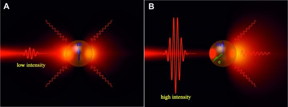 |
| An illustration of a silicon nanoparticle switching between modes depending on the intensity of incoming laser pulse. CREDIT: Nano Letters |
Abstract:
Physicists from the Department of Nanophotonics and Metamaterials at ITMO University have experimentally demonstrated the feasibility of designing an optical analog of a transistor based on a single silicon nanoparticle. Because transistors are some of the most fundamental components of computing circuits, the results of the study have crucial importance for the development of optical computers, where transistors must be very small and ultrafast at the same time. The study was published in the scientific journal Nano Letters.
Silicon nanoparticle is a new candidate for an ultrafast all-optical transistor
St. Petersburg, Russia | Posted on September 8th, 2015The performance of modern computers, which use electrons as signal carriers, is largely limited by the time needed to trigger the transistor - usually around 0.1 - 1 nanoseconds (1/1.000.000.000 of a second). Next-generation optical computers, however, rely on photons to carry the useful signal, which heavily increases the amount of information passing through the transistor per second. For this reason, the creation of an ultrafast and compact all-optical transistor is considered to be instrumental in the development of optical computing. Such a nanodevice would enable scientists to control the propagation of an optical signal beam by means of an external control beam within several picoseconds (1/1.000.000.000.000 of a second).
In the study, a group of Russian scientists from ITMO University, Lebedev Physical Institute and Academic University in Saint Petersburg put forward a completely new approach to design such optical transistors, having made a prototype using only one silicon nanoparticle.
The scientists found that they can dramatically change the properties of a silicon nanoparticle by irradiating it with intense and ultrashort laser pulse. The laser thus acts as a control beam, providing ultrafast photoexcitation of dense and rapidly recombining electron-hole plasma whose presence changes the dielectric permittivity of silicon for a few picoseconds. This abrupt change in the optical properties of the nanoparticle opens the possibility to control the direction, in which incident light is scattered. For instance, the direction of nanoparticle scattering can be changed from backward to forward on picoseconds timescale, depending on the intensity of the incident control laser pulse. This concept of ultrafast switching is very promising for designing of all-optical transistor.
"Generally, researchers in this field are focused on designing nanoscale all-optical transistors by means of controlling the absorption of nanoparticles, which, in essence, is entirely logical. In high absorption mode, the light signal is absorbed by the nanoparticle and cannot pass through, while out of this mode the light is allowed to propagate past the nanoparticle. However, this method did not yield any decisive results," explains Sergey Makarov, lead author of the study and senior researcher at the Department of Nanophotonics and Metamaterials. "Our idea is different in the sense that we control not the absorption properties of the nanoparticle, but rather its scattering diagram. Let's say, the nanoparticle normally scatters almost all incident light in the backward direction, but once we irradiate it by a control pulse, it becomes reconfigured and starts scattering light forward."
The choice of silicon as a material for the optical transistor was not accidental. Creating an optical transistor requires the use of inexpensive materials appropriate for mass production and capable of changing their optical properties in several picoseconds (in the regime of dense electron-hole plasma) without getting overheated at the same time.
"The time it takes us to deactivate our nanoparticle amounts to just several picoseconds, while to activate it we need no more than tens of femtoseconds (1/1.000.000.000.000.000). Now we already have experimental data that clearly indicates that a single silicon nanoparticle can indeed play the role of an all-optical transistor. Currently we are planning to conduct new experiments, where, along with a laser control beam, we will introduce a useful signal beam", concludes Pavel Belov, coauthor of the paper and head of the Department of Nanophotonics and Metamaterials.
####
For more information, please click here
Contacts:
Dmitry Malkov
7-953-377-5508
Copyright © ITMO University
If you have a comment, please Contact us.Issuers of news releases, not 7th Wave, Inc. or Nanotechnology Now, are solely responsible for the accuracy of the content.
Bookmark:


| Related News Press |
News and information
 Quantum computer improves AI predictions April 17th, 2026
Flexible sensor gains sensitivity under pressure April 17th, 2026
A reusable chip for particulate matter sensing April 17th, 2026
Detecting vibrational quantum beating in the predissociation dynamics of SF6 using time-resolved photoelectron spectroscopy April 17th, 2026
Chip Technology
A reusable chip for particulate matter sensing April 17th, 2026
Metasurfaces smooth light to boost magnetic sensing precision January 30th, 2026
Optical computing/Photonic computing
ICFO researchers overcome long-standing bottleneck in single photon detection with twisted 2D materials August 8th, 2025
Programmable electron-induced color router array May 14th, 2025
Discoveries
Quantum computer improves AI predictions April 17th, 2026
Flexible sensor gains sensitivity under pressure April 17th, 2026
A reusable chip for particulate matter sensing April 17th, 2026
Detecting vibrational quantum beating in the predissociation dynamics of SF6 using time-resolved photoelectron spectroscopy April 17th, 2026
Announcements
A fundamentally new therapeutic approach to cystic fibrosis: Nanobody repairs cellular defect April 17th, 2026
UC Irvine physicists discover method to reverse ‘quantum scrambling’ : The work addresses the problem of information loss in quantum computing system April 17th, 2026
Interviews/Book Reviews/Essays/Reports/Podcasts/Journals/White papers/Posters
A fundamentally new therapeutic approach to cystic fibrosis: Nanobody repairs cellular defect April 17th, 2026
UC Irvine physicists discover method to reverse ‘quantum scrambling’ : The work addresses the problem of information loss in quantum computing system April 17th, 2026
Photonics/Optics/Lasers
Metasurfaces smooth light to boost magnetic sensing precision January 30th, 2026
From sensors to smart systems: the rise of AI-driven photonic noses January 30th, 2026
 |
||
 |
||
| The latest news from around the world, FREE | ||
 |
||
|
|
||
| Premium Products | ||
 |
||
|
Only the news you want to read!
Learn More |
||
 |
||
|
Full-service, expert consulting
Learn More |
||
|
|
||