Home > Press > High-precision control of nanoparticles for digital applications
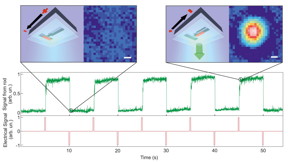 |
| A nanorod is switched between two states -- bright (high signal) and dark (low signal) by an external electrical pulse (red trace). The state of the rod can be readout instantaneously at any time using polarized light. The rod stores the most recently written state until the arrival of the next «write pulse».
CREDIT: UZH |
Abstract:
For the first time ever, researchers have succeeded in creating arrangements of colloids - tiny particles suspended in a solution - and, importantly, they have managed to control their motion with high precision and speed. Thanks to this new technique developed by scientists at the University of Zurich, colloidal nanoparticles may play a role in digital technologies of the future. Nanoparticles can be rapidly displaced, require little energy and their small footprint offers large storage capacity - all these attributes make them well suited to new data storage applications or high-resolution displays.
High-precision control of nanoparticles for digital applications
Zurich, Switzerland | Posted on August 19th, 2015Colloids are minute particles that are finely distributed throughout a liquid. Suspensions of colloidal particles are most familiar to us as beverages, cosmetics and paints. At a diameter in the range of ten to one hundred nanometres, a single such particle is invisible to the naked eye. These nanoparticles are constantly in motion due to the principle of Brownian motion. Since the particles are electrically charged, they experience forces of attraction and repulsion that can be harnessed to control and manipulate their behavior. In experiments carried out five years ago, Madhavi Krishnan, Professor of Physical Chemistry at the University of Zurich, succeeded in the controlled spatial manipulation of matter on the nanometer scale. In a new study, she and her colleagues have now demonstrated that it is not only possible to spatially confine nanoparticles, but also to control their position and orientation in time and to do so in a liquid, without using physical contact.
Manipulation using electrical and optical signals
The UZH researchers have developed a method that makes it possible to create nanostructures and manipulate them in a flexible way. They were able to organise the tiny particles into new structures with the utmost precision and then to manipulate their motion. «Manipulation is made possible by the interaction with electrical and optical fields», explains Madhavi Krishnan. This new approach using intermolecular interactions at room termperature does not require ultracold temperatures. The new technology also offers extremely fast and low-friction operation.
Smaller, faster and with more storage capacity
This technique for arranging and manipulating colloid motion makes it possible to develop completely new materials and devices. «Nanoparticles possess properties that are very useful for digital technologies, and each individual particle can now be used to store and retrieve data», explains Madhavi Krishnan. The targeted manipulation of individual nanoparticles opens up new options for their application, including in future data storage media or in displays with resolutions that have thus far been hard to attain. «This makes possible displays along the lines of the Kindle reader with a pixel size that is thousand-times smaller and a much faster response time» the scientist explains.
####
For more information, please click here
Contacts:
Dr. Madhavi Krishnan
41-446-344-465
Copyright © University of Zurich
If you have a comment, please Contact us.Issuers of news releases, not 7th Wave, Inc. or Nanotechnology Now, are solely responsible for the accuracy of the content.
Bookmark:


| Related Links |
| Related News Press |
News and information
 Quantum computer improves AI predictions April 17th, 2026
Flexible sensor gains sensitivity under pressure April 17th, 2026
A reusable chip for particulate matter sensing April 17th, 2026
Detecting vibrational quantum beating in the predissociation dynamics of SF6 using time-resolved photoelectron spectroscopy April 17th, 2026
Display technology/LEDs/SS Lighting/OLEDs
Spinel-type sulfide semiconductors to operate the next-generation LEDs and solar cells For solar-cell absorbers and green-LED source October 3rd, 2025
Efficient and stable hybrid perovskite-organic light-emitting diodes with external quantum efficiency exceeding 40 per cent July 5th, 2024
Friction/ Tribology
Perking up and crimping the 'bristles' of polyelectrolyte brushes December 13th, 2017
Chip Technology
A reusable chip for particulate matter sensing April 17th, 2026
Metasurfaces smooth light to boost magnetic sensing precision January 30th, 2026
Memory Technology
Researchers tackle the memory bottleneck stalling quantum computing October 3rd, 2025
First real-time observation of two-dimensional melting process: Researchers at Mainz University unveil new insights into magnetic vortex structures August 8th, 2025
Utilizing palladium for addressing contact issues of buried oxide thin film transistors April 5th, 2024
Optical computing/Photonic computing
ICFO researchers overcome long-standing bottleneck in single photon detection with twisted 2D materials August 8th, 2025
Programmable electron-induced color router array May 14th, 2025
Discoveries
Quantum computer improves AI predictions April 17th, 2026
Flexible sensor gains sensitivity under pressure April 17th, 2026
A reusable chip for particulate matter sensing April 17th, 2026
Detecting vibrational quantum beating in the predissociation dynamics of SF6 using time-resolved photoelectron spectroscopy April 17th, 2026
Announcements
A fundamentally new therapeutic approach to cystic fibrosis: Nanobody repairs cellular defect April 17th, 2026
UC Irvine physicists discover method to reverse ‘quantum scrambling’ : The work addresses the problem of information loss in quantum computing system April 17th, 2026
Interviews/Book Reviews/Essays/Reports/Podcasts/Journals/White papers/Posters
A fundamentally new therapeutic approach to cystic fibrosis: Nanobody repairs cellular defect April 17th, 2026
UC Irvine physicists discover method to reverse ‘quantum scrambling’ : The work addresses the problem of information loss in quantum computing system April 17th, 2026
Photonics/Optics/Lasers
Metasurfaces smooth light to boost magnetic sensing precision January 30th, 2026
From sensors to smart systems: the rise of AI-driven photonic noses January 30th, 2026
 |
||
 |
||
| The latest news from around the world, FREE | ||
 |
||
|
|
||
| Premium Products | ||
 |
||
|
Only the news you want to read!
Learn More |
||
 |
||
|
Full-service, expert consulting
Learn More |
||
|
|
||