Home > Press > A 'movie' of ultrafast rotating molecules at a hundred billion per second: A quantum wave-like nature was successfully observed in rotating nitrogen molecules
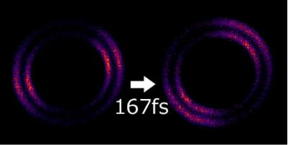 |
| Image 1: "Snapshots" of ultrafast rotating nitrogen molecules at a hundred billion per second (femtosecond = a quadrillionth part of one second). CREDIT: IMS/NINS |
Abstract:
Can you imagine how subnano-scale molecules make an ultrafast rotation at a hundred billion per second? Do the ultrafast rotating subnano-scale molecules show a wave-like nature rather than particle-like behavior? The Japanese research team led by Professor Yasuhiro Ohshima at the Tokyo Institute of Technology, and Dr Kenta Mizuse at the Institute for Molecular Science, National Institutes of Natural Sciences, successfully took sequential "snapshots" of ultrafast unidirectionally rotating molecules at a hundred billion per second. To visualize such an ultrafast molecular rotation, the team developed a Coulomb explosion imaging setup with regulating rotational direction by a pair of time-delayed, polarization-skewed laser pulses. In the sequential "snapshots", the team successfully reported high-resolution direct imaging of direction-controlled rotational wave packets (RWPs) in nitrogen molecules, and the quantum wave-like nature was successfully observed. The result will guide more sophisticated molecular manipulations, such as an ultrafast molecular "stopwatch". This result is published in Science Advances (July 3rd, 2015)
A 'movie' of ultrafast rotating molecules at a hundred billion per second: A quantum wave-like nature was successfully observed in rotating nitrogen molecules
Tokyo, Japan | Posted on July 4th, 2015Rotational wave packets (RWPs) are time-varying states of motion of rotating microscopic objects like molecules, and they change shapes in an ultrafast time scale, typically some parts in a trillion second. More importantly, because RWPs are governed by the fundamental microscopic physical laws, quantum mechanics, they show a wave-like nature, much different from what macroscopic things exhibit. So, RWPs are one of the ideal play grounds for examining the connection between quantum and classical worlds.
In the present study, the RWPs were created by using a pair of ultrafast laser pulses, of which mutual delay and polarization were properly adjusted. In addition, by using a specially designed ion-imaging setup, the team got images of unidirectional RWPs at a viewing angle that the previous 2D imaging studies could not adopt. As a result, the team succeeded in recording a series of images of time-varying molecular angular distribution with high-spatial resolution, which is nothing but a "movie" on the RWPs with a defined sense of rotation. The movie clearly shows the wave-like nature of the RWPs. Multiple running waves get together at some time to give a highly concentrated spatial orientation and split after a while into parts having different angular velocities, while the overall movement keeps rotating in one direction. This propagation of wave packets may well be expected as a pedantic example of a simple quantum system like rotating molecules in free space, for which mutual interaction is essentially inoperative. Nevertheless, it has never been visualized experimentally so far.
There have been many proposals for novel application of unidirectional RWPs. For instance, unidirectionally rotating molecular gas ensembles are expected to make sophisticated polarization shaping of ultrafast light pulses. In addition, unidirectional RWPs exhibiting cogwheel like motion are expected to be used as a "stopwatch" to measure the precise time difference between pulses from two independent ultrafast laser systems.
In a purely fundamental point of view, on the other hand, it is so challenging to experimentalists to explore how the wave-like nature of RWPs is approaching the particle-like behavior for a macroscopic object. It is also of great interest to experimentally track the loss of the wave-like character by a mutual or external interaction. Professor Ohshima said, "We hope our high-resolution RWP imaging to be applicable in making a movie on such crossovers from quantum to classical worlds."
###
Article:
Quantum unidirectional rotation directly imaged with molecules
Kenta Mizuse, Kenta Kitano, Hirokazu Hasegawa, and Yasuhiro Ohshima
Science Advances, July 3rd, 2015
DOI: 10.11126/sciadv.1400185
####
For more information, please click here
Contacts:
Professor Yasuhiro Ohshima
Department of Chemistry
Graduate School of Science and Engineering
Tokyo Institute of Technology
TEL +81-3-5734-2899
FAX +81-3-5734-2264
http://www.chemistry.titech.ac.jp/~ohshima/index_e.html
Press contacts:
Public Relations
Institute for Molecular Science
Natural Institutes of Natural Sciences
TEL/FAX: +81-564-55-7262
Center for Public Affairs and Communications
Tokyo Institute of Technology
TEL: +81-3-5734-2975
FAX: +81-3-5734-3661
Copyright © National Institutes of Natural Sciences
If you have a comment, please Contact us.Issuers of news releases, not 7th Wave, Inc. or Nanotechnology Now, are solely responsible for the accuracy of the content.
Bookmark:


| Related News Press |
News and information
 Quantum computer improves AI predictions April 17th, 2026
Flexible sensor gains sensitivity under pressure April 17th, 2026
A reusable chip for particulate matter sensing April 17th, 2026
Detecting vibrational quantum beating in the predissociation dynamics of SF6 using time-resolved photoelectron spectroscopy April 17th, 2026
Imaging
Simple algorithm paired with standard imaging tool could predict failure in lithium metal batteries August 8th, 2025
First real-time observation of two-dimensional melting process: Researchers at Mainz University unveil new insights into magnetic vortex structures August 8th, 2025
New imaging approach transforms study of bacterial biofilms August 8th, 2025
Physics
UC Irvine physicists discover method to reverse ‘quantum scrambling’ : The work addresses the problem of information loss in quantum computing system April 17th, 2026
Videos/Movies
ICFO researchers overcome long-standing bottleneck in single photon detection with twisted 2D materials August 8th, 2025
Discoveries
Quantum computer improves AI predictions April 17th, 2026
Flexible sensor gains sensitivity under pressure April 17th, 2026
A reusable chip for particulate matter sensing April 17th, 2026
Detecting vibrational quantum beating in the predissociation dynamics of SF6 using time-resolved photoelectron spectroscopy April 17th, 2026
Announcements
A fundamentally new therapeutic approach to cystic fibrosis: Nanobody repairs cellular defect April 17th, 2026
UC Irvine physicists discover method to reverse ‘quantum scrambling’ : The work addresses the problem of information loss in quantum computing system April 17th, 2026
Interviews/Book Reviews/Essays/Reports/Podcasts/Journals/White papers/Posters
A fundamentally new therapeutic approach to cystic fibrosis: Nanobody repairs cellular defect April 17th, 2026
UC Irvine physicists discover method to reverse ‘quantum scrambling’ : The work addresses the problem of information loss in quantum computing system April 17th, 2026
Tools
Metasurfaces smooth light to boost magnetic sensing precision January 30th, 2026
From sensors to smart systems: the rise of AI-driven photonic noses January 30th, 2026
Japan launches fully domestically produced quantum computer: Expo visitors to experience quantum computing firsthand August 8th, 2025
Quantum nanoscience
Beyond silicon: Electronics at the scale of a single molecule January 30th, 2026
MXene nanomaterials enter a new dimension Multilayer nanomaterial: MXene flakes created at Drexel University show new promise as 1D scrolls January 30th, 2026
ICFO researchers overcome long-standing bottleneck in single photon detection with twisted 2D materials August 8th, 2025
 |
||
 |
||
| The latest news from around the world, FREE | ||
 |
||
|
|
||
| Premium Products | ||
 |
||
|
Only the news you want to read!
Learn More |
||
 |
||
|
Full-service, expert consulting
Learn More |
||
|
|
||