Home > Press > Physicists solve quantum tunneling mystery: ANU media release: An international team of scientists studying ultrafast physics have solved a mystery of quantum mechanics, and found that quantum tunneling is an instantaneous process
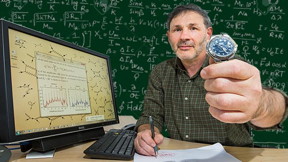 |
| Professor Anatoli Kheifets' theory has ultrafast physics wrapped up. CREDIT: Composite image Stuart Hay, ANU |
Abstract:
An international team of scientists studying ultrafast physics have solved a mystery of quantum mechanics, and found that quantum tunneling is an instantaneous process.
Physicists solve quantum tunneling mystery: ANU media release: An international team of scientists studying ultrafast physics have solved a mystery of quantum mechanics, and found that quantum tunneling is an instantaneous process
Canberra, Australia | Posted on May 27th, 2015The new theory could lead to faster and smaller electronic components, for which quantum tunneling is a significant factor. It will also lead to a better understanding of diverse areas such as electron microscopy, nuclear fusion and DNA mutations.
"Timescales this short have never been explored before. It's an entirely new world," said one of the international team, Professor Anatoli Kheifets, from The Australian National University (ANU).
"We have modelled the most delicate processes of nature very accurately."
At very small scales quantum physics shows that particles such as electrons have wave-like properties - their exact position is not well defined. This means they can occasionally sneak through apparently impenetrable barriers, a phenomenon called quantum tunneling.
Quantum tunneling plays a role in a number of phenomena, such as nuclear fusion in the sun, scanning tunneling microscopy, and flash memory for computers. However, the leakage of particles also limits the miniaturisation of electronic components.
Professor Kheifets and Dr. Igor Ivanov, from the ANU Research School of Physics and Engineering, are members of a team which studied ultrafast experiments at the attosecond scale (10-18 seconds), a field that has developed in the last 15 years.
Until their work, a number of attosecond phenomena could not be adequately explained, such as the time delay when a photon ionised an atom.
"At that timescale the time an electron takes to quantum tunnel out of an atom was thought to be significant. But the mathematics says the time during tunneling is imaginary - a complex number - which we realised meant it must be an instantaneous process," said Professor Kheifets.
"A very interesting paradox arises, because electron velocity during tunneling may become greater than the speed of light. However, this does not contradict the special theory of relativity, as the tunneling velocity is also imaginary" said Dr Ivanov, who recently took up a position at the Center for Relativistic Laser Science in Korea.
The team's calculations, which were made using the Raijin supercomputer, revealed that the delay in photoionisation originates not from quantum tunneling but from the electric field of the nucleus attracting the escaping electron.
The results give an accurate calibration for future attosecond-scale research, said Professor Kheifets.
"It's a good reference point for future experiments, such as studying proteins unfolding, or speeding up electrons in microchips," he said.
####
For more information, please click here
Contacts:
Anatoli Kheifets
61-612-52478
Copyright © Australian National University
If you have a comment, please Contact us.Issuers of news releases, not 7th Wave, Inc. or Nanotechnology Now, are solely responsible for the accuracy of the content.
Bookmark:


| Related Links |
| Related News Press |
News and information
 Quantum computer improves AI predictions April 17th, 2026
Flexible sensor gains sensitivity under pressure April 17th, 2026
A reusable chip for particulate matter sensing April 17th, 2026
Detecting vibrational quantum beating in the predissociation dynamics of SF6 using time-resolved photoelectron spectroscopy April 17th, 2026
Imaging
Simple algorithm paired with standard imaging tool could predict failure in lithium metal batteries August 8th, 2025
Physics
UC Irvine physicists discover method to reverse ‘quantum scrambling’ : The work addresses the problem of information loss in quantum computing system April 17th, 2026
Chip Technology
A reusable chip for particulate matter sensing April 17th, 2026
Metasurfaces smooth light to boost magnetic sensing precision January 30th, 2026
Discoveries
Quantum computer improves AI predictions April 17th, 2026
Flexible sensor gains sensitivity under pressure April 17th, 2026
A reusable chip for particulate matter sensing April 17th, 2026
Detecting vibrational quantum beating in the predissociation dynamics of SF6 using time-resolved photoelectron spectroscopy April 17th, 2026
Announcements
A fundamentally new therapeutic approach to cystic fibrosis: Nanobody repairs cellular defect April 17th, 2026
UC Irvine physicists discover method to reverse ‘quantum scrambling’ : The work addresses the problem of information loss in quantum computing system April 17th, 2026
Interviews/Book Reviews/Essays/Reports/Podcasts/Journals/White papers/Posters
A fundamentally new therapeutic approach to cystic fibrosis: Nanobody repairs cellular defect April 17th, 2026
UC Irvine physicists discover method to reverse ‘quantum scrambling’ : The work addresses the problem of information loss in quantum computing system April 17th, 2026
Tools
Metasurfaces smooth light to boost magnetic sensing precision January 30th, 2026
From sensors to smart systems: the rise of AI-driven photonic noses January 30th, 2026
Japan launches fully domestically produced quantum computer: Expo visitors to experience quantum computing firsthand August 8th, 2025
Energy
Sensors innovations for smart lithium-based batteries: advancements, opportunities, and potential challenges August 8th, 2025
Simple algorithm paired with standard imaging tool could predict failure in lithium metal batteries August 8th, 2025
Quantum nanoscience
Beyond silicon: Electronics at the scale of a single molecule January 30th, 2026
MXene nanomaterials enter a new dimension Multilayer nanomaterial: MXene flakes created at Drexel University show new promise as 1D scrolls January 30th, 2026
ICFO researchers overcome long-standing bottleneck in single photon detection with twisted 2D materials August 8th, 2025
 |
||
 |
||
| The latest news from around the world, FREE | ||
 |
||
|
|
||
| Premium Products | ||
 |
||
|
Only the news you want to read!
Learn More |
||
 |
||
|
Full-service, expert consulting
Learn More |
||
|
|
||