Home > Press > Thermometer-like device could help diagnose heart attacks
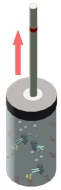 |
| A simple, thermometer-like device could make diagnosing heart attacks easier in remote or low-income locations. Credit: American Chemical Society |
Abstract:
Diagnosing a heart attack can require multiple tests using expensive equipment. But not everyone has access to such techniques, especially in remote or low-income areas. Now scientists have developed a simple, thermometer-like device that could help doctors diagnose heart attacks with minimal materials and cost. The report on their approach appears in the ACS journal Analytical Chemistry.
Thermometer-like device could help diagnose heart attacks
Washington, DC | Posted on May 6th, 2015Sangmin Jeon and colleagues note that one way to tell whether someone has had a heart attack involves measuring the level of a protein called troponin in the person's blood. The protein's concentration rises when blood is cut off from the heart, and the muscle is damaged. Today, detecting troponin requires bulky, expensive instruments and is often not practical for point-of-care use or in low-income areas. Yet three-quarters of the deaths related to cardiovascular disease occur in low- and middle-income countries. Early diagnosis could help curb these numbers, so Jeon's team set out to make a sensitive, more accessible test.
Inspired by the simplicity of alcohol and mercury thermometers, the researchers created a similarly straightforward way to detect troponin. It involves a few easy steps, a glass vial, specialized nanoparticles, a drop of ink and a skinny tube. When human serum with troponin -- even at a minute concentration -- is mixed with the nanoparticles and put in the vial, the ink climbs up a protruding tube and can be read with the naked eye, just like a thermometer.
###
The authors acknowledge funding from the National Research Foundation of Korea.
####
About American Chemical Society
The American Chemical Society is a nonprofit organization chartered by the U.S. Congress. With more than 158,000 members, ACS is the world's largest scientific society and a global leader in providing access to chemistry-related research through its multiple databases, peer-reviewed journals and scientific conferences. Its main offices are in Washington, D.C., and Columbus, Ohio.
For more information, please click here
Contacts:
Michael Bernstein
202-872-6042
Sangmin Jeon, Ph.D.
Department of Chemical Engineering
Pohang University of Science and Technology (POSTECH)
Pohang, Gyeongbuk, Korea
Copyright © American Chemical Society
If you have a comment, please Contact us.Issuers of news releases, not 7th Wave, Inc. or Nanotechnology Now, are solely responsible for the accuracy of the content.
Bookmark:


| Related Links |
| Related News Press |
News and information
 Quantum computer improves AI predictions April 17th, 2026
Flexible sensor gains sensitivity under pressure April 17th, 2026
A reusable chip for particulate matter sensing April 17th, 2026
Detecting vibrational quantum beating in the predissociation dynamics of SF6 using time-resolved photoelectron spectroscopy April 17th, 2026
Govt.-Legislation/Regulation/Funding/Policy
Quantum computer improves AI predictions April 17th, 2026
Metasurfaces smooth light to boost magnetic sensing precision January 30th, 2026
New imaging approach transforms study of bacterial biofilms August 8th, 2025
Nanomedicine
A fundamentally new therapeutic approach to cystic fibrosis: Nanobody repairs cellular defect April 17th, 2026
New molecular technology targets tumors and simultaneously silences two ‘undruggable’ cancer genes August 8th, 2025
New imaging approach transforms study of bacterial biofilms August 8th, 2025
Electrifying results shed light on graphene foam as a potential material for lab grown cartilage June 6th, 2025
Discoveries
Quantum computer improves AI predictions April 17th, 2026
Flexible sensor gains sensitivity under pressure April 17th, 2026
A reusable chip for particulate matter sensing April 17th, 2026
Detecting vibrational quantum beating in the predissociation dynamics of SF6 using time-resolved photoelectron spectroscopy April 17th, 2026
Announcements
A fundamentally new therapeutic approach to cystic fibrosis: Nanobody repairs cellular defect April 17th, 2026
UC Irvine physicists discover method to reverse ‘quantum scrambling’ : The work addresses the problem of information loss in quantum computing system April 17th, 2026
Interviews/Book Reviews/Essays/Reports/Podcasts/Journals/White papers/Posters
A fundamentally new therapeutic approach to cystic fibrosis: Nanobody repairs cellular defect April 17th, 2026
UC Irvine physicists discover method to reverse ‘quantum scrambling’ : The work addresses the problem of information loss in quantum computing system April 17th, 2026
 |
||
 |
||
| The latest news from around the world, FREE | ||
 |
||
|
|
||
| Premium Products | ||
 |
||
|
Only the news you want to read!
Learn More |
||
 |
||
|
Full-service, expert consulting
Learn More |
||
|
|
||