Home > Press > Quantum teleportation on a chip: A significant step towards ultra-high speed quantum computers
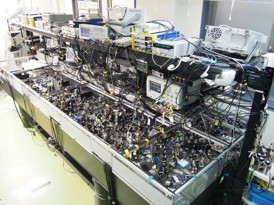 |
| The experimental setup of quantum teleportation performed in 2013 is pictured. The experimental setup shows an optical table with a size of 4.2 meters by 1.5 meters on which optical instruments such as mirrors and lenses are arranged to guide laser beams. Over 500 mirrors and lenses were used in this experiment. CREDIT: Centre for Quantum Photonics at the University of Bristol |
Abstract:
The core circuits of quantum teleportation, which generate and detect quantum entanglement, have been successfully integrated into a photonic chip by an international team of scientists from the universities of Bristol, Tokyo, Southampton and NTT Device Technology Laboratories. These results pave the way to developing ultra-high-speed quantum computers and strengthening the security of communication.
Quantum teleportation on a chip: A significant step towards ultra-high speed quantum computers
Bristol, UK | Posted on April 1st, 2015Qubits (quantum bits) are sensitive quantum versions of today's computer 0's and 1's (bits) and are the foundation of quantum computers. Photons are particles of light and they are a promising way to implement excellent qubits. One of the most important tasks is to successfully enable quantum teleportation, which transfers qubits from one photon to another. However, the conventional experimental implementation of quantum teleportation fills a laboratory and requires hundreds of optical instruments painstakingly aligned, a far cry from the scale and robustness of device required in a modern day computer or handheld device.
In 2013, Professor Furusawa and his colleagues succeeded in realising perfect quantum teleportation, however, this required a set-up covering several square metres; took many months to build, and reached the limit in terms of scalability. New research at the University of Bristol led by Professor Jeremy O'Brien has taken those optical circuits and implemented them on to a silicon microchip measuring just a few millimetres (0.0001 square metres) using state-of-the-art nano-fabrication methods. This is the first time quantum teleportation has been demonstrated on a silicon chip and the result has radically solved the problem of scalability. The team of researchers have taken a significant step closer towards their ultimate goal of integrating a quantum computer into a photonic chip.
While there has been significant progress in current computing technology, its performance is now reaching the fundamental limit of classical physics. On the other hand, it has been predicted that principles of quantum mechanics will enable the development of ultra-secure quantum communication and ultra-powerful quantum computers, overcoming the limit of current technologies. One of the most important steps in achieving this is to establish technologies for quantum teleportation (transferring signals of quantum bits in photons from a sender to a receiver at a distance). The implementation of teleportation on to a micro-chip is an important building block unlocking the potential for practical quantum technologies.
Professor Akira Furusawa from the University of Tokyo said: "This latest achievement enables us to perform the perfect quantum teleportation with a photonic chip. The next step is to integrate whole the system of quantum teleportation."
Professor Jeremy O'Brien, Director of the Centre for Quantum Photonics at the University of Bristol, who led the Bristol elements of the research, said: "Being able to replicate an optical circuit which would normally require a room sized optical table on a photonic chip is a hugely significant achievement. In effect, we have reduced a very complex quantum optical system by ten thousand in size."
The research is published this week in Nature Photonics.
####
For more information, please click here
Contacts:
Joanne Fryer
44-011-733-17276
Copyright © University of Bristol
If you have a comment, please Contact us.Issuers of news releases, not 7th Wave, Inc. or Nanotechnology Now, are solely responsible for the accuracy of the content.
Bookmark:


| Related Links |
| Related News Press |
News and information
 Quantum computer improves AI predictions April 17th, 2026
Flexible sensor gains sensitivity under pressure April 17th, 2026
A reusable chip for particulate matter sensing April 17th, 2026
Detecting vibrational quantum beating in the predissociation dynamics of SF6 using time-resolved photoelectron spectroscopy April 17th, 2026
Physics
UC Irvine physicists discover method to reverse ‘quantum scrambling’ : The work addresses the problem of information loss in quantum computing system April 17th, 2026
Quantum computers simulate fundamental physics: shedding light on the building blocks of nature June 6th, 2025
Chip Technology
A reusable chip for particulate matter sensing April 17th, 2026
Metasurfaces smooth light to boost magnetic sensing precision January 30th, 2026
Quantum Computing
Quantum computer improves AI predictions April 17th, 2026
UC Irvine physicists discover method to reverse ‘quantum scrambling’ : The work addresses the problem of information loss in quantum computing system April 17th, 2026
Researchers develop molecular qubits that communicate at telecom frequencies October 3rd, 2025
Discoveries
Quantum computer improves AI predictions April 17th, 2026
Flexible sensor gains sensitivity under pressure April 17th, 2026
A reusable chip for particulate matter sensing April 17th, 2026
Detecting vibrational quantum beating in the predissociation dynamics of SF6 using time-resolved photoelectron spectroscopy April 17th, 2026
Announcements
A fundamentally new therapeutic approach to cystic fibrosis: Nanobody repairs cellular defect April 17th, 2026
UC Irvine physicists discover method to reverse ‘quantum scrambling’ : The work addresses the problem of information loss in quantum computing system April 17th, 2026
Interviews/Book Reviews/Essays/Reports/Podcasts/Journals/White papers/Posters
A fundamentally new therapeutic approach to cystic fibrosis: Nanobody repairs cellular defect April 17th, 2026
UC Irvine physicists discover method to reverse ‘quantum scrambling’ : The work addresses the problem of information loss in quantum computing system April 17th, 2026
Photonics/Optics/Lasers
Metasurfaces smooth light to boost magnetic sensing precision January 30th, 2026
From sensors to smart systems: the rise of AI-driven photonic noses January 30th, 2026
Quantum nanoscience
Beyond silicon: Electronics at the scale of a single molecule January 30th, 2026
MXene nanomaterials enter a new dimension Multilayer nanomaterial: MXene flakes created at Drexel University show new promise as 1D scrolls January 30th, 2026
ICFO researchers overcome long-standing bottleneck in single photon detection with twisted 2D materials August 8th, 2025
 |
||
 |
||
| The latest news from around the world, FREE | ||
 |
||
|
|
||
| Premium Products | ||
 |
||
|
Only the news you want to read!
Learn More |
||
 |
||
|
Full-service, expert consulting
Learn More |
||
|
|
||