Home > Press > Learning by eye: Silicon micro-funnels increase the efficiency of solar cells
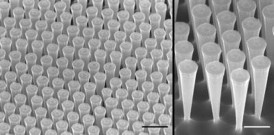 |
| The scanning electron microscopies (SEM) show how regularly the funnels etched in a silicon substrate are arranged (left: the line segment = 5 microns; right: 1 micron). The funnels measure about 800 nanometers in diameter above and run down to about a hundred nanometers at the tip. CREDIT: S. Schmitt / MPL |
Abstract:
The fovea centralis, or fovea for short, sits in the middle of the Macula lutea (or macula) of the retina, where the slender, funnel-like ocular cones are especially closely packed together. We see an image with greatest acuity in this small region because each cone there is connected to a nerve cell.
Learning by eye: Silicon micro-funnels increase the efficiency of solar cells
Berlin, Germany | Posted on February 25th, 2015This closely packed arrangement of cones has now inspired the team headed by Prof. Silke Christiansen to replicate something similar in silicon as a surface for solar cells and investigate its suitability for collecting and conducting light. Christiansen heads the Institute for Nanoarchitectures for Energy Conversion at the Helmholtz-Zentrum Berlin (HZB) and a research team at the Max Planck Institute for the Science of Light (MPL).
"We've shown in this work that the light funnels absorbs considerably more light than other optical architectures tested over the last while", says Sebastian Schmitt, one of the two first authors of the publication that has appeared in the renowned journal Nature Scientific Reports.
Small change - large effect!
The researchers were surprised at just how large the effect of this architecture was, however. It was known from previous studies that arrangements of very thin vertical cylinders (a "carpet" of silicon nanowires) absorbs light well. But even tiny deviations in the shape of the cylinders right down to the shape of a funnel increased absorption. In comparison to the carpet of nanowires that has been investigated for some time, the funnel fields clearly perform better.
Yet manufacturing the light funnels requires no special effort and is feasible with conventional semiconductor processes such as reactive ion etching or wet chemical etching, for example. Compared with a silicon film of the same thickness, a layer of the light funnels increases the absorption of sunlight about 65%.
"Our modelling enabled us to also provide an explanation of why the arrays of light funnels trap light considerably better than a carpet of nanowires (as shown in our calculations in this publication) Optical modes in nanowires mutually interfere with each other. A field of closely arrayed nanowires therefore takes in light less efficiently than an identical number of single nanowires could. Just the opposite occurs with the light funnels: immediately neighbouring light funnels mutually strengthen one another's absorption", explains Schmitt
A look into the future
"Following this interesting initial result, we are pressing ahead in various directions", says Christiansen. She and her team are working further on improving thin-film solar cells based on silicon and want to build the funnels into robust cell designs that can be economically realised over large surfaces. They will be able to access expertise at the Competence Centre Thin-Film- and Nanotechnology for Photovoltaics Berlin (PVcomB) of HZB where the division headed by Prof. Rutger Schlatmann has specialised in scaling up patterns developed in the lab and can rapidly and efficiently implement feasibility studies for large-area solar cells. "We hope you will hear from our collaboration again soon about a 30 cm x 30 cm funnel solar cell. Sebastian Schmitt is also working on using the funnels for other photonic applications in LEDs and sensor components, though. The first pilot studies are so promising that we are confident these applications will not have to remain the stuff of dreams", Christiansen offers.
####
For more information, please click here
Contacts:
Dr. Antonia Rötger
49-030-806-243-733
Copyright © Helmholtz-Zentrum Berlin für Materialien und Energie
If you have a comment, please Contact us.Issuers of news releases, not 7th Wave, Inc. or Nanotechnology Now, are solely responsible for the accuracy of the content.
Bookmark:


| Related Links |
| Related News Press |
News and information
 Quantum computer improves AI predictions April 17th, 2026
Flexible sensor gains sensitivity under pressure April 17th, 2026
A reusable chip for particulate matter sensing April 17th, 2026
Detecting vibrational quantum beating in the predissociation dynamics of SF6 using time-resolved photoelectron spectroscopy April 17th, 2026
Discoveries
Quantum computer improves AI predictions April 17th, 2026
Flexible sensor gains sensitivity under pressure April 17th, 2026
A reusable chip for particulate matter sensing April 17th, 2026
Detecting vibrational quantum beating in the predissociation dynamics of SF6 using time-resolved photoelectron spectroscopy April 17th, 2026
Materials/Metamaterials/Magnetoresistance
First real-time observation of two-dimensional melting process: Researchers at Mainz University unveil new insights into magnetic vortex structures August 8th, 2025
Researchers unveil a groundbreaking clay-based solution to capture carbon dioxide and combat climate change June 6th, 2025
A 1960s idea inspires NBI researchers to study hitherto inaccessible quantum states June 6th, 2025
Institute for Nanoscience hosts annual proposal planning meeting May 16th, 2025
Announcements
A fundamentally new therapeutic approach to cystic fibrosis: Nanobody repairs cellular defect April 17th, 2026
UC Irvine physicists discover method to reverse ‘quantum scrambling’ : The work addresses the problem of information loss in quantum computing system April 17th, 2026
Interviews/Book Reviews/Essays/Reports/Podcasts/Journals/White papers/Posters
A fundamentally new therapeutic approach to cystic fibrosis: Nanobody repairs cellular defect April 17th, 2026
UC Irvine physicists discover method to reverse ‘quantum scrambling’ : The work addresses the problem of information loss in quantum computing system April 17th, 2026
Energy
Sensors innovations for smart lithium-based batteries: advancements, opportunities, and potential challenges August 8th, 2025
Simple algorithm paired with standard imaging tool could predict failure in lithium metal batteries August 8th, 2025
Photonics/Optics/Lasers
Metasurfaces smooth light to boost magnetic sensing precision January 30th, 2026
From sensors to smart systems: the rise of AI-driven photonic noses January 30th, 2026
Solar/Photovoltaic
Spinel-type sulfide semiconductors to operate the next-generation LEDs and solar cells For solar-cell absorbers and green-LED source October 3rd, 2025
KAIST researchers introduce new and improved, next-generation perovskite solar cell November 8th, 2024
Groundbreaking precision in single-molecule optoelectronics August 16th, 2024
Development of zinc oxide nanopagoda array photoelectrode: photoelectrochemical water-splitting hydrogen production January 12th, 2024
 |
||
 |
||
| The latest news from around the world, FREE | ||
 |
||
|
|
||
| Premium Products | ||
 |
||
|
Only the news you want to read!
Learn More |
||
 |
||
|
Full-service, expert consulting
Learn More |
||
|
|
||