Home > Press > Detecting defects at the nanoscale will profit solar panel production: Researcher Mohamed Elrawemi develops new technologies for defects in thin films, vital in products as printed electronics and solar panels
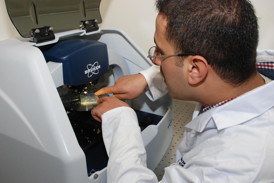 |
| The NanoMend researchers at the University of Huddersfield have been working with the Durham-based Centre for Process Innovation, a leading producer of printable electronics, including flexible solar panels. In these products, a thin "barrier film" is vital to protect the electronics. But tiny defects can allow the penetration of water vapor that can degrade the barrier and reduce the efficiency of the solar panel itself. CREDIT: University of Huddersfield |
Abstract:
RESEARCH at the University of Huddersfield will lead to major efficiency gains and cost savings in the manufacture of flexible solar panels. It has also resulted in an exceptional number of scholarly articles co-authored by a Libyan scientist who is completing his doctoral studies as a participant in the EU-backed project.
Detecting defects at the nanoscale will profit solar panel production: Researcher Mohamed Elrawemi develops new technologies for defects in thin films, vital in products as printed electronics and solar panels
Huddersfield, UK | Posted on February 24th, 2015It is named NanoMend and is funded by the EU's Framework Seven research programme. The goal is to develop new technologies for the detection, cleaning and repair of micro and nanoscale defects in thin films that are vital in products such as printed electronics and solar panels.
The University of Huddersfield's EPSRC Centre for Innovative Manufacturing in Advanced Metrology is a key collaborator in NanoMend. Its scientists recently earned an award for the development of a Wavelength Scanning Interferometer, which has uses that include the detection of defects in the coating that can have a serious impact on the longevity of roll-to-roll vapour barrier coatings for flexible PV (photovoltaic) cells. When these defects are minimised, the results will include reduced cost and increased reliability of the flexible PV cells, so that this type of renewable energy will be more widely adopted.
This is the area of research in which Mohamed Elrawemi is closely involved. Supported by funding from the Libyan Government's Higher Education Ministry, he is in the later stages of a PhD, supervised by Professor Liam Blunt, who is Research Director for the EPSRC Centre. Since 2012, Mohamed has contributed to 23 papers dealing with aspects of the NanoMend research. The latest is Metrology of Al2O3 Barrier Film for Flexible CIGS Solar Cells, due to appear in the new edition of the International Journal of Energy Optimization and Engineering.
The NanoMend researchers at the University of Huddersfield have been working with the Durham-based Centre for Process Innovation, a leading producer of printable electronics, including flexible solar panels. In these products, a thin "barrier film" is vital to protect the electronics. But tiny defects can allow the penetration of water vapour that can degrade the barrier and reduce the efficiency of the solar panel itself.
The team based at the Huddersfield EPSRC Centre have been working on a new metrology system that can detect tiny defects and will therefore aid the manufacture of roll-to-roll barrier film in large volumes.
Many of the scientific and technical issues explored by the NanoMend researchers have been explored in the body of articles and papers co-authored by Mohamed. He obtained his first science degree in his native Libya, before relocating to the UK for a University of Huddersfield Master's degree - funded by steel company Corus - in which he developed his expertise in the science of metrology. This meant that he was ideally equipped to join the NanoMend project as he studied for his doctorate.
####
For more information, please click here
Contacts:
Nicola Werritt
01-484-473-315
Copyright © University of Huddersfield
If you have a comment, please Contact us.Issuers of news releases, not 7th Wave, Inc. or Nanotechnology Now, are solely responsible for the accuracy of the content.
Bookmark:


| Related News Press |
News and information
 Quantum computer improves AI predictions April 17th, 2026
Flexible sensor gains sensitivity under pressure April 17th, 2026
A reusable chip for particulate matter sensing April 17th, 2026
Detecting vibrational quantum beating in the predissociation dynamics of SF6 using time-resolved photoelectron spectroscopy April 17th, 2026
Thin films
Tiny nanosheets, big leap: A new sensor detects ethanol at ultra-low levels January 30th, 2026
Utilizing palladium for addressing contact issues of buried oxide thin film transistors April 5th, 2024
Understanding the mechanism of non-uniform formation of diamond film on tools: Paving the way to a dry process with less environmental impact March 24th, 2023
New study introduces the best graphite films: The work by Distinguished Professor Feng Ding at UNIST has been published in the October 2022 issue of Nature Nanotechnology November 4th, 2022
Govt.-Legislation/Regulation/Funding/Policy
Quantum computer improves AI predictions April 17th, 2026
Metasurfaces smooth light to boost magnetic sensing precision January 30th, 2026
New imaging approach transforms study of bacterial biofilms August 8th, 2025
Discoveries
Quantum computer improves AI predictions April 17th, 2026
Flexible sensor gains sensitivity under pressure April 17th, 2026
A reusable chip for particulate matter sensing April 17th, 2026
Detecting vibrational quantum beating in the predissociation dynamics of SF6 using time-resolved photoelectron spectroscopy April 17th, 2026
Announcements
A fundamentally new therapeutic approach to cystic fibrosis: Nanobody repairs cellular defect April 17th, 2026
UC Irvine physicists discover method to reverse ‘quantum scrambling’ : The work addresses the problem of information loss in quantum computing system April 17th, 2026
Interviews/Book Reviews/Essays/Reports/Podcasts/Journals/White papers/Posters
A fundamentally new therapeutic approach to cystic fibrosis: Nanobody repairs cellular defect April 17th, 2026
UC Irvine physicists discover method to reverse ‘quantum scrambling’ : The work addresses the problem of information loss in quantum computing system April 17th, 2026
Energy
Sensors innovations for smart lithium-based batteries: advancements, opportunities, and potential challenges August 8th, 2025
Simple algorithm paired with standard imaging tool could predict failure in lithium metal batteries August 8th, 2025
Solar/Photovoltaic
Spinel-type sulfide semiconductors to operate the next-generation LEDs and solar cells For solar-cell absorbers and green-LED source October 3rd, 2025
KAIST researchers introduce new and improved, next-generation perovskite solar cell November 8th, 2024
Groundbreaking precision in single-molecule optoelectronics August 16th, 2024
Development of zinc oxide nanopagoda array photoelectrode: photoelectrochemical water-splitting hydrogen production January 12th, 2024
 |
||
 |
||
| The latest news from around the world, FREE | ||
 |
||
|
|
||
| Premium Products | ||
 |
||
|
Only the news you want to read!
Learn More |
||
 |
||
|
Full-service, expert consulting
Learn More |
||
|
|
||