Home > Press > Ultra-thin nanowires can trap electron 'twisters' that disrupt superconductors
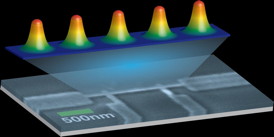 |
| This illustration depicts a short row of vortices held in place between the edges of a nanowire developed by Johns Hopkins scientists. CREDIT: Nina Markovic and Tyler Morgan-Wall/JHU |
Abstract:
Superconductor materials are prized for their ability to carry an electric current without resistance, but this valuable trait can be crippled or lost when electrons swirl into tiny tornado-like formations called vortices. These disruptive mini-twisters often form in the presence of magnetic fields, such as those produced by electric motors.
Ultra-thin nanowires can trap electron 'twisters' that disrupt superconductors
Baltimore, MD | Posted on February 24th, 2015To keep supercurrents flowing at top speed, Johns Hopkins scientists have figured out how to constrain troublesome vortices by trapping them within extremely short, ultra-thin nanowires. Their discovery was reported Feb. 18 in the journal Physical Review Letters.
"We have found a way to control individual vortices to improve the performance of superconducting wires," said Nina Markovic, an associate professor in the Department of Physics and Astronomy in the university's Krieger School of Arts and Sciences.
Many materials can become superconducting when cooled to a temperature of nearly 460 below zero F, which is achieved by using liquid helium.
The new method of maintaining resistance-free current within these superconductors is important because these materials play a key role in devices such MRI medical scanners, particle accelerators, photon detectors and the radio frequency filters used in cell phone systems. In addition, superconductors are expected to become critical components in future quantum computers, which will be able to do more complex calculations than current machines.
Wider use of superconductors may hinge on stopping the nanoscopic mischief that electron vortices cause when they skitter from side to side across a conducting material, spoiling the zero-resistance current. The Johns Hopkins scientists say their nanowires keep this from happening.
Markovic, who supervised the development of these wires, said other researchers have tried to keep vortices from disrupting a supercurrent by "pinning" the twisters to impurities in the conducting material, which renders them unable to move.
"Edges can also pin the vortices, but it is more difficult to pin the vortices in the bulk middle area of the material, farther away from the edges," she said. "To overcome this problem, we made a superconducting sample that consists mostly of edges: a very narrow aluminum nanowire."
These nanowires, Markovic said, are flat strips about one-billionth as wide as a human hair and about 50 to 100 times longer than their width. Each nanowire forms a one-way highway that allows pairs of electrons to zip ahead at a supercurrent pace.
Vortices can form when a magnetic field is applied, but because of the material's ultra-thin design, "only one short vortex row can fit within the nanowires," Markovic said. "Because there is an edge on each side of them, the vortices are trapped in place and the supercurrent can just slip around them, maintaining the resistance-free speed."
The ability to control the exact number of vortices in the nanowire may produce additional benefits, physics experts say. Future computers or other devices may someday use vortices instead of electrical charges to transmit information, they say.
###
The lead author of the Physical Review Letters article was Tyler Morgan-Wall, a doctoral student in Markovic's lab. Along with Markovic, the co-authors were Benjamin Leith, who was an undergraduate at Johns Hopkins when the research took place; Nikolaus Hartman, a graduate student; and Atikur Rahman, who was a postdoctoral fellow in Markovic's lab.
####
For more information, please click here
Contacts:
Phil Sneiderman
443-997-9907
THE JOHNS HOPKINS UNIVERSITY
OFFICE OF COMMUNICATIONS
3910 Keswick Rd., Suite N-2600
Baltimore, MD 21211
Phone: 443-997-9009 / Fax: 443-997-1006
Copyright © Johns Hopkins University
If you have a comment, please Contact us.Issuers of news releases, not 7th Wave, Inc. or Nanotechnology Now, are solely responsible for the accuracy of the content.
Bookmark:


| Related Links |
 Department of Physics and Astronomy:
Krieger School of Arts and Sciences:
| Related News Press |
News and information
Quantum computer improves AI predictions April 17th, 2026
Flexible sensor gains sensitivity under pressure April 17th, 2026
A reusable chip for particulate matter sensing April 17th, 2026
Detecting vibrational quantum beating in the predissociation dynamics of SF6 using time-resolved photoelectron spectroscopy April 17th, 2026
Superconductivity
MXene nanomaterials enter a new dimension Multilayer nanomaterial: MXene flakes created at Drexel University show new promise as 1D scrolls January 30th, 2026
Chip Technology
A reusable chip for particulate matter sensing April 17th, 2026
Metasurfaces smooth light to boost magnetic sensing precision January 30th, 2026
Nanoelectronics
Lab to industry: InSe wafer-scale breakthrough for future electronics August 8th, 2025
Interdisciplinary: Rice team tackles the future of semiconductors Multiferroics could be the key to ultralow-energy computing October 6th, 2023
Key element for a scalable quantum computer: Physicists from Forschungszentrum Jülich and RWTH Aachen University demonstrate electron transport on a quantum chip September 23rd, 2022
Reduced power consumption in semiconductor devices September 23rd, 2022
Discoveries
Quantum computer improves AI predictions April 17th, 2026
Flexible sensor gains sensitivity under pressure April 17th, 2026
A reusable chip for particulate matter sensing April 17th, 2026
Detecting vibrational quantum beating in the predissociation dynamics of SF6 using time-resolved photoelectron spectroscopy April 17th, 2026
Announcements
A fundamentally new therapeutic approach to cystic fibrosis: Nanobody repairs cellular defect April 17th, 2026
UC Irvine physicists discover method to reverse ‘quantum scrambling’ : The work addresses the problem of information loss in quantum computing system April 17th, 2026
Interviews/Book Reviews/Essays/Reports/Podcasts/Journals/White papers/Posters
A fundamentally new therapeutic approach to cystic fibrosis: Nanobody repairs cellular defect April 17th, 2026
UC Irvine physicists discover method to reverse ‘quantum scrambling’ : The work addresses the problem of information loss in quantum computing system April 17th, 2026
 |
||
 |
||
| The latest news from around the world, FREE | ||
 |
||
|
|
||
| Premium Products | ||
 |
||
|
Only the news you want to read!
Learn More |
||
 |
||
|
Full-service, expert consulting
Learn More |
||
|
|
||