Home > Press > New method allows for greater variation in band gap tunability: The method can change a material's electronic band gap by up to 200 percent
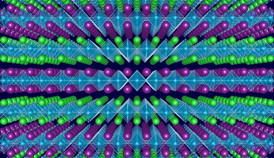 |
| This shows the atomic scale structure of 'designer' layered oxides: band-gap engineering is enabled by varying the sequence of the well-defined layers, seen as planes of similarly colored (green and purple) atoms, in transition metal oxides without changing the materials overall chemical composition. CREDIT: James Rondinelli |
Abstract:
If you can't find the ideal material, then design a new one.
Northwestern University's James Rondinelli uses quantum mechanical calculations to predict and design the properties of new materials by working at the atom-level. His group's latest achievement is the discovery of a novel way to control the electronic band gap in complex oxide materials without changing the material's overall composition. The finding could potentially lead to better electro-optical devices, such as lasers, and new energy-generation and conversion materials, including more absorbent solar cells and the improved conversion of sunlight into chemical fuels through photoelectrocatalysis.
New method allows for greater variation in band gap tunability: The method can change a material's electronic band gap by up to 200 percent
Evanston, IL | Posted on January 31st, 2015"There really aren't any perfect materials to collect the sun's light," said Rondinelli, assistant professor of materials science and engineering in the McCormick School of Engineering. "So, as materials scientists, we're trying to engineer one from the bottom up. We try to understand the structure of a material, the manner in which the atoms are arranged, and how that 'genome' supports a material's properties and functionality."
The electronic band gap is a fundamental material parameter required for controlling light harvesting, conversion, and transport technologies. Via band-gap engineering, scientists can change what portion of the solar spectrum can be absorbed by a solar cell, which requires changing the structure or chemistry of the material.
Current tuning methods in non-oxide semiconductors are only able to change the band gap by approximately one electronvolt, which still requires the material's chemical composition to become altered. Rondinelli's method can change the band gap by up to 200 percent without modifying the material's chemistry. The naturally occurring layers contained in complex oxide materials inspired his team to investigate how to control the layers. They found that by controlling the interactions between neutral and electrically charged planes of atoms in the oxide, they could achieve much greater variation in electronic band gap tunability.
"You could actually cleave the crystal and, at the nanometer scale, see well-defined layers that comprise the structure," he said. "The way in which you order the cations on these layers in the structure at the atomic level is what gives you a new control parameter that doesn't exist normally in traditional semiconductor materials."
By tuning the arrangement of the cations--ions having a net positive, neutral, or negative charge--on these planes in proximity to each other, Rondinelli's team demonstrated a band gap variation of more than two electronvolts. "We changed the band gap by a large amount without changing the material's chemical formula," he said. "The only difference is the way we sequenced the 'genes' of the material."
Supported by DARPA and the US Department of Energy, the research is described in the paper "Massive band gap variation in layered oxides through cation ordering," published in the January 30 issue of Nature Communications. Prasanna Balachandran of Los Alamos National Laboratory in New Mexico is coauthor of the paper.
Arranging oxide layers differently gives rise to different properties. Rondinelli said that having the ability to experimentally control layer-by-layer ordering today could allow researchers to design new materials with specific properties and purposes. The next step is to test his computational findings experimentally.
Rondinelli's research is aligned with President Barack Obama's Materials Genome Initiative, which aims to accelerate the discovery of advanced materials to address challenges in energy, healthcare, and transportation.
"Today it's possible to create digital materials with atomic level precision," Rondinelli said. "The space for exploration, however, is enormous. If we understand how the material behavior emerges from building blocks, then we make that challenge surmountable and meet one of the greatest challenges today--functionality by design."
####
For more information, please click here
Contacts:
Megan Fellman
847-491-3115
Copyright © Northwestern University
If you have a comment, please Contact us.Issuers of news releases, not 7th Wave, Inc. or Nanotechnology Now, are solely responsible for the accuracy of the content.
Bookmark:


| Related News Press |
News and information
 Quantum computer improves AI predictions April 17th, 2026
Flexible sensor gains sensitivity under pressure April 17th, 2026
A reusable chip for particulate matter sensing April 17th, 2026
Detecting vibrational quantum beating in the predissociation dynamics of SF6 using time-resolved photoelectron spectroscopy April 17th, 2026
Physics
UC Irvine physicists discover method to reverse ‘quantum scrambling’ : The work addresses the problem of information loss in quantum computing system April 17th, 2026
Quantum computers simulate fundamental physics: shedding light on the building blocks of nature June 6th, 2025
Discoveries
Quantum computer improves AI predictions April 17th, 2026
Flexible sensor gains sensitivity under pressure April 17th, 2026
A reusable chip for particulate matter sensing April 17th, 2026
Detecting vibrational quantum beating in the predissociation dynamics of SF6 using time-resolved photoelectron spectroscopy April 17th, 2026
Announcements
A fundamentally new therapeutic approach to cystic fibrosis: Nanobody repairs cellular defect April 17th, 2026
UC Irvine physicists discover method to reverse ‘quantum scrambling’ : The work addresses the problem of information loss in quantum computing system April 17th, 2026
Interviews/Book Reviews/Essays/Reports/Podcasts/Journals/White papers/Posters
A fundamentally new therapeutic approach to cystic fibrosis: Nanobody repairs cellular defect April 17th, 2026
UC Irvine physicists discover method to reverse ‘quantum scrambling’ : The work addresses the problem of information loss in quantum computing system April 17th, 2026
Energy
Sensors innovations for smart lithium-based batteries: advancements, opportunities, and potential challenges August 8th, 2025
Simple algorithm paired with standard imaging tool could predict failure in lithium metal batteries August 8th, 2025
Photonics/Optics/Lasers
Metasurfaces smooth light to boost magnetic sensing precision January 30th, 2026
From sensors to smart systems: the rise of AI-driven photonic noses January 30th, 2026
Solar/Photovoltaic
Spinel-type sulfide semiconductors to operate the next-generation LEDs and solar cells For solar-cell absorbers and green-LED source October 3rd, 2025
KAIST researchers introduce new and improved, next-generation perovskite solar cell November 8th, 2024
Groundbreaking precision in single-molecule optoelectronics August 16th, 2024
Development of zinc oxide nanopagoda array photoelectrode: photoelectrochemical water-splitting hydrogen production January 12th, 2024
Quantum nanoscience
Beyond silicon: Electronics at the scale of a single molecule January 30th, 2026
MXene nanomaterials enter a new dimension Multilayer nanomaterial: MXene flakes created at Drexel University show new promise as 1D scrolls January 30th, 2026
ICFO researchers overcome long-standing bottleneck in single photon detection with twisted 2D materials August 8th, 2025
 |
||
 |
||
| The latest news from around the world, FREE | ||
 |
||
|
|
||
| Premium Products | ||
 |
||
|
Only the news you want to read!
Learn More |
||
 |
||
|
Full-service, expert consulting
Learn More |
||
|
|
||