Home > Press > ORNL thermomagnetic processing method provides path to new materials
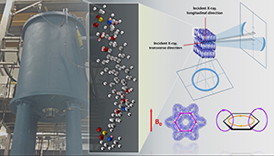 |
| The high magnetic field environments are provided by fully recondensing commercial prototype superconducting magnet processing system. The electromagnetic fields turn and align the liquid crystal phase forming a pseudo super-structure of ordered domains. This leads to advanced physical properties such as near-zero coefficient of thermal expansion. |
Abstract:
For much the same reason LCD televisions offer eye-popping performance, a thermomagnetic processing method developed at the Department of Energy's Oak Ridge National Laboratory can advance the performance of polymers.
ORNL thermomagnetic processing method provides path to new materials
Oak Ridge, TN | Posted on November 6th, 2014Polymers are used in cars, planes and hundreds of consumer products, and scientists have long been challenged to create polymers that are immune to shape-altering thermal expansion. One way to achieve this goal is to develop highly directional crystalline structures that mimic those of transparent liquid crystal diode, or LCD, films of television and computer screens. Unfortunately, polymers typically feature random microstructures rather than the perfectly aligned microstructure - and transparency - of the LCD film.
ORNL's Orlando Rios and collaborators at Washington State University have pushed this barrier aside with a processing system that changes the microstructure and mechanical properties of a liquid crystalline epoxy resin. Their finding, outlined in a paper published in the American Chemical Society journal Applied Materials and Interfaces, offers a potential path to new structural designs and functional composites with improved properties.
The method combines conventional heat processing with the application of powerful magnetic fields generated by superconducting magnets. This provides a lever researchers can use to control the orientation of the molecules and, ultimately, the crystal alignment.
"In this way, we can achieve our goal of a zero thermal expansion coefficient and a polymer that is highly crystalline," said Rios, a member of ORNL's Deposition Science Group. "And this means we have the potential to dial in the desired properties for the epoxy resin polymers that are so prevalent today."
Epoxy is commonly used in structural composites, bonded magnets and coatings. Rios noted that thermosets such as epoxy undergo a chemical cross-linking reaction that hardens or sets the material. Conventional epoxy typically consists of randomly oriented molecules with the molecular chains pointing in every direction, almost like a spider web of atoms.
"Using thermomagnetic processing and magnetically responsive molecular chains, we are able to form highly aligned structures analogous to many stacks of plates sitting on a shelf," Rios said. "We confirmed the directionality of this structure using X-ray measurements, mechanical properties and thermal expansion."
Co-authors of the paper, "Thermomagnetic processing of liquid crystalline epoxy resins and their mechanical characterization using nanoindentation," are Yuzhan Li and Michael Kessler of Washington State's School of Mechanical and Materials Engineering. The ORNL portion of the research was supported by the Critical Materials Institute, an Energy Innovation Hub funded by DOE's Office of Energy Efficiency and Renewable Energy. Washington State's research was funded by the Air Force Office of Scientific Research.
####
About DOE/Oak Ridge National Laboratory
UT-Battelle manages ORNL for the Department of Energy's Office of Science. The Office of Science is the single largest supporter of basic research in the physical sciences in the United States, and is working to address some of the most pressing challenges of our time. For more information, please visit http://science.energy.gov/.
For more information, please click here
Contacts:
Ron Walli
865-576-0226
Copyright © DOE/Oak Ridge National Laboratory
If you have a comment, please Contact us.Issuers of news releases, not 7th Wave, Inc. or Nanotechnology Now, are solely responsible for the accuracy of the content.
Bookmark:


| Related News Press |
News and information
 Quantum computer improves AI predictions April 17th, 2026
Flexible sensor gains sensitivity under pressure April 17th, 2026
A reusable chip for particulate matter sensing April 17th, 2026
Detecting vibrational quantum beating in the predissociation dynamics of SF6 using time-resolved photoelectron spectroscopy April 17th, 2026
Laboratories
Researchers develop molecular qubits that communicate at telecom frequencies October 3rd, 2025
A battery’s hopping ions remember where they’ve been: Seen in atomic detail, the seemingly smooth flow of ions through a battery’s electrolyte is surprisingly complicated February 16th, 2024
Govt.-Legislation/Regulation/Funding/Policy
Quantum computer improves AI predictions April 17th, 2026
Metasurfaces smooth light to boost magnetic sensing precision January 30th, 2026
New imaging approach transforms study of bacterial biofilms August 8th, 2025
Discoveries
Quantum computer improves AI predictions April 17th, 2026
Flexible sensor gains sensitivity under pressure April 17th, 2026
A reusable chip for particulate matter sensing April 17th, 2026
Detecting vibrational quantum beating in the predissociation dynamics of SF6 using time-resolved photoelectron spectroscopy April 17th, 2026
Materials/Metamaterials/Magnetoresistance
First real-time observation of two-dimensional melting process: Researchers at Mainz University unveil new insights into magnetic vortex structures August 8th, 2025
Researchers unveil a groundbreaking clay-based solution to capture carbon dioxide and combat climate change June 6th, 2025
A 1960s idea inspires NBI researchers to study hitherto inaccessible quantum states June 6th, 2025
Institute for Nanoscience hosts annual proposal planning meeting May 16th, 2025
Announcements
A fundamentally new therapeutic approach to cystic fibrosis: Nanobody repairs cellular defect April 17th, 2026
UC Irvine physicists discover method to reverse ‘quantum scrambling’ : The work addresses the problem of information loss in quantum computing system April 17th, 2026
Interviews/Book Reviews/Essays/Reports/Podcasts/Journals/White papers/Posters
A fundamentally new therapeutic approach to cystic fibrosis: Nanobody repairs cellular defect April 17th, 2026
UC Irvine physicists discover method to reverse ‘quantum scrambling’ : The work addresses the problem of information loss in quantum computing system April 17th, 2026
Tools
Metasurfaces smooth light to boost magnetic sensing precision January 30th, 2026
From sensors to smart systems: the rise of AI-driven photonic noses January 30th, 2026
Japan launches fully domestically produced quantum computer: Expo visitors to experience quantum computing firsthand August 8th, 2025
Military
Quantum engineers ‘squeeze’ laser frequency combs to make more sensitive gas sensors January 17th, 2025
Chainmail-like material could be the future of armor: First 2D mechanically interlocked polymer exhibits exceptional flexibility and strength January 17th, 2025
Single atoms show their true color July 5th, 2024
NRL charters Navy’s quantum inertial navigation path to reduce drift April 5th, 2024
Automotive/Transportation
Decoding hydrogen‑bond network of electrolyte for cryogenic durable aqueous zinc‑ion batteries January 30th, 2026
Sensors innovations for smart lithium-based batteries: advancements, opportunities, and potential challenges August 8th, 2025
Simple algorithm paired with standard imaging tool could predict failure in lithium metal batteries August 8th, 2025
Aerospace/Space
Decoding hydrogen‑bond network of electrolyte for cryogenic durable aqueous zinc‑ion batteries January 30th, 2026
ICFO researchers overcome long-standing bottleneck in single photon detection with twisted 2D materials August 8th, 2025
Onion-like nanoparticles found in aircraft exhaust May 14th, 2025
 |
||
 |
||
| The latest news from around the world, FREE | ||
 |
||
|
|
||
| Premium Products | ||
 |
||
|
Only the news you want to read!
Learn More |
||
 |
||
|
Full-service, expert consulting
Learn More |
||
|
|
||