Home > Press > NIST quantum probe enhances electric field measurements
 |
Abstract:
Researchers at the National Institute of Standards and Technology (NIST) and the University of Michigan have demonstrated a technique based on the quantum properties of atoms that directly links measurements of electric field strength to the International System of Units (SI).*
NIST quantum probe enhances electric field measurements
Boulder, CO | Posted on October 8th, 2014The new method could improve the sensitivity, precision and ease of tests and calibrations of antennas, sensors, and biomedical and nano-electronic systems and facilitate the design of novel devices.
Conventional electric field probes have limited frequency range and sensitivity, often disturb the field being measured, and require laboratory calibrations that are inherently imprecise (because the reference field depends on the geometry of the source). Furthermore, linking these measurements to SI units, the highest level of calibration, is a complex process.
NIST's new electric-field probe spans enormous ranges. It can measure the strength of fields from 1 to 500 gigahertz, including the radio, microwave, millimeter-wave and sub-terahertz bands. It can measure fields up to 100 times weaker than conventional methods can (as weak as 0.8millivolts per meter, the SI unit of measure). Researchers used the new method to measure field strengths for a wide range of frequencies, and the results agreed with both numerical simulations and calculations.
Importantly, the new method can calibrate itself, as well as other instruments, because it is based on predictable quantum properties: vibrations in atoms as they switch between energy levels. This self-calibration feature improves measurement precision and may make traceable calibrations possible in the millimeter and sub-terahertz bands of the spectrum for the first time.
"The exciting aspect of this approach is that an atom is rich in the number of transitions that can be excited," NIST project leader Chris Holloway says. "This results in a broadband measurement probe covering a frequency range of 1 to 500 gigahertz and possibly up to 1 terahertz."
The NIST instrument currently is tabletop sized, but researchers are working on miniaturizing it using photonic structures.
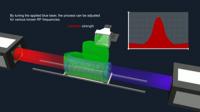
The basic method has already been demonstrated for imaging applications.** Briefly, researchers use a red and a blue laser to prepare atoms contained in a cylinder to high-energy ("Rydberg") states, which have novel properties such as extreme sensitivity and reactivity to electromagnetic fields. An antenna or other source generates an electric field, which, depending on its frequency, affects the spectrum of light absorbed by the atoms. By measuring this effect, researchers can calculate the field strength. Various atoms can be used—NIST uses rubidium or cesium—to measure field strength in different parts of the frequency spectrum.
Among possible applications, the NIST probe may be suitable for measuring and optimizing compatibility in densely packaged electronics that include radar and wireless communications and control links, and for integration into endoscopic probes with medical applications such as investigating implants in the body. The technique might also be included in a future "NIST on a chip" offering multiple measurement methods and standards in a portable form.
Importantly, the technique also enables, for the first time, calibrated measurements of frequencies above 100 GHZ, in the millimeter wave and sub-terahertz bands.*** This capability will be crucial for the development of advanced communications systems and climate change research, among other applications.
###
Five co-authors of the new paper are with the University of Michigan, which provided the blue laser and aided in the experiments. The project is funded in part by the Defense Advanced Research Projects Agency.
* C.L. Holloway, J.A. Gordon, S. Jefferts, A. Schwarzkopf, D. A. Anderson, S.A. Miller, N. Thaicharoen and G. Raithelet. Broadband Rydbergatom-based electric-field probe: From self-calibrated measurements to sub-wavelength imaging. IEEE Trans. on Antennas and Propagation. 99. Accepted for publication. DOI: 10.1109/TAP.2014.2360208.
** See 2014 NIST Tech Beat article, "NIST Technique Could Make Sub-wavelength Images at Radio Frequencies," at www.nist.gov/pml/electromagnetics/subwave-061714.cfm.
*** J.A. Gordon, C.L. Holloway, A. Schwarzkopf, D. A. Anderson, S. Miller, N. Thaicharoen and G. Raithel. Millimeter wave detection via Autler-Townes splitting in rubidium Rydberg atoms. Applied Physics Letters, 2014. Vol. 105, Issue 2.DOI:10.1063/1.4890094.
####
For more information, please click here
Contacts:
Laura Ost
303-497-4880
Copyright © National Institute of Standards and Technology (NIST)
If you have a comment, please Contact us.Issuers of news releases, not 7th Wave, Inc. or Nanotechnology Now, are solely responsible for the accuracy of the content.
Bookmark:


| Related Links |
| Related News Press |
News and information
 Quantum computer improves AI predictions April 17th, 2026
Flexible sensor gains sensitivity under pressure April 17th, 2026
A reusable chip for particulate matter sensing April 17th, 2026
Detecting vibrational quantum beating in the predissociation dynamics of SF6 using time-resolved photoelectron spectroscopy April 17th, 2026
Wireless/telecommunications/RF/Antennas/Microwaves
Researchers develop molecular qubits that communicate at telecom frequencies October 3rd, 2025
HKUST researchers develop new integration technique for efficient coupling of III-V and silicon February 16th, 2024
Laboratories
Researchers develop molecular qubits that communicate at telecom frequencies October 3rd, 2025
Videos/Movies
ICFO researchers overcome long-standing bottleneck in single photon detection with twisted 2D materials August 8th, 2025
Govt.-Legislation/Regulation/Funding/Policy
Quantum computer improves AI predictions April 17th, 2026
Metasurfaces smooth light to boost magnetic sensing precision January 30th, 2026
New imaging approach transforms study of bacterial biofilms August 8th, 2025
Discoveries
Quantum computer improves AI predictions April 17th, 2026
Flexible sensor gains sensitivity under pressure April 17th, 2026
A reusable chip for particulate matter sensing April 17th, 2026
Detecting vibrational quantum beating in the predissociation dynamics of SF6 using time-resolved photoelectron spectroscopy April 17th, 2026
Announcements
A fundamentally new therapeutic approach to cystic fibrosis: Nanobody repairs cellular defect April 17th, 2026
UC Irvine physicists discover method to reverse ‘quantum scrambling’ : The work addresses the problem of information loss in quantum computing system April 17th, 2026
Interviews/Book Reviews/Essays/Reports/Podcasts/Journals/White papers/Posters
A fundamentally new therapeutic approach to cystic fibrosis: Nanobody repairs cellular defect April 17th, 2026
UC Irvine physicists discover method to reverse ‘quantum scrambling’ : The work addresses the problem of information loss in quantum computing system April 17th, 2026
Tools
Metasurfaces smooth light to boost magnetic sensing precision January 30th, 2026
From sensors to smart systems: the rise of AI-driven photonic noses January 30th, 2026
Japan launches fully domestically produced quantum computer: Expo visitors to experience quantum computing firsthand August 8th, 2025
Environment
A reusable chip for particulate matter sensing April 17th, 2026
Researchers unveil a groundbreaking clay-based solution to capture carbon dioxide and combat climate change June 6th, 2025
Quantum nanoscience
Beyond silicon: Electronics at the scale of a single molecule January 30th, 2026
MXene nanomaterials enter a new dimension Multilayer nanomaterial: MXene flakes created at Drexel University show new promise as 1D scrolls January 30th, 2026
ICFO researchers overcome long-standing bottleneck in single photon detection with twisted 2D materials August 8th, 2025
 |
||
 |
||
| The latest news from around the world, FREE | ||
 |
||
|
|
||
| Premium Products | ||
 |
||
|
Only the news you want to read!
Learn More |
||
 |
||
|
Full-service, expert consulting
Learn More |
||
|
|
||