Home > Press > All directions are not created equal for nanoscale heat sources
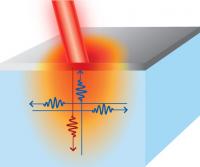 |
| Schematic representation of thermal transport for small heater dimensions. Vibrational waves, or photons, that travel parallel to the surface do not help cool the hot region when its dimensions are small because they can traverse its small diameter without interacting with it. The metal-coated surface prevents phonons traveling perpendicular the surface from traversing the heated region without interaction.
Credit: Richard Wilson, University of Illinois |
Abstract:
Thermal considerations are rapidly becoming one of the most serious design constraints in microelectronics, especially on submicron scale lengths. A study by researchers from the University of Illinois at Urbana-Champaign has shown that standard thermal models will lead to the wrong answer in a three-dimensional heat-transfer problem if the dimensions of the heating element are on the order of one micron or smaller.
All directions are not created equal for nanoscale heat sources
Urbana, IL | Posted on October 2nd, 2014"As materials shrink, the rules governing heat transfer change as well," explained David Cahill, a professor of materials science and engineering at Illinois. "Our current understanding of nanoscale thermal transport isn't nuanced enough to quantitatively predict when standard theory won't work. This can impact the design of high-power RF devices that are widely used in the telecommunication industry—for example, 4G wireless infrastructure. The transistor spacing in RF devices is rapidly approaching length-scales where theory based on the diffusion of heat won't be valid, and the engineering models currently used won't accurately predict the operating temperature of the device. The temperature is a key factor for predicting mean-time to failure"
"Our research focuses on understanding the physics of thermal transport on submicron length-scales in the presence of an interface," explained Richard Wilson, lead author of the study published in Nature Communications. "Our study focused on a variety of crystals that have controlled differences in thermal transport properties, such as Si, doped Si, and SiGe alloys," Wilson said. "We coated these crystals with a thin metal film, heated the surface with a laser beam, and then recorded the temperature evolution of the sample.
"On length-scales shorter than the phonon mean-free-paths of the crystal, heat is transported ballistically, not diffusively. Interfaces between materials further complicate the heat-transfer problem by adding additional thermal resistance."
Researchers found that when the radius of the laser beam used to heat the metal coated crystals was above ten microns, the predictions made by assuming heat is transported diffusively matched the experimental observations. However, when the radius neared one micron, diffusive theory over-predicted the amount of energy carried away from the heated surface.
"We discovered fundamental differences in how heat is transported over short versus long distances. Fourier theory, which assumes heat is transported by diffusion, predicts that a cubic crystal like silicon will carry heat equally well in all directions. We demonstrated that on short length-scales heat is not carried equally well in all directions. By measuring the temperature of the sample surface as a function of distance from the center of the heated region, we were able to determine how far heat was traveling parallel to the surface, and deduce that, when heater dimensions are small, significantly less heat is carried parallel to the surface than Fourier theory predicts," Wilson stated.
Wilson and Cahill also studied the effect of interfaces on nanoscale thermal transport.
"It's been well known for 75 years that the presence of a boundary adds a thermal boundary resistance to the heat-transfer problem, but it's always been assumed that this boundary resistance was localized to the interface and independent of the thermal transport properties of the underlying material," Cahill added. "Our experiments show that these assumptions aren't generally valid. In particularly for crystals with defects, the boundary resistance is distributed and strongly dependent on the defect concentration. "
Wilson and Cahill also provided a theoretical description of their results that can be used by device engineers to better manage heat and temperature in nanoscale devices.
###
This work was supported by the Air Force Office of Scientific Research and was carried out, in part, in the Frederick Seitz Materials Research Laboratory at Illinois.
####
For more information, please click here
Contacts:
David G. Cahill
217-333-6753
Copyright © University of Illinois College of Engineering
If you have a comment, please Contact us.Issuers of news releases, not 7th Wave, Inc. or Nanotechnology Now, are solely responsible for the accuracy of the content.
Bookmark:


| Related News Press |
News and information
 Quantum computer improves AI predictions April 17th, 2026
Flexible sensor gains sensitivity under pressure April 17th, 2026
A reusable chip for particulate matter sensing April 17th, 2026
Detecting vibrational quantum beating in the predissociation dynamics of SF6 using time-resolved photoelectron spectroscopy April 17th, 2026
Physics
UC Irvine physicists discover method to reverse ‘quantum scrambling’ : The work addresses the problem of information loss in quantum computing system April 17th, 2026
Quantum computers simulate fundamental physics: shedding light on the building blocks of nature June 6th, 2025
A 1960s idea inspires NBI researchers to study hitherto inaccessible quantum states June 6th, 2025
Laboratories
Researchers develop molecular qubits that communicate at telecom frequencies October 3rd, 2025
Govt.-Legislation/Regulation/Funding/Policy
Quantum computer improves AI predictions April 17th, 2026
Metasurfaces smooth light to boost magnetic sensing precision January 30th, 2026
New imaging approach transforms study of bacterial biofilms August 8th, 2025
Chip Technology
A reusable chip for particulate matter sensing April 17th, 2026
Metasurfaces smooth light to boost magnetic sensing precision January 30th, 2026
Discoveries
Quantum computer improves AI predictions April 17th, 2026
Flexible sensor gains sensitivity under pressure April 17th, 2026
A reusable chip for particulate matter sensing April 17th, 2026
Detecting vibrational quantum beating in the predissociation dynamics of SF6 using time-resolved photoelectron spectroscopy April 17th, 2026
Announcements
A fundamentally new therapeutic approach to cystic fibrosis: Nanobody repairs cellular defect April 17th, 2026
UC Irvine physicists discover method to reverse ‘quantum scrambling’ : The work addresses the problem of information loss in quantum computing system April 17th, 2026
Interviews/Book Reviews/Essays/Reports/Podcasts/Journals/White papers/Posters
A fundamentally new therapeutic approach to cystic fibrosis: Nanobody repairs cellular defect April 17th, 2026
UC Irvine physicists discover method to reverse ‘quantum scrambling’ : The work addresses the problem of information loss in quantum computing system April 17th, 2026
Military
Quantum engineers ‘squeeze’ laser frequency combs to make more sensitive gas sensors January 17th, 2025
Chainmail-like material could be the future of armor: First 2D mechanically interlocked polymer exhibits exceptional flexibility and strength January 17th, 2025
Single atoms show their true color July 5th, 2024
NRL charters Navy’s quantum inertial navigation path to reduce drift April 5th, 2024
 |
||
 |
||
| The latest news from around the world, FREE | ||
 |
||
|
|
||
| Premium Products | ||
 |
||
|
Only the news you want to read!
Learn More |
||
 |
||
|
Full-service, expert consulting
Learn More |
||
|
|
||