Home > Press > University of Electro-Communications research: High density quantum dots for powerful solar cells
 |
Abstract:
The September 2014 issue of the University of Electro-Communications e-Bulletin includes research highlights on self-organized indium arsenide quantum dots for solar cells; silicon nanophotonics; solutions to internet congestion; and humanizing robots.
University of Electro-Communications research: High density quantum dots for powerful solar cells
Tokyo, Japan | Posted on September 25th, 2014Feature article
Koichi Yamaguchi
Nanotechnology for real world applications: Self-organized indium arsenide quantum dots for solar cells
www.ru.uec.ac.jp/e-bulletin/feature/2014/self-organized-indium-arsenide-quantum-dots-for-solar-cells.html
Kouichi Yamaguchi is internationally recognized for his pioneering research on the fabrication and applications of 'semiconducting quantum dots' (QDs). "We exploit the 'self-organization' of semiconducting nanocrystals by the 'Stranski-Krasnov (SK) mode of crystal growth for producing ordered, highly dense, and highly uniform quantum dots," explains Yamaguchi. "Our 'bottom-up' approach yields much better results than the conventional photolithographic or 'top-down' methods widely used for the fabrication of nano-structures."
InAs QD density: 1.0×1012 cm-2
Research Highlights
Silicon nanophotonics: controlling photoluminescence for better devices
www.ru.uec.ac.jp/e-bulletin/research-highlights/2014/controlling-photoluminescence-for-better-devices.html
Okuno and his colleagues fabricated silicon nanowire arrays by metal-assisted chemical etching, an approach that is simple and cost-effective.
Micromanipulators: Taking the future in hand
www.ru.uec.ac.jp/e-bulletin/research-highlights/2014/taking-the-future-in-hand.html
Now, Sungwan Boksuwan and co-workers at the University of Electro-Communications in Tokyo, together with scientists in Thailand, have created a new robust two-dimensional handheld micromanipulator for use in cell manipulation.
Depth perception - understanding ambiguities
www.ru.uec.ac.jp/e-bulletin/research-highlights/2014/depth-perception-understanding-ambiguities.html
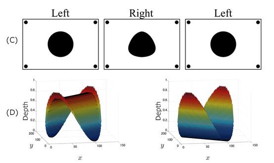
Binocular vision allows us to gauge depth. For example a dot directly ahead of the left eye will be at an angle to the right that decreases with distance. So how, ask Eiichi Mitsukura and Shunji Satoh at the University of Electro-Communications in Tokyo, can we estimate the depth of black or white paper? With no pattern or texture on the paper there should be no way of determining its contours. They turned to the computational tools used for filling in blind spots for an answer.
nternet protocol networks: Optimizing link reinforcements
http://www.ru.uec.ac.jp/e-bulletin/research-highlights/2014/optimizing-link-reinforcements.html
At any given moment in time, a network can be represented by a series of nodes and links. Each link is given a 'weight' - a measure of the link's quality of service. The aim of an internet engineer is to keep the links as uncongested as possible, allowing as much data as possible to flow freely at any one time.
Topics
Intelligent robots as models for studying human communication
www.ru.uec.ac.jp/e-bulletin/topics/2014/intelligent-robots-as-models-for-studying-human-communication.html
Visions of reality: Insights into information processing by the brain
www.ru.uec.ac.jp/e-bulletin/topics/2014/insights-into-information-processing-by-the-brain.html
####
About University of Electro-Communications
The University of Electro-Communications (UEC) in Tokyo is a small, luminous university at the forefront of applied sciences, engineering, and technology research. Its roots go back to the Technical
Institute for Wireless Commutations, which was established in 1918 by the Wireless Association to train so-called wireless engineers in maritime communications in response to the Titanic disaster in 1912. In 1949, the UEC was established as a national university by the Japanese Ministry of Education,and moved in 1957 from Meguro to its current Chofu campus Tokyo.
With approximately 4,000 students and 350 faculty, UEC is regarded as a small university, but with particular expertise in wireless communications, laser science, robotics, informatics, and material science, to name just a few areas of research.
The UEC was selected for the Ministry of Education, Culture, Sports, Science and Technology (MEXT) Program for Promoting the Enhancement of Research Universities as a result of its strengths in three main areas: optics and photonics research, where we are number one for the number of joint publications with foreign researchers; wireless communications, which reflects our roots; and materials-based research, particularly on fuel cells.
For more information, please click here
Contacts:
International Public Relations
The University of Electro-Communications
1-5-1 Chofugaoka, Chofu, Tokyo 182-8585
Website: http://www.uec.ac.jp/
Copyright © University of Electro-Communications
If you have a comment, please Contact us.Issuers of news releases, not 7th Wave, Inc. or Nanotechnology Now, are solely responsible for the accuracy of the content.
Bookmark:


| Related News Press |
News and information
 Quantum computer improves AI predictions April 17th, 2026
Flexible sensor gains sensitivity under pressure April 17th, 2026
A reusable chip for particulate matter sensing April 17th, 2026
Detecting vibrational quantum beating in the predissociation dynamics of SF6 using time-resolved photoelectron spectroscopy April 17th, 2026
Discoveries
Quantum computer improves AI predictions April 17th, 2026
Flexible sensor gains sensitivity under pressure April 17th, 2026
A reusable chip for particulate matter sensing April 17th, 2026
Detecting vibrational quantum beating in the predissociation dynamics of SF6 using time-resolved photoelectron spectroscopy April 17th, 2026
Announcements
A fundamentally new therapeutic approach to cystic fibrosis: Nanobody repairs cellular defect April 17th, 2026
UC Irvine physicists discover method to reverse ‘quantum scrambling’ : The work addresses the problem of information loss in quantum computing system April 17th, 2026
Interviews/Book Reviews/Essays/Reports/Podcasts/Journals/White papers/Posters
A fundamentally new therapeutic approach to cystic fibrosis: Nanobody repairs cellular defect April 17th, 2026
UC Irvine physicists discover method to reverse ‘quantum scrambling’ : The work addresses the problem of information loss in quantum computing system April 17th, 2026
Energy
Sensors innovations for smart lithium-based batteries: advancements, opportunities, and potential challenges August 8th, 2025
Simple algorithm paired with standard imaging tool could predict failure in lithium metal batteries August 8th, 2025
Quantum Dots/Rods
A new kind of magnetism November 17th, 2023
IOP Publishing celebrates World Quantum Day with the announcement of a special quantum collection and the winners of two prestigious quantum awards April 14th, 2023
Qubits on strong stimulants: Researchers find ways to improve the storage time of quantum information in a spin rich material January 27th, 2023
NIST’s grid of quantum islands could reveal secrets for powerful technologies November 18th, 2022
Solar/Photovoltaic
Spinel-type sulfide semiconductors to operate the next-generation LEDs and solar cells For solar-cell absorbers and green-LED source October 3rd, 2025
KAIST researchers introduce new and improved, next-generation perovskite solar cell November 8th, 2024
Groundbreaking precision in single-molecule optoelectronics August 16th, 2024
Development of zinc oxide nanopagoda array photoelectrode: photoelectrochemical water-splitting hydrogen production January 12th, 2024
 |
||
 |
||
| The latest news from around the world, FREE | ||
 |
||
|
|
||
| Premium Products | ||
 |
||
|
Only the news you want to read!
Learn More |
||
 |
||
|
Full-service, expert consulting
Learn More |
||
|
|
||