Home > Press > New star-shaped molecule breakthrough: Scientists at The University of Manchester have generated a new star-shaped molecule made up of interlocking rings, which is the most complex of its kind ever created
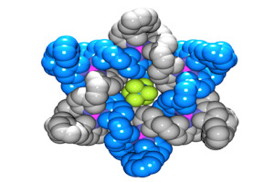 |
| Atoms in the Star of David molecule. Image credit: University of Manchester |
Abstract:
Scientists at The University of Manchester have generated a new star-shaped molecule made up of interlocking rings, which is the most complex of its kind ever created.
New star-shaped molecule breakthrough: Scientists at The University of Manchester have generated a new star-shaped molecule made up of interlocking rings, which is the most complex of its kind ever created
Manchester, UK | Posted on September 22nd, 2014Known as a 'Star of David' molecule, scientists have been trying to create one for over a quarter of a century and the team's findings are published in the journal Nature Chemistry.
Consisting of two molecular triangles, entwined about each other three times into a hexagram, the structure's interlocked molecules are tiny - each triangle is 114 atoms in length around the perimeter. The molecular triangles are threaded around each other at the same time that the triangles are formed, by a process called 'self-assembly', similar to how the DNA double helix is formed in biology.
The molecule was created at The University of Manchester by PhD student Alex Stephens.
Professor David Leigh, in Manchester's School of Chemistry, said: "It was a great day when Alex finally got it in the lab. In nature, biology already uses molecular chainmail to make the tough, light shells of certain viruses and now we are on the path towards being able to reproduce its remarkable properties.
"It's the next step on the road to man-made molecular chainmail, which could lead to the development of new materials which are light, flexible and very strong. Just as chainmail was a breakthrough over heavy suits of armour in medieval times, this could be a big step towards materials created using nanotechnology. I hope this will lead to many exciting developments in the future."
The team's next step will be to make larger, more elaborate, interlocked structures.
###
The scientists' work was funded by the Engineering and Physical Sciences Research Council (EPSRC).
####
For more information, please click here
Contacts:
Aeron Haworth
44-717-788-1563
University of Manchester
Academic Contact
Copyright © University of Manchester
If you have a comment, please Contact us.Issuers of news releases, not 7th Wave, Inc. or Nanotechnology Now, are solely responsible for the accuracy of the content.
Bookmark:


| Related Links |
| Related News Press |
News and information
 Quantum computer improves AI predictions April 17th, 2026
Flexible sensor gains sensitivity under pressure April 17th, 2026
A reusable chip for particulate matter sensing April 17th, 2026
Detecting vibrational quantum beating in the predissociation dynamics of SF6 using time-resolved photoelectron spectroscopy April 17th, 2026
Chemistry
Projecting light to dispense liquids: A new route to ultra-precise microdroplets January 30th, 2026
From sensors to smart systems: the rise of AI-driven photonic noses January 30th, 2026
"Nanoreactor" cage uses visible light for catalytic and ultra-selective cross-cycloadditions October 3rd, 2025
Cambridge chemists discover simple way to build bigger molecules – one carbon at a time June 6th, 2025
Govt.-Legislation/Regulation/Funding/Policy
Quantum computer improves AI predictions April 17th, 2026
Metasurfaces smooth light to boost magnetic sensing precision January 30th, 2026
New imaging approach transforms study of bacterial biofilms August 8th, 2025
Discoveries
Quantum computer improves AI predictions April 17th, 2026
Flexible sensor gains sensitivity under pressure April 17th, 2026
A reusable chip for particulate matter sensing April 17th, 2026
Detecting vibrational quantum beating in the predissociation dynamics of SF6 using time-resolved photoelectron spectroscopy April 17th, 2026
Materials/Metamaterials/Magnetoresistance
First real-time observation of two-dimensional melting process: Researchers at Mainz University unveil new insights into magnetic vortex structures August 8th, 2025
Researchers unveil a groundbreaking clay-based solution to capture carbon dioxide and combat climate change June 6th, 2025
A 1960s idea inspires NBI researchers to study hitherto inaccessible quantum states June 6th, 2025
Institute for Nanoscience hosts annual proposal planning meeting May 16th, 2025
Announcements
A fundamentally new therapeutic approach to cystic fibrosis: Nanobody repairs cellular defect April 17th, 2026
UC Irvine physicists discover method to reverse ‘quantum scrambling’ : The work addresses the problem of information loss in quantum computing system April 17th, 2026
Interviews/Book Reviews/Essays/Reports/Podcasts/Journals/White papers/Posters
A fundamentally new therapeutic approach to cystic fibrosis: Nanobody repairs cellular defect April 17th, 2026
UC Irvine physicists discover method to reverse ‘quantum scrambling’ : The work addresses the problem of information loss in quantum computing system April 17th, 2026
Nanobiotechnology
A fundamentally new therapeutic approach to cystic fibrosis: Nanobody repairs cellular defect April 17th, 2026
New molecular technology targets tumors and simultaneously silences two ‘undruggable’ cancer genes August 8th, 2025
New imaging approach transforms study of bacterial biofilms August 8th, 2025
Electrifying results shed light on graphene foam as a potential material for lab grown cartilage June 6th, 2025
 |
||
 |
||
| The latest news from around the world, FREE | ||
 |
||
|
|
||
| Premium Products | ||
 |
||
|
Only the news you want to read!
Learn More |
||
 |
||
|
Full-service, expert consulting
Learn More |
||
|
|
||