Home > Press > Electrical engineers take major step toward photonic circuits: Team invents non-metallic metamaterial that enables them to 'compress' and contain light
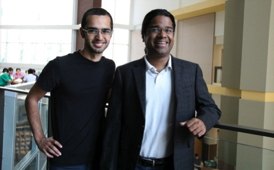 |
| Cables designed by graduate student Saman Jahani (left) and electrical engineering professor Zubin Jacob are 10 times smaller than existing fibre optic cables—small enough to replace copper wiring still used on computer chips. - See more at: http://uofa.ualberta.ca/news-and-events/newsarticles/2014/august/ualberta-engineers-take-major-step-toward-optical-computing#sthash.nm6gAr1H.dpuf |
Abstract:
The invention of fibre optics revolutionized the way we share information, allowing us to transmit data at volumes and speeds we'd only previously dreamed of.
Electrical engineers take major step toward photonic circuits: Team invents non-metallic metamaterial that enables them to 'compress' and contain light
Edmonton, Canada | Posted on August 19th, 2014Now, electrical engineering researchers at the University of Alberta in Edmonton, Alberta, Canada are breaking another barrier, designing nano-optical cables small enough to replace the copper wiring on computer chips.
This could result in radical increases in computing speeds and reduced energy use by electronic devices.
"We're already transmitting data from continent to continent using fibre optics, but the killer application is using this inside chips for interconnects—that is the Holy Grail," says Zubin Jacob, an electrical engineering professor leading the research. "What we've done is come up with a fundamentally new way of confining light to the nano scale."
At present, the diameter of fibre optic cables is limited to about 1/1000th of a millimetre. Cables designed by graduate student Saman Jahani and Jacob are 10 times smaller—small enough to replace copper wiring still used on computer chips. (Put into perspective, a dime is about 1 mm thick.)
Jahani and Jacob have invented a new, non-metallic metamaterial that enables them to "compress" and contain light waves in smaller cables without creating heat, slowing the signal or losing data. Their findings will be published in Optica (Aug. 20), The Optical Society's (OSA) new high-impact photonics journal. The article is available online.
###
The team's research is funded by the Natural Sciences and Engineering Research Council of Canada and the Helmholtz-Alberta Initiative.
####
For more information, please click here
Contacts:
Richard Cairney
Communications Officer
University of Alberta Faculty of Engineering
780.492.4514
780.886.9278 (mobile)
Copyright © University of Alberta
If you have a comment, please Contact us.Issuers of news releases, not 7th Wave, Inc. or Nanotechnology Now, are solely responsible for the accuracy of the content.
Bookmark:


| Related News Press |
News and information
 Quantum computer improves AI predictions April 17th, 2026
Flexible sensor gains sensitivity under pressure April 17th, 2026
A reusable chip for particulate matter sensing April 17th, 2026
Detecting vibrational quantum beating in the predissociation dynamics of SF6 using time-resolved photoelectron spectroscopy April 17th, 2026
Govt.-Legislation/Regulation/Funding/Policy
Quantum computer improves AI predictions April 17th, 2026
Metasurfaces smooth light to boost magnetic sensing precision January 30th, 2026
New imaging approach transforms study of bacterial biofilms August 8th, 2025
Chip Technology
A reusable chip for particulate matter sensing April 17th, 2026
Metasurfaces smooth light to boost magnetic sensing precision January 30th, 2026
Optical computing/Photonic computing
ICFO researchers overcome long-standing bottleneck in single photon detection with twisted 2D materials August 8th, 2025
Programmable electron-induced color router array May 14th, 2025
Discoveries
Quantum computer improves AI predictions April 17th, 2026
Flexible sensor gains sensitivity under pressure April 17th, 2026
A reusable chip for particulate matter sensing April 17th, 2026
Detecting vibrational quantum beating in the predissociation dynamics of SF6 using time-resolved photoelectron spectroscopy April 17th, 2026
Announcements
A fundamentally new therapeutic approach to cystic fibrosis: Nanobody repairs cellular defect April 17th, 2026
UC Irvine physicists discover method to reverse ‘quantum scrambling’ : The work addresses the problem of information loss in quantum computing system April 17th, 2026
Photonics/Optics/Lasers
Metasurfaces smooth light to boost magnetic sensing precision January 30th, 2026
From sensors to smart systems: the rise of AI-driven photonic noses January 30th, 2026
 |
||
 |
||
| The latest news from around the world, FREE | ||
 |
||
|
|
||
| Premium Products | ||
 |
||
|
Only the news you want to read!
Learn More |
||
 |
||
|
Full-service, expert consulting
Learn More |
||
|
|
||