Home > Press > Laser makes microscopes way cooler: Cooling a nanowire probe with a laser could lead to substantial improvements in the sensitivity of atomic force probe microscopes
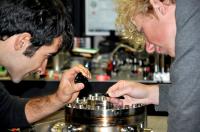 |
| Ph.D. students Giovanni Guccione (left) and Harry Slatyer examine their gold coated nanowire probe in the Quantum Optics Laboratory at the Australian National University.
Credit: ANU Quantum Optics Group |
Abstract:
Laser physicists have found a way to make atomic-force microscope probes 20 times more sensitive and capable of detecting forces as small as the weight of an individual virus.
Laser makes microscopes way cooler: Cooling a nanowire probe with a laser could lead to substantial improvements in the sensitivity of atomic force probe microscopes
Canberra, Australia | Posted on August 15th, 2014The technique, developed by researchers at The Australian National University (ANU), hinges on using laser beams to cool a nanowire probe to minus 265 degrees Celsius.
"The level of sensitivity achieved after cooling is accurate enough for us to sense the weight of a large virus that is 100 billion times lighter than a mosquito," said Dr Ben Buchler from the ANU Research School of Physics and Engineering.
The development could be used to improve the resolution of atomic-force microscopes, which are the state-of-the-art tool for measuring nanoscopic structures and the tiny forces between molecules.
Atomic force microscopes achieve extraordinarily sensitivity measurements of microscopic features by scanning a wire probe over a surface.
However, the probes, around 500 times finer than a human hair, are prone to vibration.
"At room temperature the probe vibrates, just because it is warm, and this can make your measurements noisy," said Professor Ping Koy Lam, a co-author of the research that is published in Nature Communications.
"We can stop this motion by shining lasers at the probe," he said.
The force sensor used by the ANU team was a 200 nm-wide silver gallium nanowire coated with gold.
"The laser makes the probe warp and move due to heat. But we have learned to control this warping effect and were able to use the effect to counter the thermal vibration of the probe," said Giovanni Guccione, a PhD student on the team.
However, the probe cannot be used while the laser is on as the laser effect overwhelms the sensitive probe. So the laser has to be turned off and any measurements quickly made before the probe heats up within a few milliseconds. By making measurements over a number of cycles of heating and cooling, an accurate value can be found.
"We now understand this cooling effect really well," says PhD student Harry Slatyer. "With clever data processing we might be able to improve the sensitivity, and even eliminate the need for a cooling laser."
####
For more information, please click here
Contacts:
Dr. Ben Buchler
61-261-259-973
Copyright © Australian National University
If you have a comment, please Contact us.Issuers of news releases, not 7th Wave, Inc. or Nanotechnology Now, are solely responsible for the accuracy of the content.
Bookmark:


| Related News Press |
News and information
 Quantum computer improves AI predictions April 17th, 2026
Flexible sensor gains sensitivity under pressure April 17th, 2026
A reusable chip for particulate matter sensing April 17th, 2026
Detecting vibrational quantum beating in the predissociation dynamics of SF6 using time-resolved photoelectron spectroscopy April 17th, 2026
Imaging
Simple algorithm paired with standard imaging tool could predict failure in lithium metal batteries August 8th, 2025
Discoveries
Quantum computer improves AI predictions April 17th, 2026
Flexible sensor gains sensitivity under pressure April 17th, 2026
A reusable chip for particulate matter sensing April 17th, 2026
Detecting vibrational quantum beating in the predissociation dynamics of SF6 using time-resolved photoelectron spectroscopy April 17th, 2026
Announcements
A fundamentally new therapeutic approach to cystic fibrosis: Nanobody repairs cellular defect April 17th, 2026
UC Irvine physicists discover method to reverse ‘quantum scrambling’ : The work addresses the problem of information loss in quantum computing system April 17th, 2026
Tools
Metasurfaces smooth light to boost magnetic sensing precision January 30th, 2026
From sensors to smart systems: the rise of AI-driven photonic noses January 30th, 2026
Japan launches fully domestically produced quantum computer: Expo visitors to experience quantum computing firsthand August 8th, 2025
Photonics/Optics/Lasers
Metasurfaces smooth light to boost magnetic sensing precision January 30th, 2026
From sensors to smart systems: the rise of AI-driven photonic noses January 30th, 2026
 |
||
 |
||
| The latest news from around the world, FREE | ||
 |
||
|
|
||
| Premium Products | ||
 |
||
|
Only the news you want to read!
Learn More |
||
 |
||
|
Full-service, expert consulting
Learn More |
||
|
|
||