Home > Press > New quantum mechanism to trigger the emission of tunable light at terahertz frequencies
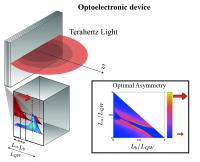 |
| This is an optoelectronic device formed of multiple quantum wells, whose design is optimised to maximise the dipole and thus its efficiency, emitting terahertz light.
Credit: University of Southampton |
Abstract:
Scientists have found that two-dimensional (2D) nanostructures with asymmetric design enable a new quantum mechanism, triggering the emission of tunable light at terahertz frequencies—with unprecedented efficiency.
New quantum mechanism to trigger the emission of tunable light at terahertz frequencies
Southampton, UK | Posted on June 18th, 2014The researchers, from the University of Southampton and Imperial College London, found that quantum wells, 2D nanostructures formed of several layers of semi-conductor alloys placed on top of each other like a sandwich, can enhance light emission in a technological challenging spectral range.
It is hoped that the findings will have an impact on photonic and optoelectronic devices across a broad range of applications, including harmless medical imaging and security scanning.
Electrons are trapped in the structure and this confinement can be exploited to enhance their capacity to interact with light at given frequencies much lower than the laser frequency at which they are excited: the system emits light by interacting with "vacuum fluctuations" that permeate space, according to quantum theory.
Nathan Shammah, from the University's Quantum Light and Matter (QLM) group and co-author of the study says: "As the 2D nanostructures can be manufactured with an asymmetric design, this allows light to interact with trapped electrons in a way that is not otherwise allowed. This interaction process, leading to the emission of light at lower frequencies, has not been observed in atoms because those are very symmetrical systems and symmetry rules prevent the transitions that trigger this light emission from happening."
In the paper, which is published in Physical Review B, the researchers predict that by shining light on a 2D asymmetric nanostructure with a laser that is tuned at resonance with the electronic transitions that can occur in the nanostructure, in addition to the scattered laser light, this 2D device would emit light at other frequencies, which can be tuned simply by changing the laser power.
Nathan, who co-authored the paper with Dr Simone De Liberato, from the QLM group, and Professor Chris Phillips from Imperial College London, adds: "Due to the large oscillating dipole and high density of electrons that characterise these "artificial atoms" formed of asymmetric 2D structures, the control of light-matter coupling can be greatly enhanced, triggering spontaneous light emission, similar to what occurs in LEDs lamps.
"This new mechanism is perfectly suited for the terahertz frequency range, which spans from above the current wi-fi bandwidth to below the visible light spectrum, where the lack of practical light emitters constitutes a serious technological gap."
The high efficiency shown by the simulations suggests that this theoretical result could be exploited in the near future for a broad range of optoelectronic applications—from harmless medical imaging and security scanners, to short-range, ultra-fast wireless communication.
####
For more information, please click here
Contacts:
Glenn Harris
44-023-805-93212
Copyright © University of Southampton
If you have a comment, please Contact us.Issuers of news releases, not 7th Wave, Inc. or Nanotechnology Now, are solely responsible for the accuracy of the content.
Bookmark:


| Related News Press |
News and information
 Quantum computer improves AI predictions April 17th, 2026
Flexible sensor gains sensitivity under pressure April 17th, 2026
A reusable chip for particulate matter sensing April 17th, 2026
Detecting vibrational quantum beating in the predissociation dynamics of SF6 using time-resolved photoelectron spectroscopy April 17th, 2026
Imaging
Simple algorithm paired with standard imaging tool could predict failure in lithium metal batteries August 8th, 2025
First real-time observation of two-dimensional melting process: Researchers at Mainz University unveil new insights into magnetic vortex structures August 8th, 2025
New imaging approach transforms study of bacterial biofilms August 8th, 2025
Wireless/telecommunications/RF/Antennas/Microwaves
Researchers develop molecular qubits that communicate at telecom frequencies October 3rd, 2025
Law enforcement/Anti-Counterfeiting/Security/Loss prevention
Chainmail-like material could be the future of armor: First 2D mechanically interlocked polymer exhibits exceptional flexibility and strength January 17th, 2025
With VECSELs towards the quantum internet Fraunhofer: IAF achieves record output power with VECSEL for quantum frequency converters April 5th, 2024
Researchers’ approach may protect quantum computers from attacks March 8th, 2024
Nanomedicine
A fundamentally new therapeutic approach to cystic fibrosis: Nanobody repairs cellular defect April 17th, 2026
New molecular technology targets tumors and simultaneously silences two ‘undruggable’ cancer genes August 8th, 2025
New imaging approach transforms study of bacterial biofilms August 8th, 2025
Electrifying results shed light on graphene foam as a potential material for lab grown cartilage June 6th, 2025
Discoveries
Quantum computer improves AI predictions April 17th, 2026
Flexible sensor gains sensitivity under pressure April 17th, 2026
A reusable chip for particulate matter sensing April 17th, 2026
Detecting vibrational quantum beating in the predissociation dynamics of SF6 using time-resolved photoelectron spectroscopy April 17th, 2026
Announcements
A fundamentally new therapeutic approach to cystic fibrosis: Nanobody repairs cellular defect April 17th, 2026
UC Irvine physicists discover method to reverse ‘quantum scrambling’ : The work addresses the problem of information loss in quantum computing system April 17th, 2026
Interviews/Book Reviews/Essays/Reports/Podcasts/Journals/White papers/Posters
A fundamentally new therapeutic approach to cystic fibrosis: Nanobody repairs cellular defect April 17th, 2026
UC Irvine physicists discover method to reverse ‘quantum scrambling’ : The work addresses the problem of information loss in quantum computing system April 17th, 2026
Tools
Metasurfaces smooth light to boost magnetic sensing precision January 30th, 2026
From sensors to smart systems: the rise of AI-driven photonic noses January 30th, 2026
Japan launches fully domestically produced quantum computer: Expo visitors to experience quantum computing firsthand August 8th, 2025
Photonics/Optics/Lasers
Metasurfaces smooth light to boost magnetic sensing precision January 30th, 2026
From sensors to smart systems: the rise of AI-driven photonic noses January 30th, 2026
Quantum nanoscience
Beyond silicon: Electronics at the scale of a single molecule January 30th, 2026
MXene nanomaterials enter a new dimension Multilayer nanomaterial: MXene flakes created at Drexel University show new promise as 1D scrolls January 30th, 2026
ICFO researchers overcome long-standing bottleneck in single photon detection with twisted 2D materials August 8th, 2025
 |
||
 |
||
| The latest news from around the world, FREE | ||
 |
||
|
|
||
| Premium Products | ||
 |
||
|
Only the news you want to read!
Learn More |
||
 |
||
|
Full-service, expert consulting
Learn More |
||
|
|
||