Home > Press > CIQUS researchers control the activation and deactivation of the "sergeants - soldiers effect" in helical polymers by the addition of metal ions
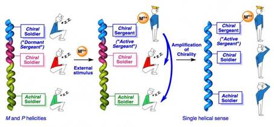 |
| Scheme: Activation of the “dormant sergeant” by an external stimulus |
Abstract:
This research, published in the prestigious Chemical Science, describes novel properties of chiral amplification. In these new copolymers with chiral and achiral units, the "sergeants and soldiers effect" is activated or deactivated at will by the presence of metal ions. They can also become encapsulating nanospheres with controlled size and chirality.
CIQUS researchers control the activation and deactivation of the "sergeants - soldiers effect" in helical polymers by the addition of metal ions
Santiago de Compostela | Posted on May 9th, 2014The prestigious journal Chemical Science has recently published a work by CIQUS researchers (University of Santiago de Compostela, Spain), which it will help to understand the transmission of the structural information between the molecules of helical polymers.
Currently, it is known the "Sergeants and Soldiers effect" in helical copolymers is a chiral amplification phenomenon where a small amount of a chiral monomer in the copolymer is capable to induce a single helical structure.
This work presents a family of copolymers where the chiral amplification based on the "Sergeants and Soldiers effect" can be switched ON/OFF by the presence/absence of metal ions. But in these copolymers, the chiral component does not trigger the chiral amplification by itself — it does not act as a "Sergeant" — until a small amount of a metal ion is added. This allows the selective induction, through chiral amplification, of any of the two helical senses (M or P) on a single copolymer just by selecting the type of ion.
Remarkably, these copolymers also allows the aggregation and encapsulation properties reported for the homopolymers as a result of the cross-linking role played by the metal cations that does not affect the "Sergeants and Soldiers effect" here reported copolymers where the "Sergeants and Soldiers effect" can be switched ON and OFF by the presence of a metal ion. These copolymers have been prepared by a combination of achiral and chiral monomer units, where the chiral ones are unable to drive the chiral amplification unless a small amount of mono- or divalent metal ions is added.
This work, developed by Félix Freire, a member of the Research Group NanoBioMol group, led by Professors Ricardo Riguera and Emilio Quiñoá, belongs to a research line focused on the study of new sensors based on smart polymers that respond to external stimuli. They have already published previous results in prestigious chemistry scientific journals as Angewandte Chemie (2010 and 2011), Journal of the American Chemical Society (2012) and Chemical Science (2013).
####
For more information, please click here
Contacts:
Fernando Casal
Copyright © CIQUS
If you have a comment, please Contact us.Issuers of news releases, not 7th Wave, Inc. or Nanotechnology Now, are solely responsible for the accuracy of the content.
Bookmark:


| Related Links |
| Related News Press |
News and information
 Quantum computer improves AI predictions April 17th, 2026
Flexible sensor gains sensitivity under pressure April 17th, 2026
A reusable chip for particulate matter sensing April 17th, 2026
Detecting vibrational quantum beating in the predissociation dynamics of SF6 using time-resolved photoelectron spectroscopy April 17th, 2026
Chemistry
Projecting light to dispense liquids: A new route to ultra-precise microdroplets January 30th, 2026
From sensors to smart systems: the rise of AI-driven photonic noses January 30th, 2026
"Nanoreactor" cage uses visible light for catalytic and ultra-selective cross-cycloadditions October 3rd, 2025
Cambridge chemists discover simple way to build bigger molecules – one carbon at a time June 6th, 2025
Discoveries
Quantum computer improves AI predictions April 17th, 2026
Flexible sensor gains sensitivity under pressure April 17th, 2026
A reusable chip for particulate matter sensing April 17th, 2026
Detecting vibrational quantum beating in the predissociation dynamics of SF6 using time-resolved photoelectron spectroscopy April 17th, 2026
Materials/Metamaterials/Magnetoresistance
First real-time observation of two-dimensional melting process: Researchers at Mainz University unveil new insights into magnetic vortex structures August 8th, 2025
Researchers unveil a groundbreaking clay-based solution to capture carbon dioxide and combat climate change June 6th, 2025
A 1960s idea inspires NBI researchers to study hitherto inaccessible quantum states June 6th, 2025
Institute for Nanoscience hosts annual proposal planning meeting May 16th, 2025
Announcements
A fundamentally new therapeutic approach to cystic fibrosis: Nanobody repairs cellular defect April 17th, 2026
UC Irvine physicists discover method to reverse ‘quantum scrambling’ : The work addresses the problem of information loss in quantum computing system April 17th, 2026
Interviews/Book Reviews/Essays/Reports/Podcasts/Journals/White papers/Posters
A fundamentally new therapeutic approach to cystic fibrosis: Nanobody repairs cellular defect April 17th, 2026
UC Irvine physicists discover method to reverse ‘quantum scrambling’ : The work addresses the problem of information loss in quantum computing system April 17th, 2026
 |
||
 |
||
| The latest news from around the world, FREE | ||
 |
||
|
|
||
| Premium Products | ||
 |
||
|
Only the news you want to read!
Learn More |
||
 |
||
|
Full-service, expert consulting
Learn More |
||
|
|
||