Home > Press > A Lab in Your Pocket
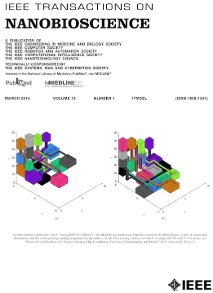 |
| The cover of IEEE Transactions on Nanobiosciences featured Shiyan Hu's research on using CAD to create labs-on-a-chip that could run dozens of medical tests in minutes. |
Abstract:
When you get sick, your physician may take a sample of your blood, send it to the lab and wait for results. In the near future, however, doctors may be able to run those tests almost instantly on a piece of plastic about the size of credit card.
A Lab in Your Pocket
Houghton, MI | Posted on May 7th, 2014These labs-on-a-chip would not only be quick—results are available in minutes—but also inexpensive and portable. They could be used miles from the nearest medical clinic to test for anything from HIV to diabetes. But as powerful as they may be, they could be far better, says Shiyan Hu, an associate professor of electrical and computer engineering at Michigan Technological University.
Generally, a lab-on-a-chip (LOC) can run no more than a test or two. That's because the chips are designed manually, says Hu. If the LOC were made using computer-aided design, you could run dozens of tests with a single drop of blood.
"In a very short time, you could test for many conditions," he said. "This really would be an entire lab on a chip."
With PhD student Chen Liao, Hu has taken the first step. "We have developed software to design the hardware," he said. Their work focuses on routing the droplet of blood or other fluid through each test on the chip efficiently while avoiding any chip contamination.
"It has taken us four years to do the software, but to manufacture the LOC would be inexpensive," Hu said. "The materials are very cheap, and the results are more accurate than a conventional lab's."
Ultimately, Hu aims to fabricate their own biochip using their software.
####
About Michigan Technological University
Michigan Technological University (www.mtu.edu) is a leading public research university developing new technologies and preparing students to create the future for a prosperous and sustainable world. Michigan Tech offers more than 130 undergraduate and graduate degree programs in engineering; forest resources; computing; technology; business; economics; natural, physical and environmental sciences; arts; humanities; and social sciences.
For more information, please click here
Contacts:
Marcia Goodrich
906-487-2343
Copyright © Michigan Technological University
If you have a comment, please Contact us.Issuers of news releases, not 7th Wave, Inc. or Nanotechnology Now, are solely responsible for the accuracy of the content.
Bookmark:


| Related Links |
| Related News Press |
News and information
 Quantum computer improves AI predictions April 17th, 2026
Flexible sensor gains sensitivity under pressure April 17th, 2026
A reusable chip for particulate matter sensing April 17th, 2026
Detecting vibrational quantum beating in the predissociation dynamics of SF6 using time-resolved photoelectron spectroscopy April 17th, 2026
Lab-on-a-chip
Micro-scale opto-thermo-mechanical actuation in the dry adhesive regime Peer-Reviewed Publication September 24th, 2021
Silicon-graphene hybrid plasmonic waveguide photodetectors beyond 1.55 μm March 13th, 2020
Nanomedicine
A fundamentally new therapeutic approach to cystic fibrosis: Nanobody repairs cellular defect April 17th, 2026
New molecular technology targets tumors and simultaneously silences two ‘undruggable’ cancer genes August 8th, 2025
New imaging approach transforms study of bacterial biofilms August 8th, 2025
Electrifying results shed light on graphene foam as a potential material for lab grown cartilage June 6th, 2025
Discoveries
Quantum computer improves AI predictions April 17th, 2026
Flexible sensor gains sensitivity under pressure April 17th, 2026
A reusable chip for particulate matter sensing April 17th, 2026
Detecting vibrational quantum beating in the predissociation dynamics of SF6 using time-resolved photoelectron spectroscopy April 17th, 2026
Announcements
A fundamentally new therapeutic approach to cystic fibrosis: Nanobody repairs cellular defect April 17th, 2026
UC Irvine physicists discover method to reverse ‘quantum scrambling’ : The work addresses the problem of information loss in quantum computing system April 17th, 2026
Interviews/Book Reviews/Essays/Reports/Podcasts/Journals/White papers/Posters
A fundamentally new therapeutic approach to cystic fibrosis: Nanobody repairs cellular defect April 17th, 2026
UC Irvine physicists discover method to reverse ‘quantum scrambling’ : The work addresses the problem of information loss in quantum computing system April 17th, 2026
 |
||
 |
||
| The latest news from around the world, FREE | ||
 |
||
|
|
||
| Premium Products | ||
 |
||
|
Only the news you want to read!
Learn More |
||
 |
||
|
Full-service, expert consulting
Learn More |
||
|
|
||