Home > Press > Miracle cure made from plants: Nanocellulose sponges to combat oil pollution
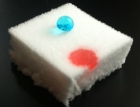 |
| Demonstration of the oleophilic and at the same time hydrophobic properties of a silylated nanocellulose sponge: A droplet of water (blue) sits on the surface, whereas a droplet of oil (red) is absorbed by the material. Image: Empa |
Abstract:
A new, absorbable material from Empa wood research could be of assistance in future oil spill accidents: a chemically modified nanocellulose sponge. The light material absorbs the oil spill, remains floating on the surface and can then be recovered. The absorbent can be produced in an environmentally-friendly manner from recycled paper, wood or agricultural by-products.
Miracle cure made from plants: Nanocellulose sponges to combat oil pollution
Duebendorf, Switzerland | Posted on May 6th, 2014All industrial nations need large volumes of oil which is normally delivered by ocean-going tankers or via inland waterways to its destination. The most environmentally-friendly way of cleaning up nature after an oil spill accident is to absorb and recover the floating film of oil. The Empa researchers Tanja Zimmermann and Philippe Tingaut, in collaboration with Gilles Sèbe from the University of Bordeaux, have now succeeded in developing a highly absorbent material which separates the oil film from the water and can then be easily recovered, "silylated" nanocellulose sponge. In laboratory tests the sponges absorbed up to 50 times their own weight of mineral oil or engine oil. They kept their shape to such an extent that they could be removed with pincers from the water. The next step is to fine tune the sponges so that they can be used not only on a laboratory scale but also in real disasters. To this end, a partner from industry is currently seeked.
One step production - from cellulose plants
Nanofibrillated Cellulose (NFC), the basic material for the sponges, is extracted from cellulose-containing materials like wood pulp, agricultural by products (such as straw) or waste materials (such as recycled paper) by adding water to them and pressing the aqueous pulp through several narrow nozzles at high pressure. This produces a suspension with gel-like properties containing long and interconnected cellulose nanofibres .
When the water from the gel is replaced with air by freeze-drying, a nanocellulose sponge is formed which absorbs both water and oil. This pristine material sinks in water and is thus not useful for the envisaged purpose. The Empa researchers have succeeded in modifying the chemical properties of the nanocellulose in just one process step by admixing a reactive alkoxysilane molecule in the gel before freeze-drying. The nanocellulose sponge loses its hydrophilic properties, is no longer suffused with water and only binds with oily substances.
In the laboratory the "silylated" nanocellulose sponge absorbed test substances like engine oil, silicone oil, ethanol, acetone or chloroform within seconds. Nanofibrillated cellulose sponge, therefore, reconciles several desirable properties: it is absorbent, floats reliably on water even when fully saturated and is biodegradable.
####
For more information, please click here
Contacts:
Rainer Klose
41-587-654-733
Copyright © EMPA
If you have a comment, please Contact us.Issuers of news releases, not 7th Wave, Inc. or Nanotechnology Now, are solely responsible for the accuracy of the content.
Bookmark:


| Related Links |
| Related News Press |
News and information
 Quantum computer improves AI predictions April 17th, 2026
Flexible sensor gains sensitivity under pressure April 17th, 2026
A reusable chip for particulate matter sensing April 17th, 2026
Detecting vibrational quantum beating in the predissociation dynamics of SF6 using time-resolved photoelectron spectroscopy April 17th, 2026
Discoveries
Quantum computer improves AI predictions April 17th, 2026
Flexible sensor gains sensitivity under pressure April 17th, 2026
A reusable chip for particulate matter sensing April 17th, 2026
Detecting vibrational quantum beating in the predissociation dynamics of SF6 using time-resolved photoelectron spectroscopy April 17th, 2026
Materials/Metamaterials/Magnetoresistance
First real-time observation of two-dimensional melting process: Researchers at Mainz University unveil new insights into magnetic vortex structures August 8th, 2025
Researchers unveil a groundbreaking clay-based solution to capture carbon dioxide and combat climate change June 6th, 2025
A 1960s idea inspires NBI researchers to study hitherto inaccessible quantum states June 6th, 2025
Institute for Nanoscience hosts annual proposal planning meeting May 16th, 2025
Announcements
A fundamentally new therapeutic approach to cystic fibrosis: Nanobody repairs cellular defect April 17th, 2026
UC Irvine physicists discover method to reverse ‘quantum scrambling’ : The work addresses the problem of information loss in quantum computing system April 17th, 2026
Interviews/Book Reviews/Essays/Reports/Podcasts/Journals/White papers/Posters
A fundamentally new therapeutic approach to cystic fibrosis: Nanobody repairs cellular defect April 17th, 2026
UC Irvine physicists discover method to reverse ‘quantum scrambling’ : The work addresses the problem of information loss in quantum computing system April 17th, 2026
Environment
A reusable chip for particulate matter sensing April 17th, 2026
Researchers unveil a groundbreaking clay-based solution to capture carbon dioxide and combat climate change June 6th, 2025
Industrial
Tiny nanosheets, big leap: A new sensor detects ethanol at ultra-low levels January 30th, 2026
Quantum interference in molecule-surface collisions February 28th, 2025
Boron nitride nanotube fibers get real: Rice lab creates first heat-tolerant, stable fibers from wet-spinning process June 24th, 2022
 |
||
 |
||
| The latest news from around the world, FREE | ||
 |
||
|
|
||
| Premium Products | ||
 |
||
|
Only the news you want to read!
Learn More |
||
 |
||
|
Full-service, expert consulting
Learn More |
||
|
|
||