Home > Press > Gas Composition in Vacua
 |
Abstract:
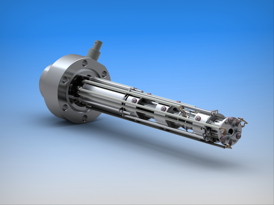
Hiden Analytical offer an extensive range of quadrupole residual gas analysers for diverse vacuum applications through the pressure range from millibar through to extreme high vacuum(XHV). The catalogue items are supplemented by a custom-engineering design service for experiment-specific requirements including in-vacuum cooling and heating, probe insertion distance and remote in-vacuum mounting.
Gas Composition in Vacua
Warrington, UK | Posted on April 10th, 2014Typical mass ranges of 1:50amu to 1:300amu accommodate most gaseous and vapour species, with alternative mass ranges to 1000amu offered for specialised applications. Analogue and pulse ion counting detectors are selectable to optimise performance for widest dynamic range of 10 decades, fastest measurement rate to 500 samples per second and highest sensitivity to 5x10E-16 millibar. Ion source options are configured for general analysis, for molecular beam applications or for minimal degas rates for UHV/XHV applications.
The single-stage mass filters are used for many general applications, with the 3F-series triple-stage mass filter being used for the most demanding applications requiring maximum performance in terms of both mass resolution and abundance sensitivity.
All operating parameters are software integrated giving full control of mass resolution, ionisation current and ionisation energies, with the soft ionisation feature being used for simplification of complex molecular fragmentation spectra.
####
For more information, please click here
Contacts:
Hiden Analytical
Copyright © Hiden Analytical Ltd
If you have a comment, please Contact us.Issuers of news releases, not 7th Wave, Inc. or Nanotechnology Now, are solely responsible for the accuracy of the content.
Bookmark:


| Related News Press |
News and information
 Quantum computer improves AI predictions April 17th, 2026
Flexible sensor gains sensitivity under pressure April 17th, 2026
A reusable chip for particulate matter sensing April 17th, 2026
Detecting vibrational quantum beating in the predissociation dynamics of SF6 using time-resolved photoelectron spectroscopy April 17th, 2026
Announcements
A fundamentally new therapeutic approach to cystic fibrosis: Nanobody repairs cellular defect April 17th, 2026
UC Irvine physicists discover method to reverse ‘quantum scrambling’ : The work addresses the problem of information loss in quantum computing system April 17th, 2026
Tools
Metasurfaces smooth light to boost magnetic sensing precision January 30th, 2026
From sensors to smart systems: the rise of AI-driven photonic noses January 30th, 2026
Japan launches fully domestically produced quantum computer: Expo visitors to experience quantum computing firsthand August 8th, 2025
 |
||
 |
||
| The latest news from around the world, FREE | ||
 |
||
|
|
||
| Premium Products | ||
 |
||
|
Only the news you want to read!
Learn More |
||
 |
||
|
Full-service, expert consulting
Learn More |
||
|
|
||