Home > Press > Diamond Defect Boosts Quantum Technology
 |
Abstract:
New research shows that a remarkable defect in synthetic diamond produced by chemical vapor deposition allows researchers to measure, witness, and potentially manipulate electrons in a manner that could lead to new "quantum technology" for information processing. The study is published in the January 31, 2014, issue of Physical Review Letters.
Diamond Defect Boosts Quantum Technology
Washington, DC | Posted on February 4th, 2014Normal computers process bits, the fundamental ones and zeros, one at a time. But in quantum computing, a "qubit" can be a one or a zero at the same time. This duplicitous state can allow multitasking at an astounding rate, which could exponentially increase the computing capacity of a tiny, tiny machine.
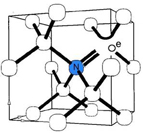
An "NV-" center can be created within a diamond's scaffold-like structure by replacing a missing carbon atom with a nitrogen atom (N)that has trapped an electron making the center negatively charged. Scientists can monitor the center's behavior and thereby provide a window for understanding how electrons respond to different conditions. The center has the potential to serve as a qubit in future quantum computers.
Electrons occupy different orbits around their atom and, by analogy, spin like the Earth. For the first time, Struzhkin and his team, led by Marcus Doherty of the Australian National University, observed what happens to electrons in these NV- centers under high-pressure and normal temperatures. Coauthor of the study, Viktor Struzhkin at the Carnegie Institution for Science, explained: "Our technique offers a powerful new tool for analyzing and manipulating electrons to advance our understanding of high-pressure superconductivity, as well as magnetic and electrical properties."
Struzhkin and team subjected single-crystal diamonds to pressures up to 600,000 times atmospheric pressure at sea level (60 gigapascals, GPa) in a diamond anvil cell and observed how electron spin and motion were affected. They optically excited the NV- centers with light and scanned microwave frequencies in a process called optically detected magnetic resonance to determine any changes. The NV- center is very sensitive to magnetic fields, electrical fields, and stress.
Until now, researchers thought that the orbits of the electrons that contribute to the defect's electronic structure and spin dynamics were localized to the area immediately surrounding the vacancy. Doherty explained: "Our team found instead that the electrons also orbit more distant atoms and that the span of their orbits contract with increasing pressure."
In addition to overturning previous beliefs about the electron orbits, the researchers found a sensitive means to measure pressure. This method can detect changes in pressure of about 10 atmospheres in one second, even up to pressures of 500,000 atmospheres (50 GPa).
"This work demonstrates that defects in diamond have great potential as quantum sensors of high pressure phenomena and, conversely, that high pressure can be employed to study the quantum phenomena of the defects," remarked Doherty.
###
This work was supported by BES/DOE, DOE-NNSA, the Australian Research Council Discovery Project, Centre of Excellence for Quantum Computation and Communications Technology, and the Alexander von Humboldt Foundation.
####
About Carnegie Institution
The Carnegie Institution for Science is a private, nonprofit organization headquartered in Washington, D.C., with six research departments throughout the U.S. Since its founding in 1902, the Carnegie Institution has been a pioneering force in basic scientific research. Carnegie scientists are leaders in plant biology, developmental biology, astronomy, materials science, global ecology, and Earth and planetary science.
For more information, please click here
Contacts:
Viktor Struzhkin
202-478-8952
Copyright © Carnegie Institution
If you have a comment, please Contact us.Issuers of news releases, not 7th Wave, Inc. or Nanotechnology Now, are solely responsible for the accuracy of the content.
Bookmark:


| Related News Press |
News and information
 Quantum computer improves AI predictions April 17th, 2026
Flexible sensor gains sensitivity under pressure April 17th, 2026
A reusable chip for particulate matter sensing April 17th, 2026
Detecting vibrational quantum beating in the predissociation dynamics of SF6 using time-resolved photoelectron spectroscopy April 17th, 2026
Govt.-Legislation/Regulation/Funding/Policy
Quantum computer improves AI predictions April 17th, 2026
Metasurfaces smooth light to boost magnetic sensing precision January 30th, 2026
New imaging approach transforms study of bacterial biofilms August 8th, 2025
Possible Futures
A fundamentally new therapeutic approach to cystic fibrosis: Nanobody repairs cellular defect April 17th, 2026
UC Irvine physicists discover method to reverse ‘quantum scrambling’ : The work addresses the problem of information loss in quantum computing system April 17th, 2026
Chip Technology
A reusable chip for particulate matter sensing April 17th, 2026
Metasurfaces smooth light to boost magnetic sensing precision January 30th, 2026
Quantum Computing
Quantum computer improves AI predictions April 17th, 2026
UC Irvine physicists discover method to reverse ‘quantum scrambling’ : The work addresses the problem of information loss in quantum computing system April 17th, 2026
Researchers develop molecular qubits that communicate at telecom frequencies October 3rd, 2025
Sensors
Flexible sensor gains sensitivity under pressure April 17th, 2026
Tiny nanosheets, big leap: A new sensor detects ethanol at ultra-low levels January 30th, 2026
From sensors to smart systems: the rise of AI-driven photonic noses January 30th, 2026
Sensors innovations for smart lithium-based batteries: advancements, opportunities, and potential challenges August 8th, 2025
Discoveries
Quantum computer improves AI predictions April 17th, 2026
Flexible sensor gains sensitivity under pressure April 17th, 2026
A reusable chip for particulate matter sensing April 17th, 2026
Detecting vibrational quantum beating in the predissociation dynamics of SF6 using time-resolved photoelectron spectroscopy April 17th, 2026
Announcements
A fundamentally new therapeutic approach to cystic fibrosis: Nanobody repairs cellular defect April 17th, 2026
UC Irvine physicists discover method to reverse ‘quantum scrambling’ : The work addresses the problem of information loss in quantum computing system April 17th, 2026
Interviews/Book Reviews/Essays/Reports/Podcasts/Journals/White papers/Posters
A fundamentally new therapeutic approach to cystic fibrosis: Nanobody repairs cellular defect April 17th, 2026
UC Irvine physicists discover method to reverse ‘quantum scrambling’ : The work addresses the problem of information loss in quantum computing system April 17th, 2026
Grants/Sponsored Research/Awards/Scholarships/Gifts/Contests/Honors/Records
Quantum computer improves AI predictions April 17th, 2026
Detecting vibrational quantum beating in the predissociation dynamics of SF6 using time-resolved photoelectron spectroscopy April 17th, 2026
Metasurfaces smooth light to boost magnetic sensing precision January 30th, 2026
Quantum nanoscience
Beyond silicon: Electronics at the scale of a single molecule January 30th, 2026
MXene nanomaterials enter a new dimension Multilayer nanomaterial: MXene flakes created at Drexel University show new promise as 1D scrolls January 30th, 2026
ICFO researchers overcome long-standing bottleneck in single photon detection with twisted 2D materials August 8th, 2025
 |
||
 |
||
| The latest news from around the world, FREE | ||
 |
||
|
|
||
| Premium Products | ||
 |
||
|
Only the news you want to read!
Learn More |
||
 |
||
|
Full-service, expert consulting
Learn More |
||
|
|
||