Home > Press > Edison electrifies scientific computing: NERSC Flips Switch on New Flagship Supercomputer
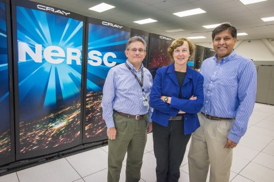 |
| Jeff Broughton, NERSC deputy for operations and leader of the Edison procurement; Kathy Yelick, associate laboratory director for computing sciences at Berkeley Lab; and Sudip Dosanjh, NERSC division director, pose with Edison, NERSC’s new flagship supercomputer. Select to enlarge. Photos: Roy Kaltschmidt, LBNL |
Abstract:
The National Energy Research Scientific Computing (NERSC) Center recently accepted "Edison," a new flagship supercomputer designed for scientific productivity.
Edison electrifies scientific computing: NERSC Flips Switch on New Flagship Supercomputer
Berkeley, CA | Posted on January 30th, 2014About 5,000 researchers working on 700 projects and running 600 different codes compute at NERSC, which is operated by Berkeley Lab. They produce an average of 1,700 peer-reviewed publications every year, making NERSC the most productive scientific computing center serving the Department of Energy's Office of Science.
"We support a very broad range of science, from basic energy research to climate science, from biosciences to discovering new materials, exploring high energy physics and even uncovering the very origins of the universe," said NERSC Director Sudip Dosanjh.
Edison can execute nearly 2.4 quadrillion floating-point operations per second (petaflop/s) at peak theoretical speeds. While theoretical speeds are impressive, "NERSC's longstanding approach is to evaluate proposed systems by how well they meet the needs of our diverse community of researchers, so we focus on sustained performance on real applications," said NERSC Division Deputy for Operations Jeff Broughton, who led the Edison procurement team.
"For us, what's really important is the scientific productivity of our users," Dosanjh said. That's why Edison was configured to handle two kinds of computing equally well: data analysis and simulation and modeling.
Data Analysis Joins Simulation and Modeling
Traditionally, scientific supercomputers are configured to simulate and model complex phenomena, such as nanomaterials converting electricity into photons of light, climate changing over decades or centuries, or interstellar gases forming into stars and galaxies. Simulations require a lot of processors running in unison, but not necessarily a lot of memory for each processor.
Data analysis, such as genome sequencing or molecular screening programs that search for promising new materials or drugs, often involves high throughput computing—running large numbers of loosely coupled simulations simultaneously. Such "ensemble computing" requires more memory per node and has typically been relegated to separate computer clusters. As instruments and experiments deliver more and more data however, scientists need more computing power to crunch it; so smaller clusters no longer suffice.
"Facilities throughout the Department of Energy are being inundated with data that researchers don't have the ability to understand, process or analyze sufficiently," said Dosanjh. Historically, NERSC was an exporter of data as scientists ran large-scale simulations and then moved that data to other sites. But with the growth of experimental data coming from other sites, NERSC is now a net importer, taking in a petabyte of data in fields such as biosciences, climate and high-energy physics each month.
Both types of computing rely heavily on moving data, said Dosanjh. "So Edison has been optimized for that: It has a really high-speed interconnect, it has lots of memory bandwidth, lots of memory per node, and it has very high input/output speeds to the file system and disk system."
"If you have a computing resource like Edison, one with the flexibility to run different classes of problems, then you can apply the full capacity of your system to the problem at hand, whether that be high-throughput genome sequencing or highly parallel climate simulations," said Broughton.
Less Time Tweaking Codes, More Time Doing Science
Because Edison does not employ accelerators, such as graphics processing units (GPUs), scientists have been able to move their codes from NERSC's previous flagship system (a Cray XE6 named for computer scientist Grace Hopper) to Edison with little or no changes, another consideration meant to keep scientists doing science instead of rewriting code.
"We were able to open Edison to all our users shortly after installation for testing, and the system was immediately full," said Broughton. By the time Edison was accepted and placed into production, scientists had logged millions of processor hours of research into areas as varied as carbon sequestration, nanomaterials, cosmology, and combustion.
And while researchers may not see or appreciate Edison's advances in energy efficiency, it will impact their ability to do science. "In coming years, performance will be more limited by power than anything else, so energy efficiency is critical," said Dosanjh.
Free Cooling
In preparation for its 2015 move into a custom-built data center (the Computational Research and Theory facility), Edison is the first supercomputer at NERSC to rely solely on outside air for cooling, a technique known as "free cooling." Edison is cooled without mechanical chillers. Instead water is circulated through outdoor cooling towers and back into the system's internal radiators, which cool air rather than heat it. Fans located between each pair of cabinets in a row pull air in one end; circulate it through a radiator, over the hot components and on to the next set of cabinets before it exits at the row's end. This side-to-side airflow, or transverse cooling, is more energy efficient than the typical front-to-back flow of most systems.
Dedication February 5
Edison will be dedicated on Ferbruary 5 as part of the annual NERSC Users Group being held February 3-6 at Berkeley Lab (»More information). "As we celebrate NERSC's 40th anniversary, it's quite fitting we start the year by dedicating Edison, a system that embodies our guiding principle over the last four decades: computing in the service of science," said NERSC director Dosanjh.
Deployment of Edison was made possible in part by funding from DOE's Office of Science and the DARPA High Productivity Computing Systems program.
DOE's Office of Science is the single largest supporter of basic research in the physical sciences in the United States, and is working to address some of the most pressing challenges of our time. For more information, please visit science.energy.gov.
####
About DOE/Lawrence Berkeley National Laboratory
The National Energy Research Scientific Computing Center (NERSC) is the primary high-performance computing facility for scientific research sponsored by the U.S. Department of Energy's Office of Science. Located at Lawrence Berkeley National Laboratory, the NERSC Center serves more than 4,000 scientists at national laboratories and universities researching a wide range of problems in combustion, climate modeling, fusion energy, materials science, physics, chemistry, computational biology, and other disciplines. Berkeley Lab is a U.S. Department of Energy national laboratory located in Berkeley, California. It conducts unclassified scientific research and is managed by the University of California for the U.S. DOE Office of Science. »Learn more about computing sciences at Berkeley Lab.
For more information, please click here
Contacts:
Margie Wylie
510-486-7421
Copyright © DOE/Lawrence Berkeley National Laboratory
If you have a comment, please Contact us.Issuers of news releases, not 7th Wave, Inc. or Nanotechnology Now, are solely responsible for the accuracy of the content.
Bookmark:


| Related Links |
 For more details, see “Saving Energy with ‘Free’ Cooling and the Cray XC30” PDF
| Related News Press |
News and information
Quantum computer improves AI predictions April 17th, 2026
Flexible sensor gains sensitivity under pressure April 17th, 2026
A reusable chip for particulate matter sensing April 17th, 2026
Detecting vibrational quantum beating in the predissociation dynamics of SF6 using time-resolved photoelectron spectroscopy April 17th, 2026
Laboratories
Researchers develop molecular qubits that communicate at telecom frequencies October 3rd, 2025
A battery’s hopping ions remember where they’ve been: Seen in atomic detail, the seemingly smooth flow of ions through a battery’s electrolyte is surprisingly complicated February 16th, 2024
Govt.-Legislation/Regulation/Funding/Policy
Quantum computer improves AI predictions April 17th, 2026
Metasurfaces smooth light to boost magnetic sensing precision January 30th, 2026
New imaging approach transforms study of bacterial biofilms August 8th, 2025
Announcements
A fundamentally new therapeutic approach to cystic fibrosis: Nanobody repairs cellular defect April 17th, 2026
UC Irvine physicists discover method to reverse ‘quantum scrambling’ : The work addresses the problem of information loss in quantum computing system April 17th, 2026
Energy
Sensors innovations for smart lithium-based batteries: advancements, opportunities, and potential challenges August 8th, 2025
Simple algorithm paired with standard imaging tool could predict failure in lithium metal batteries August 8th, 2025
Photonics/Optics/Lasers
Metasurfaces smooth light to boost magnetic sensing precision January 30th, 2026
From sensors to smart systems: the rise of AI-driven photonic noses January 30th, 2026
Solar/Photovoltaic
Spinel-type sulfide semiconductors to operate the next-generation LEDs and solar cells For solar-cell absorbers and green-LED source October 3rd, 2025
KAIST researchers introduce new and improved, next-generation perovskite solar cell November 8th, 2024
Groundbreaking precision in single-molecule optoelectronics August 16th, 2024
Development of zinc oxide nanopagoda array photoelectrode: photoelectrochemical water-splitting hydrogen production January 12th, 2024
 |
||
 |
||
| The latest news from around the world, FREE | ||
 |
||
|
|
||
| Premium Products | ||
 |
||
|
Only the news you want to read!
Learn More |
||
 |
||
|
Full-service, expert consulting
Learn More |
||
|
|
||