Home > Press > Material Developed by UC San Diego Engineers Could Speed Up Underwater Communications by Orders of Magnitude
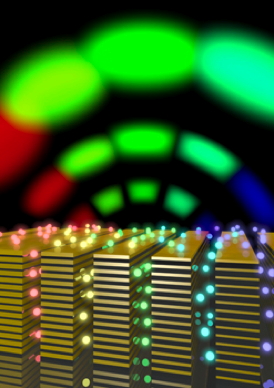 |
| Electrical engineers at UC San Diego have demonstrated that artificial materials can significantly improve the speed of optical communications. The team showed that an artificial metamaterial can increase the light density and blink speed of a flourescent light-emitting dye molecule. Image credit: Liu Research Group/UC San Diego |
Abstract:
University of California, San Diego electrical engineering professor Zhaowei Liu and colleagues have taken the first steps in a project to develop fast-blinking LED systems for underwater optical communications.
Material Developed by UC San Diego Engineers Could Speed Up Underwater Communications by Orders of Magnitude
San Diego, CA | Posted on January 24th, 2014 In a recent article in Nature Nanotechnology, Liu and colleagues show that an artificial metamaterial can increase the light intensity and "blink speed" of a fluorescent light-emitting dye molecule.
The nanopatterned layers of silver and silicon in the new material sped up the molecule's blink rate to 76 times faster than normal, while producing an 80-fold increase in its brightness.
"The major purpose of this program is to develop a better light source for communication purposes," Liu said. "But this is just a first step in the whole story. We have proved that this artificial, manmade material can be designed to enhance light emission and intensity, but the next step will be to apply this on conventional LEDs."
Extreme blinking speed - ultrafast modulation - in blue and green LEDs is a missing link that is necessary for increasing the rate at which information can be sent via optical channels through the open water, such as between ships and submarines, submarines and divers, underwater environmental sensors and unmanned underwater vehicles, or other combinations.
If dramatically improved, optical wireless communications could eventually replace underwater acoustic communications systems for short distance applications. Acoustic communications are limited by slow speed and low data rates and may possibly cause distress to whales, dolphins and other marine life. To do this, they must develop blue and green LED systems that blink one or two orders of magnitude faster than today's blue and green gallium nitride (GaN) based LEDs.
In underwater optical wireless communications systems, data is converted from an electrical signal to optical waves that travel through the water from a light source such as a LED to an optical receiver. Blinking blue and green LEDs are already used to transfer information through the water. (Blue and green LEDs are used because their light is less apt to be absorbed by the water than other colors.)
The metamaterials developed by the researchers are synthetic, with properties not found in nature, and are specially designed to accelerate the light generation process.
So far, it's been difficult to directly convert an electrical signal into an optical signal in LEDs with adequate speed. At the moment, the blink rate for most of these converted signals is less than one gigahertz, a rate slower than the speed of most WiFi signals, Liu said.
The materials are designed to have extremely strong interactions with the light emitters that are specific to the wavelength--or color--of the emissions. In the new report, the researchers used a dye molecule that gives off a yellow-green hue. So the next step will be to pair the materials with the blue and green LEDs.
"The design of the materials may not be the hardest thing," said UC San Diego graduate student Dylan Lu, the lead author of the Nature Nanotechnology paper, who noted that they will work with LEDs that have been manufactured to a specific industry standard. "I think the major challenge, to apply it to LEDs, will be an integration issue."
Liu recently won a grant from the Office of Naval Research (ONR) to develop the fast-blinking blue and green LED systems, which includes a little more than $500,000 over three years.
Along with Electrical and Computer Engineering professors Paul Yu and Eric Fullerton, Liu aims to eventually test ultrafast blinking LED configurations in San Diego's ocean waters.
"We started from advances in fundamental material research, and we want to transfer the knowledge to the LED business," said Liu.
####
For more information, please click here
Contacts:
Catherine Hockmuth
858-822-1359
Copyright © University of California - San Diego
If you have a comment, please Contact us.Issuers of news releases, not 7th Wave, Inc. or Nanotechnology Now, are solely responsible for the accuracy of the content.
Bookmark:


| Related Links |
 More Electrical and Computer Engineering News Via RSS:
| Related News Press |
News and information
Quantum computer improves AI predictions April 17th, 2026
Flexible sensor gains sensitivity under pressure April 17th, 2026
A reusable chip for particulate matter sensing April 17th, 2026
Detecting vibrational quantum beating in the predissociation dynamics of SF6 using time-resolved photoelectron spectroscopy April 17th, 2026
Display technology/LEDs/SS Lighting/OLEDs
Spinel-type sulfide semiconductors to operate the next-generation LEDs and solar cells For solar-cell absorbers and green-LED source October 3rd, 2025
Efficient and stable hybrid perovskite-organic light-emitting diodes with external quantum efficiency exceeding 40 per cent July 5th, 2024
Wireless/telecommunications/RF/Antennas/Microwaves
Researchers develop molecular qubits that communicate at telecom frequencies October 3rd, 2025
Govt.-Legislation/Regulation/Funding/Policy
Quantum computer improves AI predictions April 17th, 2026
Metasurfaces smooth light to boost magnetic sensing precision January 30th, 2026
New imaging approach transforms study of bacterial biofilms August 8th, 2025
Discoveries
Quantum computer improves AI predictions April 17th, 2026
Flexible sensor gains sensitivity under pressure April 17th, 2026
A reusable chip for particulate matter sensing April 17th, 2026
Detecting vibrational quantum beating in the predissociation dynamics of SF6 using time-resolved photoelectron spectroscopy April 17th, 2026
Announcements
A fundamentally new therapeutic approach to cystic fibrosis: Nanobody repairs cellular defect April 17th, 2026
UC Irvine physicists discover method to reverse ‘quantum scrambling’ : The work addresses the problem of information loss in quantum computing system April 17th, 2026
Interviews/Book Reviews/Essays/Reports/Podcasts/Journals/White papers/Posters
A fundamentally new therapeutic approach to cystic fibrosis: Nanobody repairs cellular defect April 17th, 2026
UC Irvine physicists discover method to reverse ‘quantum scrambling’ : The work addresses the problem of information loss in quantum computing system April 17th, 2026
Military
Quantum engineers ‘squeeze’ laser frequency combs to make more sensitive gas sensors January 17th, 2025
Chainmail-like material could be the future of armor: First 2D mechanically interlocked polymer exhibits exceptional flexibility and strength January 17th, 2025
Single atoms show their true color July 5th, 2024
NRL charters Navy’s quantum inertial navigation path to reduce drift April 5th, 2024
Grants/Sponsored Research/Awards/Scholarships/Gifts/Contests/Honors/Records
Quantum computer improves AI predictions April 17th, 2026
Detecting vibrational quantum beating in the predissociation dynamics of SF6 using time-resolved photoelectron spectroscopy April 17th, 2026
Metasurfaces smooth light to boost magnetic sensing precision January 30th, 2026
Photonics/Optics/Lasers
Metasurfaces smooth light to boost magnetic sensing precision January 30th, 2026
From sensors to smart systems: the rise of AI-driven photonic noses January 30th, 2026
 |
||
 |
||
| The latest news from around the world, FREE | ||
 |
||
|
|
||
| Premium Products | ||
 |
||
|
Only the news you want to read!
Learn More |
||
 |
||
|
Full-service, expert consulting
Learn More |
||
|
|
||