Home > Press > The University of Valencia creates a low cost thin film photovoltaic device with high energy efficiency
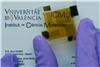 |
| Thin film photovoltaic device |
Abstract:
A group of researchers led by Hendrik Bolink of the Institut de Ciència Molecular (ICMol) of the Scientific Park of the University of Valencia has developed a thin film low cost photovoltaic device with high power conversion efficiency. The results of this work, done in collaboration with researchers of École Polytechnique Fédérale de Lausanne (EPFL) in Switzerland, were published in the scientific magazine Nature Photonics.
The University of Valencia creates a low cost thin film photovoltaic device with high energy efficiency
Valencia, Spain | Posted on December 27th, 2013The solar cell developed by the researchers of the ICMol consists of a thin perovskite film sandwiched in between two very thin organic semiconductors. The total thickness of the device is less than half a micrometer, less than a millions' part of a meter. The hybrid organic-inorganic perovskite material can be prepared easily and at low cost. Hendrik Bolink explains that these devices were prepared with low temperature processes similar to those used in the printing industry which allows the use of plastic substrates such that flexible devices can be prepared.
It is also possible to make the device semitransparent which allows their integration with building facades since they are very thin and light weight. In this way the sun light is filtered protecting the building interior from intense sun light while at the same electricity is generated.
An 85% of the solar cells that convert sun light into electricity are based on crystalline silicon, an expensive material, whereas the rest use polycrystalline thin film cells, mostly cadmium telluride/cadmium sulfide. These thin film cells are cheaper to produce yet are based on rare and rather toxic elements. Therefore, "the demonstration of high efficiency in thin film solar cells based on abundantly available and cheap materials like as used in these perovskite based solar cells, allows for an increasing share of solar energy in the mix of renewable resources" according to Dr. Bolink.
Dr. Bolink obtained his PhD in Materials Science at the University of Groningen, The Netherlands in 1997. He worked at the chemical multinational DSM as a materials scientist and project manager in the central research and new business development department, respectively. In 2001 he joined Philips, to lead the materials development activity of Philips´s PolyLED project.
Since 2003 Dr. Bolink is at the ICMol of the University of Valencia where he initiated a research line on molecular opto-eletronic devices. He has published 125 scientific papers in international journals and has been main scientist in eleven European research projects, currently three of them are still active.
Full bibliographic information
Perovskite solar cells employing organic charge transport layers. O. Malinkiewicz, Y. Aswani, Y. H. Lee, M. Minguez Espallargas, M. Graetzel, M. K. Nazeeruddin and H. J. Bolink. Nature Photonics DOI 10.1038/nphoton.2013.341
####
For more information, please click here
Contacts:
Lauren Kelly Wickman
+34 963877978
Copyright © AlphaGalileo
If you have a comment, please Contact us.Issuers of news releases, not 7th Wave, Inc. or Nanotechnology Now, are solely responsible for the accuracy of the content.
Bookmark:


| Related News Press |
News and information
 Quantum computer improves AI predictions April 17th, 2026
Flexible sensor gains sensitivity under pressure April 17th, 2026
A reusable chip for particulate matter sensing April 17th, 2026
Detecting vibrational quantum beating in the predissociation dynamics of SF6 using time-resolved photoelectron spectroscopy April 17th, 2026
Thin films
Tiny nanosheets, big leap: A new sensor detects ethanol at ultra-low levels January 30th, 2026
Utilizing palladium for addressing contact issues of buried oxide thin film transistors April 5th, 2024
Understanding the mechanism of non-uniform formation of diamond film on tools: Paving the way to a dry process with less environmental impact March 24th, 2023
New study introduces the best graphite films: The work by Distinguished Professor Feng Ding at UNIST has been published in the October 2022 issue of Nature Nanotechnology November 4th, 2022
Discoveries
Quantum computer improves AI predictions April 17th, 2026
Flexible sensor gains sensitivity under pressure April 17th, 2026
A reusable chip for particulate matter sensing April 17th, 2026
Detecting vibrational quantum beating in the predissociation dynamics of SF6 using time-resolved photoelectron spectroscopy April 17th, 2026
Announcements
A fundamentally new therapeutic approach to cystic fibrosis: Nanobody repairs cellular defect April 17th, 2026
UC Irvine physicists discover method to reverse ‘quantum scrambling’ : The work addresses the problem of information loss in quantum computing system April 17th, 2026
Interviews/Book Reviews/Essays/Reports/Podcasts/Journals/White papers/Posters
A fundamentally new therapeutic approach to cystic fibrosis: Nanobody repairs cellular defect April 17th, 2026
UC Irvine physicists discover method to reverse ‘quantum scrambling’ : The work addresses the problem of information loss in quantum computing system April 17th, 2026
Energy
Sensors innovations for smart lithium-based batteries: advancements, opportunities, and potential challenges August 8th, 2025
Simple algorithm paired with standard imaging tool could predict failure in lithium metal batteries August 8th, 2025
Solar/Photovoltaic
Spinel-type sulfide semiconductors to operate the next-generation LEDs and solar cells For solar-cell absorbers and green-LED source October 3rd, 2025
KAIST researchers introduce new and improved, next-generation perovskite solar cell November 8th, 2024
Groundbreaking precision in single-molecule optoelectronics August 16th, 2024
Development of zinc oxide nanopagoda array photoelectrode: photoelectrochemical water-splitting hydrogen production January 12th, 2024
 |
||
 |
||
| The latest news from around the world, FREE | ||
 |
||
|
|
||
| Premium Products | ||
 |
||
|
Only the news you want to read!
Learn More |
||
 |
||
|
Full-service, expert consulting
Learn More |
||
|
|
||