Home > Press > New magnetic behavior in nanoparticles could lead to even smaller digital memories
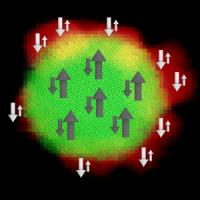 |
| This is a schematic representation of the antiferromagnetic coupling between a magnetic Fe3O4 soft core and a magnetic Mn3O4 hard shell. The image of an electronic high-resolution transmission microscope, superimposed on a map of electronic energy loss spectroscopy, reveals the high quality of the interface with a coherent increase between the two phases.
Credit: UAB |
Abstract:
Electronic devices such as mobile phones and tablets spur on a scientific race to find smaller and smaller information processing and storage elements. One of the challenges in this race is to reproduce certain magnetic effects at nanometre scale.
New magnetic behavior in nanoparticles could lead to even smaller digital memories
Barcelona, Spain | Posted on December 19th, 2013An international collaboration of scientists led by researchers from the Universitat Autònoma de Barcelona Department of Physics and the Institut Catala de Nanociencia i Nanotecnologia, and with the participation of the Universitat de Barcelona, has been able to reproduce in particles measuring 10 to 20 nanometres a magnetic phenomenon of great importance in magnetic devices: the antiferromagnetic coupling between layers.
This phenomenon appears when coupling layers of materials with different magnetic properties, which allows controlling the magnetic behaviour of the whole device. This property has very important technological applications. For example, it forms an important part of data reading systems found in hard drives and in the MRAM memories of computers and mobile devices.
Researchers have managed for the first time to reproduce this phenomenon in nanoscopic materials, measuring a mere few tens of atoms in diameter. They managed to do this by using iron-oxide particles surrounded by a thin layer of manganese-oxide and vice versa: manganese-oxide particles covered by a layer of iron-oxide. The discovery provides an unprecedented control of the magnetic behaviour of nanoparticles, since it permits controlling and easily adjusting their properties without having to manipulate their shape or composition, solely by controlling the temperature and the magnetic fields surrounding it.
"We've been able to reproduce a magnetic behaviour not previously observed in nanoparticles, and this paves the way for miniaturisation up to limits which seemed impossible for magnetic storage and other more sophisticated applications such as spin filters, magnetic codifiers and multi-level recording", explain Josep Nogués, ICREA research professor, and Maria Dolors Baró, professor of Applied Physics.
###
The research, published today in Nature Communications, included the participation of professors Maria Dolors Baró and Santiago Suriñach from the Department of Physics of the UAB; ICREA research professor Josep Nogués, from the Department of Physics of the UAB and ICN2; researchers from the Department of Inorganic Chemistry and from the Department of Electronics at the University of Barcelona (UB); researchers from the Complutense University of Madrid; the Università degli Studi di Firenze, Italy; the St. Petersburg Nuclear Physics Institute, Russia; the Stockholm University, Sweden; the NCSR in Greece; the Oak Ridge National Laboratory, USA; the Miami University, Ohio, USA; and the Argonne National Laboratory, USA.
####
For more information, please click here
Contacts:
Dolors Baró
34-935-811-657
Copyright © Universitat Autonoma de Barcelona
If you have a comment, please Contact us.Issuers of news releases, not 7th Wave, Inc. or Nanotechnology Now, are solely responsible for the accuracy of the content.
Bookmark:


| Related News Press |
News and information
 Quantum computer improves AI predictions April 17th, 2026
Flexible sensor gains sensitivity under pressure April 17th, 2026
A reusable chip for particulate matter sensing April 17th, 2026
Detecting vibrational quantum beating in the predissociation dynamics of SF6 using time-resolved photoelectron spectroscopy April 17th, 2026
Imaging
Simple algorithm paired with standard imaging tool could predict failure in lithium metal batteries August 8th, 2025
First real-time observation of two-dimensional melting process: Researchers at Mainz University unveil new insights into magnetic vortex structures August 8th, 2025
New imaging approach transforms study of bacterial biofilms August 8th, 2025
Laboratories
Researchers develop molecular qubits that communicate at telecom frequencies October 3rd, 2025
Govt.-Legislation/Regulation/Funding/Policy
Quantum computer improves AI predictions April 17th, 2026
Metasurfaces smooth light to boost magnetic sensing precision January 30th, 2026
New imaging approach transforms study of bacterial biofilms August 8th, 2025
Chip Technology
A reusable chip for particulate matter sensing April 17th, 2026
Metasurfaces smooth light to boost magnetic sensing precision January 30th, 2026
Memory Technology
Researchers tackle the memory bottleneck stalling quantum computing October 3rd, 2025
First real-time observation of two-dimensional melting process: Researchers at Mainz University unveil new insights into magnetic vortex structures August 8th, 2025
Utilizing palladium for addressing contact issues of buried oxide thin film transistors April 5th, 2024
Discoveries
Quantum computer improves AI predictions April 17th, 2026
Flexible sensor gains sensitivity under pressure April 17th, 2026
A reusable chip for particulate matter sensing April 17th, 2026
Detecting vibrational quantum beating in the predissociation dynamics of SF6 using time-resolved photoelectron spectroscopy April 17th, 2026
Announcements
A fundamentally new therapeutic approach to cystic fibrosis: Nanobody repairs cellular defect April 17th, 2026
UC Irvine physicists discover method to reverse ‘quantum scrambling’ : The work addresses the problem of information loss in quantum computing system April 17th, 2026
Interviews/Book Reviews/Essays/Reports/Podcasts/Journals/White papers/Posters
A fundamentally new therapeutic approach to cystic fibrosis: Nanobody repairs cellular defect April 17th, 2026
UC Irvine physicists discover method to reverse ‘quantum scrambling’ : The work addresses the problem of information loss in quantum computing system April 17th, 2026
Tools
Metasurfaces smooth light to boost magnetic sensing precision January 30th, 2026
From sensors to smart systems: the rise of AI-driven photonic noses January 30th, 2026
Japan launches fully domestically produced quantum computer: Expo visitors to experience quantum computing firsthand August 8th, 2025
Research partnerships
Lab to industry: InSe wafer-scale breakthrough for future electronics August 8th, 2025
HKU physicists uncover hidden order in the quantum world through deconfined quantum critical points April 25th, 2025
 |
||
 |
||
| The latest news from around the world, FREE | ||
 |
||
|
|
||
| Premium Products | ||
 |
||
|
Only the news you want to read!
Learn More |
||
 |
||
|
Full-service, expert consulting
Learn More |
||
|
|
||