Home > Press > Accidental nanoparticle discovery could hail revolution in manufacturing
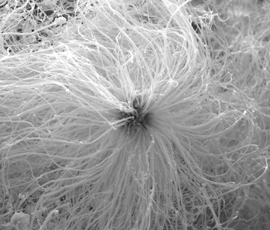 |
| Sea Urchin nanoparticle |
Abstract:
A nanoparticle shaped like a spiky ball, with magnetic properties, has been uncovered in a new method of synthesising carbon nanotubes by physicists at Queen Mary University of London and the University of Kent.
Accidental nanoparticle discovery could hail revolution in manufacturing
London, UK | Posted on September 9th, 2013Carbon nanotubes are hollow, cylindrical molecules that can be manipulated to give them useful properties. The nanoparticles were discovered accidentally on the rough surfaces of a reactor designed to grow carbon nanotubes.
Described as sea urchins because of their characteristic spiny appearance, the particles consist of nanotubes filled with iron, with equal lengths pointing outwards in all directions from a central particle.
The presence of iron and the unusual nanoparticle shape could have potential for a number of applications, such as batteries that can be charged from waste heat, mixing with polymers to make permanent magnets, or as particles for cancer therapies that use heat to kill cancerous cells.
The researchers found that the rough surfaces of the reactor were covered in a thick powder of the new nanoparticles and that intentional roughening of the surfaces produced large quantities of the sea urchin nanoparticles.
"The surprising conclusion is that the sea urchin nanoparticles grow in vapour by a mechanism that's similar to snowflake formation. Just as moist air flowing over a mountain range produces turbulence which results in a snowfall, the rough surface disrupts a flow to produce a symmetrical and ordered nanoparticle out of chaotic conditions," said Dr Mark Baxendale from Queen Mary's School of Physics and Astronomy.
On analysis, the researchers found that a small fraction of the iron inside the carbon nanotubes was a particular type usually only found in high temperature and pressure conditions.
Dr Baxendale added: "We were surprised to see this rare kind of iron inside the nanotubes. While we don't know much about its behaviour, we can see that the presence of this small fraction of iron greatly influences the magnetic properties of the nanoparticle."
The research was supported by the South East Physics Network and is published in the journal Carbon.
####
For more information, please click here
Contacts:
Neha Okhandiar
020-788-27927
Copyright © Queen Mary, University of London
If you have a comment, please Contact us.Issuers of news releases, not 7th Wave, Inc. or Nanotechnology Now, are solely responsible for the accuracy of the content.
Bookmark:


| Related Links |
| Related News Press |
News and information
 Quantum computer improves AI predictions April 17th, 2026
Flexible sensor gains sensitivity under pressure April 17th, 2026
A reusable chip for particulate matter sensing April 17th, 2026
Detecting vibrational quantum beating in the predissociation dynamics of SF6 using time-resolved photoelectron spectroscopy April 17th, 2026
Nanotubes/Buckyballs/Fullerenes/Nanorods/Nanostrings/Nanosheets
Tiny nanosheets, big leap: A new sensor detects ethanol at ultra-low levels January 30th, 2026
Enhancing power factor of p- and n-type single-walled carbon nanotubes April 25th, 2025
Chainmail-like material could be the future of armor: First 2D mechanically interlocked polymer exhibits exceptional flexibility and strength January 17th, 2025
Innovative biomimetic superhydrophobic coating combines repair and buffering properties for superior anti-erosion December 13th, 2024
Discoveries
Quantum computer improves AI predictions April 17th, 2026
Flexible sensor gains sensitivity under pressure April 17th, 2026
A reusable chip for particulate matter sensing April 17th, 2026
Detecting vibrational quantum beating in the predissociation dynamics of SF6 using time-resolved photoelectron spectroscopy April 17th, 2026
Announcements
A fundamentally new therapeutic approach to cystic fibrosis: Nanobody repairs cellular defect April 17th, 2026
UC Irvine physicists discover method to reverse ‘quantum scrambling’ : The work addresses the problem of information loss in quantum computing system April 17th, 2026
Industrial
Tiny nanosheets, big leap: A new sensor detects ethanol at ultra-low levels January 30th, 2026
Quantum interference in molecule-surface collisions February 28th, 2025
Boron nitride nanotube fibers get real: Rice lab creates first heat-tolerant, stable fibers from wet-spinning process June 24th, 2022
Research partnerships
Lab to industry: InSe wafer-scale breakthrough for future electronics August 8th, 2025
HKU physicists uncover hidden order in the quantum world through deconfined quantum critical points April 25th, 2025
 |
||
 |
||
| The latest news from around the world, FREE | ||
 |
||
|
|
||
| Premium Products | ||
 |
||
|
Only the news you want to read!
Learn More |
||
 |
||
|
Full-service, expert consulting
Learn More |
||
|
|
||