Home > Press > Anasys users publish new peer-reviewed research papers using nanoIR
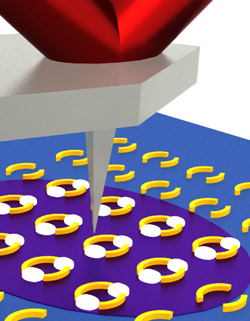 |
| Image from the referenced NIST paper: A scanning AFM tip detects the expansion of the underlying material in response to absorption of infrared light. Credit: NIST |
Abstract:
Anasys Instruments reports on three user groups who have published peer reviewed papers where nanoIR is being applied to look at characterization challenges in semiconductors, polymers and healthcare.
Anasys users publish new peer-reviewed research papers using nanoIR
Santa Barbara, CA | Posted on August 13th, 2013There have been several recent exciting publications by nanoIR users in a number of growing applications areas. These include plasmonics, health care, fuel cell membranes and polymer nanostructures. Three of these publications are reported here.
Nanoscale Imaging of Plasmonic Hot Spots and Dark Modes with the Photothermal-Induced Resonance Technique. The lead author is Dr Andrea Centrone from NIST, USA. In this publication from NIST, the AFM-IR technique is applied for the first time to image the dark plasmonic resonance of gold asymmetric split ring resonators (A-SRRs) in the mid-infrared (IR) spectral region with nanoscale resolution. Additionally, the chemically specific PTIR signal is used to map the local absorption enhancement of poly(methyl methacrylate) coated on A-SRRs, revealing hot spots with local enhancement factors up to ≈30.
Nanoscale infrared (IR) spectroscopy and imaging of structural lipids in human stratum corneum using an AFM to directly detect absorbed light from a tunable IR laser source. The lead author is Dr Gustavo Luengo of L'Oréal, France. Samples of normal and delipidized stratum corneum were studied in this work by L'Oréal together with researchers at Anasys Instruments. This shows substantially less long-chain CH2 -stretching IR absorption band intensity than in normal skin. AFM-IR images that compare absorbance values at 2930/cm (lipid) and 3290/cm (keratin) suggest that regions of higher lipid concentration are located at the perimeter of corneocytes in the normal stratum corneum.
Morphology of water transport channels and hydrophobic clusters in Nafion from high spatial resolution AFM-IR spectroscopy and imaging. The lead author is Dr Tadashi Awatani from Nissan ARC in Japan. The nanoscale distribution of distinctly different water molecules within a perfluorinated sulfonic acid polymer Nafion film has been chemically imaged for the first time. Chemical imaging results have revealed ionic bound water molecules, iH2O, (3211 cm-1) that were clustered in domains, while the hydrated free bulk-like water molecules, bH2O, (3482 cm-1) were found within transportable channels that linked these clusters. A direct visual insight of the Nafion water structure given by this method will enlighten the understanding of the present proton exchange mechanism that is essential for the development of more efficient fuel cells.
For a full list of applications papers on nanoIR, please visit www.anasysinstruments.com/applications/nanoir-spectroscopy. *AFM-IR is a product from Anasys Instruments, Inc. For more information on AFM-IR and its applications, please visit the Anasys web site: www.anasysinstruments.com.
####
About Anasys Instruments
Anasys Instruments is dedicated to delivering innovative products that measure material properties for samples with spatially varying physical and chemical properties at the nanoscale. Anasys introduced the nano-TA in 2006 which pioneered the field of nanoscale thermal property measurement. In 2010, Anasys introduced the award-winning breakthrough nanoIR™ Platform which pioneered the field of nanoscale IR measurement. Most recently, Anasys is proud to introduce the breakthrough Lorentz Force Contact Resonance, which pioneers the field of wideband nanomechanical spectroscopy.
For more information, please click here
Contacts:
Anasys contact:
Roshan Shetty
Anasys Instruments Corporation
121 Gray Avenue, Suite 100
Santa Barbara
CA 93101 USA
Tel: +1 (805) 730-3310
www.anasysinstruments.com
Media contact:
Jezz Leckenby
Talking Science Limited
39 de Bohun Court
Saffron Walden
Essex CB10 2BA, UK
Tel +44 (0) 1799 521881
Mob +44 (0) 7843 012997
www.talking-science.com
Copyright © Anasys Instruments
If you have a comment, please Contact us.Issuers of news releases, not 7th Wave, Inc. or Nanotechnology Now, are solely responsible for the accuracy of the content.
Bookmark:


| Related Links |
| Related News Press |
News and information
 Quantum computer improves AI predictions April 17th, 2026
Flexible sensor gains sensitivity under pressure April 17th, 2026
A reusable chip for particulate matter sensing April 17th, 2026
Detecting vibrational quantum beating in the predissociation dynamics of SF6 using time-resolved photoelectron spectroscopy April 17th, 2026
Imaging
Simple algorithm paired with standard imaging tool could predict failure in lithium metal batteries August 8th, 2025
First real-time observation of two-dimensional melting process: Researchers at Mainz University unveil new insights into magnetic vortex structures August 8th, 2025
New imaging approach transforms study of bacterial biofilms August 8th, 2025
Laboratories
Researchers develop molecular qubits that communicate at telecom frequencies October 3rd, 2025
Govt.-Legislation/Regulation/Funding/Policy
Quantum computer improves AI predictions April 17th, 2026
Metasurfaces smooth light to boost magnetic sensing precision January 30th, 2026
New imaging approach transforms study of bacterial biofilms August 8th, 2025
Discoveries
Quantum computer improves AI predictions April 17th, 2026
Flexible sensor gains sensitivity under pressure April 17th, 2026
A reusable chip for particulate matter sensing April 17th, 2026
Detecting vibrational quantum beating in the predissociation dynamics of SF6 using time-resolved photoelectron spectroscopy April 17th, 2026
Announcements
A fundamentally new therapeutic approach to cystic fibrosis: Nanobody repairs cellular defect April 17th, 2026
UC Irvine physicists discover method to reverse ‘quantum scrambling’ : The work addresses the problem of information loss in quantum computing system April 17th, 2026
Interviews/Book Reviews/Essays/Reports/Podcasts/Journals/White papers/Posters
A fundamentally new therapeutic approach to cystic fibrosis: Nanobody repairs cellular defect April 17th, 2026
UC Irvine physicists discover method to reverse ‘quantum scrambling’ : The work addresses the problem of information loss in quantum computing system April 17th, 2026
Tools
Metasurfaces smooth light to boost magnetic sensing precision January 30th, 2026
From sensors to smart systems: the rise of AI-driven photonic noses January 30th, 2026
Japan launches fully domestically produced quantum computer: Expo visitors to experience quantum computing firsthand August 8th, 2025
 |
||
 |
||
| The latest news from around the world, FREE | ||
 |
||
|
|
||
| Premium Products | ||
 |
||
|
Only the news you want to read!
Learn More |
||
 |
||
|
Full-service, expert consulting
Learn More |
||
|
|
||