Home > Press > SU Chemists Develop ‘Fresh, New’ Approach to Making Alloy Nanomaterials: Potential applications include gas storage, heterogeneous catalysis and lithium-ion batteries
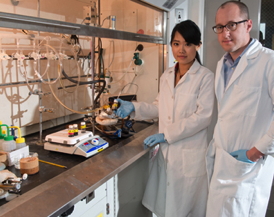 |
| Associate Professor Mathew M. Maye, right, with research assistant Wenjie Wu G’11, G’13 |
Abstract:
Chemists in The College of Arts and Sciences have figured out how to synthesize nanomaterials with stainless steel-like interfaces. Their discovery may change how the form and structure of nanomaterials are manipulated, particularly those used for gas storage, heterogeneous catalysis and lithium-ion batteries.
SU Chemists Develop ‘Fresh, New’ Approach to Making Alloy Nanomaterials: Potential applications include gas storage, heterogeneous catalysis and lithium-ion batteries
Syracuse, NY | Posted on August 10th, 2013The findings are the subject of a July 24 article in the journal Small (Wiley-VCH, 2013), co-authored by associate professor Mathew M. Maye and research assistant Wenjie Wu G'11, G'13.
Until now, scientists have used many wet-chemical approaches—collectively known as colloidal synthesis—to manipulate reactions in which metallic ions form alloys at the nanoscale. Here, metal nanoparticles are typically 2 to 50 nanometers in size and have highly unique properties, including various colors, high reactivity and novel chemistry.
Maye and Wu are part of a growing team of international chemists and materials scientists devising new ways to alter the size, shape and composition of nanoparticles.
"At SU, we have developed a new synthetic pathway to tailor the internal microstructure of nanomaterials," says Maye, whose research spans inorganic chemistry, catalysis, materials science, self-assembly and biotechnology.
Maye's approach begins with a pre-synthesized iron nanoparticle core. After synthesizing the core in its crystalline metallic form, he and Wu chemically deposit thin shells of chromium onto the iron. When the "core/shell" nanoparticles are exposed to high temperatures, they anneal. Moreover, the iron and chromium diffuse into one another, forming an iron-chromium alloy shell. Thus, the "core/alloy" product has an interface similar to some forms of stainless steel.
Since stainless steel is known for its resistance to oxidation, the big challenge for Maye and Wu has been finding out how nanoparticles cope during this process.
"We've discovered that nanoparticles exhibit a unique behavior when oxidized," he says. "A thin, iron-chromium oxide shell forms, leaving behind an unoxidized iron core. Even more interesting is the fact that a void forms, separating the core from the shell. This phenomenon is known in materials science as Kirkendall Diffusion, or Vacancy Coalescence."
This kind of work, he adds, wouldn't be possible without high-resolution electron microscopy, X-ray diffraction and magnetic measurements.
Although "core/alloy" fabrication is a new approach, it may allow for more diverse forms of alloy nanomaterials.
"Most alloys we take for granted at the macroscale, such as steel, are hard to fabricate at the nanoscale, because of ease of oxidation and other specific conditions that are required," says Maye. "Our approach may open new doors."
A recipient of many honors and awards, including the Presidential Early Career Award for Scientists and Engineers, Maye joined SU's faculty in 2008.
Wu, whose expertise encompasses nanomaterials synthesis, was the lead graduate student on the project. In August, she earns a Ph.D. in inorganic chemistry from SU.
Maye's work is supported by the American Chemical Society Petroleum Research Fund. It has made use of the Cornell Center for Materials Research, which is part of the National Science Foundation's Materials Research Science and Engineering Centers, as well as the Binghamton University Analytical and Diagnostics Laboratory and the SUNY College of Environmental Science and Forestry Microscopy Facility.
####
For more information, please click here
Contacts:
Rob Enslin
315-443-3403
Copyright © Syracuse University
If you have a comment, please Contact us.Issuers of news releases, not 7th Wave, Inc. or Nanotechnology Now, are solely responsible for the accuracy of the content.
Bookmark:


| Related Links |
| Related News Press |
News and information
 Quantum computer improves AI predictions April 17th, 2026
Flexible sensor gains sensitivity under pressure April 17th, 2026
A reusable chip for particulate matter sensing April 17th, 2026
Detecting vibrational quantum beating in the predissociation dynamics of SF6 using time-resolved photoelectron spectroscopy April 17th, 2026
Chemistry
Projecting light to dispense liquids: A new route to ultra-precise microdroplets January 30th, 2026
From sensors to smart systems: the rise of AI-driven photonic noses January 30th, 2026
"Nanoreactor" cage uses visible light for catalytic and ultra-selective cross-cycloadditions October 3rd, 2025
Cambridge chemists discover simple way to build bigger molecules – one carbon at a time June 6th, 2025
Govt.-Legislation/Regulation/Funding/Policy
Quantum computer improves AI predictions April 17th, 2026
Metasurfaces smooth light to boost magnetic sensing precision January 30th, 2026
New imaging approach transforms study of bacterial biofilms August 8th, 2025
Discoveries
Quantum computer improves AI predictions April 17th, 2026
Flexible sensor gains sensitivity under pressure April 17th, 2026
A reusable chip for particulate matter sensing April 17th, 2026
Detecting vibrational quantum beating in the predissociation dynamics of SF6 using time-resolved photoelectron spectroscopy April 17th, 2026
Materials/Metamaterials/Magnetoresistance
First real-time observation of two-dimensional melting process: Researchers at Mainz University unveil new insights into magnetic vortex structures August 8th, 2025
Researchers unveil a groundbreaking clay-based solution to capture carbon dioxide and combat climate change June 6th, 2025
A 1960s idea inspires NBI researchers to study hitherto inaccessible quantum states June 6th, 2025
Institute for Nanoscience hosts annual proposal planning meeting May 16th, 2025
Announcements
A fundamentally new therapeutic approach to cystic fibrosis: Nanobody repairs cellular defect April 17th, 2026
UC Irvine physicists discover method to reverse ‘quantum scrambling’ : The work addresses the problem of information loss in quantum computing system April 17th, 2026
Interviews/Book Reviews/Essays/Reports/Podcasts/Journals/White papers/Posters
A fundamentally new therapeutic approach to cystic fibrosis: Nanobody repairs cellular defect April 17th, 2026
UC Irvine physicists discover method to reverse ‘quantum scrambling’ : The work addresses the problem of information loss in quantum computing system April 17th, 2026
Energy
Sensors innovations for smart lithium-based batteries: advancements, opportunities, and potential challenges August 8th, 2025
Simple algorithm paired with standard imaging tool could predict failure in lithium metal batteries August 8th, 2025
Battery Technology/Capacitors/Generators/Piezoelectrics/Thermoelectrics/Energy storage
Decoding hydrogen‑bond network of electrolyte for cryogenic durable aqueous zinc‑ion batteries January 30th, 2026
COF scaffold membrane with gate‑lane nanostructure for efficient Li+/Mg2+ separation January 30th, 2026
MXene nanomaterials enter a new dimension Multilayer nanomaterial: MXene flakes created at Drexel University show new promise as 1D scrolls January 30th, 2026
Grants/Sponsored Research/Awards/Scholarships/Gifts/Contests/Honors/Records
Quantum computer improves AI predictions April 17th, 2026
Detecting vibrational quantum beating in the predissociation dynamics of SF6 using time-resolved photoelectron spectroscopy April 17th, 2026
Metasurfaces smooth light to boost magnetic sensing precision January 30th, 2026
 |
||
 |
||
| The latest news from around the world, FREE | ||
 |
||
|
|
||
| Premium Products | ||
 |
||
|
Only the news you want to read!
Learn More |
||
 |
||
|
Full-service, expert consulting
Learn More |
||
|
|
||