Home > Press > Novel beams made of twisted atoms: Scientists can now theoretically construct atomic beams of a particular kind
 |
Abstract:
Physicists have, for the first time, now built a theoretical construct of beams made of twisted atoms. These findings by Armen Hayrapetyan and colleagues at Ruprecht-Karls-University Heidelberg in Germany are about to be published in EPJ D. These so-called atomic Bessel beams can, in principle, have potential applications in quantum communication as well as in atomic and nuclear processes.
Novel beams made of twisted atoms: Scientists can now theoretically construct atomic beams of a particular kind
Heidelberg, Germany | Posted on August 7th, 2013The concept for twisted atom beams stems from a similar approach with twisted photon beams, which are currently used as optical tweezers, for instance. It was later extended to twisted electron beams, which are used to improve the magnetic mapping of biological specimens and magnetic materials by means of twisted electron microscopy.
The authors focused on a beam made of twisted two-level atoms, which are driven by a laser field. They created a theoretical construct by using an equation, referred to as the non-relativistic Schrödinger equation, for atoms which are moving much slower than the speed of light. Hayrapetyan and colleagues solved this equation by taking into account the propagation directions of both the atomic and laser beams. By superimposing a multitude of plane waves with well-defined amplitudes, they produced Bessel beams for two-level atoms that resonantly interact with the laser field.
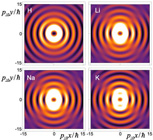
The authors confirmed that their atomic beams fulfilled the two main characteristics of Bessel beams. First, they showed that these beams carry a non-zero orbital angular momentum, as reflected by a rotation of the beam's wave front around the propagation axis in a corkscrew-like manner. Second, by taking a snapshot of the atomic beam intensity they demonstrated that these beams do not spread along the propagation axis. Moreover, they were able to control the profile of laser-driven atomic Bessel beams by tuning the parameters of both the atomic and laser beams.
####
For more information, please click here
Contacts:
Sophia Grein
49-622-148-78414
Copyright © Springer
If you have a comment, please Contact us.Issuers of news releases, not 7th Wave, Inc. or Nanotechnology Now, are solely responsible for the accuracy of the content.
Bookmark:


| Related Links |
| Related News Press |
News and information
 Quantum computer improves AI predictions April 17th, 2026
Flexible sensor gains sensitivity under pressure April 17th, 2026
A reusable chip for particulate matter sensing April 17th, 2026
Detecting vibrational quantum beating in the predissociation dynamics of SF6 using time-resolved photoelectron spectroscopy April 17th, 2026
Physics
UC Irvine physicists discover method to reverse ‘quantum scrambling’ : The work addresses the problem of information loss in quantum computing system April 17th, 2026
Quantum computers simulate fundamental physics: shedding light on the building blocks of nature June 6th, 2025
Discoveries
Quantum computer improves AI predictions April 17th, 2026
Flexible sensor gains sensitivity under pressure April 17th, 2026
A reusable chip for particulate matter sensing April 17th, 2026
Detecting vibrational quantum beating in the predissociation dynamics of SF6 using time-resolved photoelectron spectroscopy April 17th, 2026
Announcements
A fundamentally new therapeutic approach to cystic fibrosis: Nanobody repairs cellular defect April 17th, 2026
UC Irvine physicists discover method to reverse ‘quantum scrambling’ : The work addresses the problem of information loss in quantum computing system April 17th, 2026
Interviews/Book Reviews/Essays/Reports/Podcasts/Journals/White papers/Posters
A fundamentally new therapeutic approach to cystic fibrosis: Nanobody repairs cellular defect April 17th, 2026
UC Irvine physicists discover method to reverse ‘quantum scrambling’ : The work addresses the problem of information loss in quantum computing system April 17th, 2026
Tools
Metasurfaces smooth light to boost magnetic sensing precision January 30th, 2026
From sensors to smart systems: the rise of AI-driven photonic noses January 30th, 2026
Japan launches fully domestically produced quantum computer: Expo visitors to experience quantum computing firsthand August 8th, 2025
Photonics/Optics/Lasers
Metasurfaces smooth light to boost magnetic sensing precision January 30th, 2026
From sensors to smart systems: the rise of AI-driven photonic noses January 30th, 2026
Quantum nanoscience
Beyond silicon: Electronics at the scale of a single molecule January 30th, 2026
MXene nanomaterials enter a new dimension Multilayer nanomaterial: MXene flakes created at Drexel University show new promise as 1D scrolls January 30th, 2026
ICFO researchers overcome long-standing bottleneck in single photon detection with twisted 2D materials August 8th, 2025
 |
||
 |
||
| The latest news from around the world, FREE | ||
 |
||
|
|
||
| Premium Products | ||
 |
||
|
Only the news you want to read!
Learn More |
||
 |
||
|
Full-service, expert consulting
Learn More |
||
|
|
||