Home > Press > Injectable ‘Smart Sponge’ Holds Promise for Controlled Drug Delivery
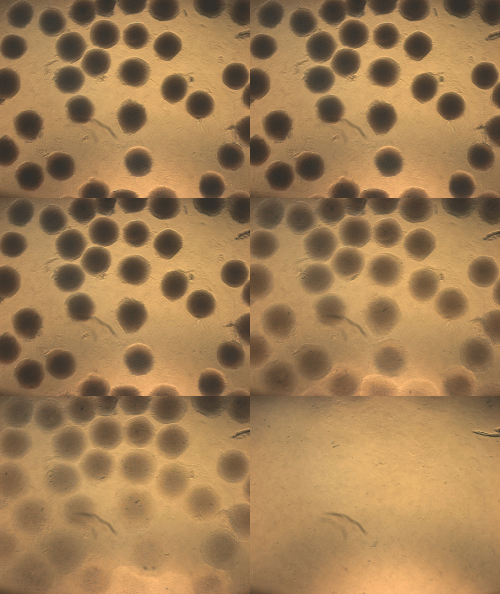 |
| In this image, the “smart sponges” are exposed to high glucose levels and are swelling to release insulin. Image: Zhen Gu |
Abstract:
"Glucose-Responsive Microgels Integrated with Enzyme Nanocapsules for Closed-Loop Insulin Delivery"
Authors: Zhen Gu, North Carolina State University and the University of North Carolina at Chapel Hill; Tram T. Dang, Minglin Ma, Benjamin C. Tang, Yizhou Dong, Yunlong Zhang, and Daniel G. Anderson, MIT and Children's Hospital Boston; Hao Cheng and Shan Jiang, MIT
Published: July 8, ACS Nano
DOI: 10.1021/nn401617u
Abstract: A glucose-responsive closed-loop insulin delivery system represents the ideal treatment of type 1 diabetes mellitus. In this study, we develop uniform injectable microgels for controlled glucose-responsive release of insulin. Monodisperse microgels (256 +/= 18 ?m), consisting of a pH-responsive chitosan matrix, enzyme nanocapsules, and recombinant human insulin, were fabricated through a one-step electrospray procedure. Glucose-specific enzymes were covalently encapsulated into the nanocapsules to improve enzymatic stability by protecting from denaturation and immunogenicity as well as to minimize loss due to diffusion from the matrix. The microgel system swelled when subjected to hyperglycemic conditions, as a result of the enzymatic conversion of glucose into gluconic acid and protonation of the chitosan network. Acting as a self-regulating valve system, microgels were adjusted to release insulin at basal release rates under normoglycemic conditions and at higher rates under hyperglycemic conditions. Finally, we demonstrated that these microgels with enzyme nanocapsules facilitate insulin release and result in a reduction of blood glucose levels in a mouse model of type 1 diabetes.
Injectable ‘Smart Sponge’ Holds Promise for Controlled Drug Delivery
Raleigh, NC | Posted on July 18th, 2013Researchers have developed a drug delivery technique for diabetes treatment in which a sponge-like material surrounds an insulin core. The sponge expands and contracts in response to blood sugar levels to release insulin as needed. The technique could also be used for targeted drug delivery to cancer cells.
"We wanted to mimic the function of health beta-cells, which produce insulin and control its release in a healthy body," says Dr. Zhen Gu, lead author of a paper describing the work and an assistant professor in the joint biomedical engineering program at North Carolina State University and the University of North Carolina at Chapel Hill. "But what we've found also holds promise for smart drug delivery targeting cancer or other diseases." The research team includes Daniel Anderson, the senior author and an associate professor of chemical engineering and member of the Koch Institute for Integrative Cancer Research at MIT, and researchers from the Department of Anesthesiology at Boston Children's Hospital.
The researchers created a spherical, sponge-like matrix out of chitosan, a material found in shrimp and crab shells. Scattered throughout this matrix are smaller nanocapsules made of a porous polymer that contain glucose oxidase or catalase enzymes. The sponge-like matrix surrounds a reservoir that contains insulin. The entire matrix sphere is approximately 250 micrometers in diameter and can be injected into a patient.
When a diabetic patient's blood sugar rises, the glucose triggers a reaction that causes the nanocapsules' enzymes to release hydrogen ions. Those ions bind to the molecular strands of the chitosan sponge, giving them a positive charge. The positively charged chitosan strands then push away from each other, creating larger gaps in the sponge's pores that allow the insulin to escape into the bloodstream. In type 1 and advanced type 2 diabetes, the body needs injections of insulin, a hormone that transports glucose - or blood sugar - from the bloodstream into the body's cells.
As the insulin is released, the body's glucose levels begin to drop. This causes the chitosan to lose its positive charge, and the strands begin to come back together. This shrinks the size of the pores in the sponge, trapping the remaining insulin.
While this work created hydrogen ions by using enzymes that are responsive to glucose, the technique could be simplified to target cancers by eliminating the enzymes altogether. Tumors are acidic environments that have high concentrations of hydrogen ions. If the sponge reservoir were filled with anticancer drugs, the drugs would be released when the chitosan came into contact with the hydrogen ions in tumor tissues or cancer cells.
"We can also adjust the size of the overall ‘sponge' matrix as needed, as small as 100 nanometers," Gu says. "And the chitosan itself can be absorbed by the body, so there are no long term health effects."
In tests using diabetic laboratory mice, the researchers found the sponge matrix was effective at reducing blood sugar for up to 48 hours. However, the researchers published a separate "smart system" for insulin delivery in May that maintained normal blood sugar levels for 10 days.
"But we learned a lot from the promising ‘sponge' research and will further optimize it. Meanwhile, we are already exploring applications to combat cancer," Gu says.
The paper, "Glucose-Responsive Microgels Integrated with Enzyme Nanocapsules for Closed-Loop Insulin Delivery," is published online in ACS Nano. The research was supported by a grant from the Leona M. and Harry B. Helmsley Charitable Trust Foundation, and a gift from the Tayebati Family Foundation.
####
For more information, please click here
Contacts:
Matt Shipman
919-515-6386
Copyright © North Carolina State University
If you have a comment, please Contact us.Issuers of news releases, not 7th Wave, Inc. or Nanotechnology Now, are solely responsible for the accuracy of the content.
Bookmark:


| Related Links |
| Related News Press |
News and information
 Quantum computer improves AI predictions April 17th, 2026
Flexible sensor gains sensitivity under pressure April 17th, 2026
A reusable chip for particulate matter sensing April 17th, 2026
Detecting vibrational quantum beating in the predissociation dynamics of SF6 using time-resolved photoelectron spectroscopy April 17th, 2026
Nanomedicine
A fundamentally new therapeutic approach to cystic fibrosis: Nanobody repairs cellular defect April 17th, 2026
New molecular technology targets tumors and simultaneously silences two ‘undruggable’ cancer genes August 8th, 2025
New imaging approach transforms study of bacterial biofilms August 8th, 2025
Electrifying results shed light on graphene foam as a potential material for lab grown cartilage June 6th, 2025
Discoveries
Quantum computer improves AI predictions April 17th, 2026
Flexible sensor gains sensitivity under pressure April 17th, 2026
A reusable chip for particulate matter sensing April 17th, 2026
Detecting vibrational quantum beating in the predissociation dynamics of SF6 using time-resolved photoelectron spectroscopy April 17th, 2026
Announcements
A fundamentally new therapeutic approach to cystic fibrosis: Nanobody repairs cellular defect April 17th, 2026
UC Irvine physicists discover method to reverse ‘quantum scrambling’ : The work addresses the problem of information loss in quantum computing system April 17th, 2026
Interviews/Book Reviews/Essays/Reports/Podcasts/Journals/White papers/Posters
A fundamentally new therapeutic approach to cystic fibrosis: Nanobody repairs cellular defect April 17th, 2026
UC Irvine physicists discover method to reverse ‘quantum scrambling’ : The work addresses the problem of information loss in quantum computing system April 17th, 2026
Grants/Sponsored Research/Awards/Scholarships/Gifts/Contests/Honors/Records
Quantum computer improves AI predictions April 17th, 2026
Detecting vibrational quantum beating in the predissociation dynamics of SF6 using time-resolved photoelectron spectroscopy April 17th, 2026
Metasurfaces smooth light to boost magnetic sensing precision January 30th, 2026
 |
||
 |
||
| The latest news from around the world, FREE | ||
 |
||
|
|
||
| Premium Products | ||
 |
||
|
Only the news you want to read!
Learn More |
||
 |
||
|
Full-service, expert consulting
Learn More |
||
|
|
||