Home > Press > Unexpected behavior of well-known catalysts
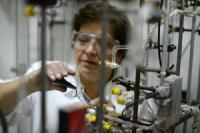 |
| Dr. Magdalena Bonarowska from the Institute of Physical Chemistry of the Polish Academy of Sciences (IPC PAS) in Warsaw puts a weighted amount of Pd-Cu/SiO2 catalyst into an experimental setup for studying catalytic hydrogen-assisted dechlorination of tetrachloromethane.
Credit: IPC PAS / Grzegorz Krzyżewski |
Abstract:
Industrial palladium-copper catalysts change their structures before they get to work, already during the activation process. As a result, the reaction is catalysed by a catalyst that is different from the one originally prepared for it. This surprising discovery was made by researchers from the Institute of Physical Chemistry of the Polish Academy of Sciences in Warsaw.
Unexpected behavior of well-known catalysts
Warsaw, Poland | Posted on June 20th, 2013Removing of nitrates from ground water or chlorine from dry cleaning wastes are important environmental protection operations that require the use of appropriate catalysts. Popular catalysts include well-known silica-supported palladium-copper catalysts. A team of researchers led by Prof. Zbigniew Karpiński from the Institute of Physical Chemistry of the Polish Academy of Sciences (IPC PAS) in Warsaw has shown that these catalysts behave differently than assumed to date.
Catalyst is a chemical that speeds up a chemical reaction by participating in it and is regenerated after the reaction is completed. Apart from profiting from shorter reaction time, the use of a catalyst may result in increased reaction selectivity, i.e., a higher yield of the target product as compared with the by-products.
Selective catalysts are usually systems composed of more than one metal. Palladium catalysts are often modified with copper. Active catalyst nanoparticles are deposited on a silica (SiO2) support. Before reaction, so prepared palladium-copper (Pd-Cu) catalyst is heated at high temperature in the presence of hydrogen. The purpose of the operation is to activate the catalyst, which means to provide the catalyst's atoms with energy allowing them for participation in the final reaction.
The ratio of amounts of both metals used in the catalyst has a substantial effect on the operational efficiency of a bimetallic catalyst. "With x-ray measurements we discovered something the researchers were not aware of to date", says Dr Magdalena Bonarowska (IPC PAS). Analytical results indicated that during the activation process in the hydrogen atmosphere at temperatures above 400 °C palladium interacts with silica in the support - and so escapes from active catalyst's nanoparticles. "A catalyst originally composed of, say, 75% palladium and 25% copper can have the ratio of metals strongly disturbed, for instance 50% to 50%. Moreover, its crystal structure changes. This means that the reaction will be catalysed by a catalyst that is different from the one originally prepared!", states Dr Bonarowska.
Palladium losses from the active catalyst's nanoparticles lead to faster catalyst deactivation. Practically, it translates into additional, substantial costs related to unloading of a chemical reactor and regeneration or even replacement of the catalyst inside the reactor.
"It's not uncommon that silica-supported palladium-copper catalysts must be activated at temperatures as high as 500 °C. The operation aims at possibly ideal mixing of both metals dispersed on the surface of the support. It is, however, worth to consider if - provided the target reaction allows for that - the activation of the catalyst at lower temperatures, but for instance for a longer time, wouldn't be a better solution", notices Prof. Karpiński.
Palladium-copper catalysts on various supports, including silica, are used for removal of nitrates from ground water, and for selective reduction of numerous organic chemicals, including the reduction of nitro compounds to amines, and unsaturated hydrocarbons (e.g., acetylene to ethylene or butadiene to butene). They are also used for electrocatalytic oxidation of methanol and hydrogen-assisted dechlorination, i.e., chlorine removal from harmful organic chemicals with hydrogen.
###
This press release was prepared thanks to the NOBLESSE grant under the activity "Research potential" of the 7th Framework Programme of the European Union.
####
About Institute of Physical Chemistry of the Polish Academy of Sciences
The Institute of Physical Chemistry of the Polish Academy of Sciences was established in 1955 as one of the first chemical institutes of the PAS. The Institute's scientific profile is strongly related to the newest global trends in the development of physical chemistry and chemical physics. Scientific research is conducted in nine scientific departments. CHEMIPAN R&D Laboratories, operating as part of the Institute, implement, produce and commercialise specialist chemicals to be used, in particular, in agriculture and pharmaceutical industry. The Institute publishes approximately 200 original research papers annually.
For more information, please click here
Contacts:
Zbigniew Karpinski
tel. +48 22 3433356
Copyright © Institute of Physical Chemistry of the Polish Academy of Sci
If you have a comment, please Contact us.Issuers of news releases, not 7th Wave, Inc. or Nanotechnology Now, are solely responsible for the accuracy of the content.
Bookmark:


| Related Links |
 Website of the Institute of Physical Chemistry of the Polish Academy of Sciences:
Press releases of the Institute of Physical Chemistry of the PAS:
| Related News Press |
Chemistry
Projecting light to dispense liquids: A new route to ultra-precise microdroplets January 30th, 2026
From sensors to smart systems: the rise of AI-driven photonic noses January 30th, 2026
"Nanoreactor" cage uses visible light for catalytic and ultra-selective cross-cycloadditions October 3rd, 2025
Cambridge chemists discover simple way to build bigger molecules – one carbon at a time June 6th, 2025
Govt.-Legislation/Regulation/Funding/Policy
Quantum computer improves AI predictions April 17th, 2026
Metasurfaces smooth light to boost magnetic sensing precision January 30th, 2026
New imaging approach transforms study of bacterial biofilms August 8th, 2025
Discoveries
Quantum computer improves AI predictions April 17th, 2026
Flexible sensor gains sensitivity under pressure April 17th, 2026
A reusable chip for particulate matter sensing April 17th, 2026
Detecting vibrational quantum beating in the predissociation dynamics of SF6 using time-resolved photoelectron spectroscopy April 17th, 2026
Announcements
A fundamentally new therapeutic approach to cystic fibrosis: Nanobody repairs cellular defect April 17th, 2026
UC Irvine physicists discover method to reverse ‘quantum scrambling’ : The work addresses the problem of information loss in quantum computing system April 17th, 2026
Environment
A reusable chip for particulate matter sensing April 17th, 2026
Researchers unveil a groundbreaking clay-based solution to capture carbon dioxide and combat climate change June 6th, 2025
 |
||
 |
||
| The latest news from around the world, FREE | ||
 |
||
|
|
||
| Premium Products | ||
 |
||
|
Only the news you want to read!
Learn More |
||
 |
||
|
Full-service, expert consulting
Learn More |
||
|
|
||