Home > Press > Coupled particles cross energy wall: Model demonstrates that it is possible for two particles to cross an energy barrier together, where a single particle could not
 |
Abstract:
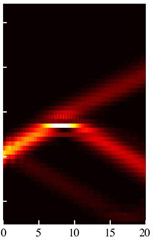
For the first time, a new kind of so-called Klein tunnelling—representing the quantum equivalent of crossing an energy wall— has been presented in a model of two interacting particles. This work by Stefano Longhi and Giuseppe Della Valle from the Institute of Photonics and Nanotechnology in Milan, Italy, is about to be published in EPJ B.
Coupled particles cross energy wall: Model demonstrates that it is possible for two particles to cross an energy barrier together, where a single particle could not
New York, NY and Heidelberg, Germany | Posted on May 30th, 2013Klein tunnelling is a quantum phenomenon referring to the fact that a high-potential barrier can be transparent to a particle moving at a speed nearing that of light, referred to as relativistic. Most of the previous Klein tunnelling models describe the phenomenon for a single particle. However, when two particles are involved, tunnelling can be modified as a result of their mutual interaction. This means, for example, that two electrons hopping on a lattice, or two ultra-cold atoms trapped in an optical lattice can exchange energy when they occupy the same lattice site.
The authors relied on an analytical and numerical study of a landmark model of interacting particles, called the Hubbard model. It is typically used to describe particle pairs in condensed matter such as in semi-conductors and in so-called matter wave physics, used for instance to describe microscopic particles oscillating between their material and wave-like characteristics. Longhi and Della Valle predict a new type of Klein tunnelling for a couple of interacting particles confronted by an energy barrier. Even though the barrier is impenetrable for single particles, it becomes transparent when the two particles cross the energy barrier together.
They expect these predictions to be confirmed experimentally in ultra-cold atoms trapped in optical lattices. If this is the case, similar quantum simulation could be a tool for emulating multiple-particle systems that cannot be modelled using classical computations.
####
For more information, please click here
Contacts:
Sophia Grein
49-622-148-78414
Copyright © Springer
If you have a comment, please Contact us.Issuers of news releases, not 7th Wave, Inc. or Nanotechnology Now, are solely responsible for the accuracy of the content.
Bookmark:


| Related Links |
| Related News Press |
News and information
 Quantum computer improves AI predictions April 17th, 2026
Flexible sensor gains sensitivity under pressure April 17th, 2026
A reusable chip for particulate matter sensing April 17th, 2026
Detecting vibrational quantum beating in the predissociation dynamics of SF6 using time-resolved photoelectron spectroscopy April 17th, 2026
Physics
UC Irvine physicists discover method to reverse ‘quantum scrambling’ : The work addresses the problem of information loss in quantum computing system April 17th, 2026
Quantum computers simulate fundamental physics: shedding light on the building blocks of nature June 6th, 2025
Discoveries
Quantum computer improves AI predictions April 17th, 2026
Flexible sensor gains sensitivity under pressure April 17th, 2026
A reusable chip for particulate matter sensing April 17th, 2026
Detecting vibrational quantum beating in the predissociation dynamics of SF6 using time-resolved photoelectron spectroscopy April 17th, 2026
Announcements
A fundamentally new therapeutic approach to cystic fibrosis: Nanobody repairs cellular defect April 17th, 2026
UC Irvine physicists discover method to reverse ‘quantum scrambling’ : The work addresses the problem of information loss in quantum computing system April 17th, 2026
Interviews/Book Reviews/Essays/Reports/Podcasts/Journals/White papers/Posters
A fundamentally new therapeutic approach to cystic fibrosis: Nanobody repairs cellular defect April 17th, 2026
UC Irvine physicists discover method to reverse ‘quantum scrambling’ : The work addresses the problem of information loss in quantum computing system April 17th, 2026
Quantum nanoscience
Beyond silicon: Electronics at the scale of a single molecule January 30th, 2026
MXene nanomaterials enter a new dimension Multilayer nanomaterial: MXene flakes created at Drexel University show new promise as 1D scrolls January 30th, 2026
ICFO researchers overcome long-standing bottleneck in single photon detection with twisted 2D materials August 8th, 2025
 |
||
 |
||
| The latest news from around the world, FREE | ||
 |
||
|
|
||
| Premium Products | ||
 |
||
|
Only the news you want to read!
Learn More |
||
 |
||
|
Full-service, expert consulting
Learn More |
||
|
|
||