Home > Press > Single-Cell Transfection Tool Enables Added Control for Biological Studies: McCormick researchers develop method of delivering molecules into targeted cells
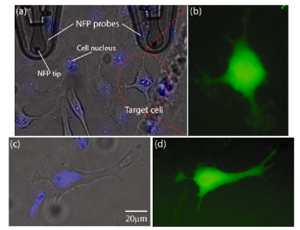 |
| Transfection of the dextran Alexa Fluor 488 dye into a targeted HeLa cell using Nanofountain Probe Electroporation. Reprinted with permission from Nano Letters. Copyright 2013 American Chemical Society. |
Abstract:
Northwestern University researchers have developed a new method for delivering molecules into single, targeted cells through temporary holes in the cell surface. The technique could find applications in drug delivery, cell therapy, and related biological fields.
Single-Cell Transfection Tool Enables Added Control for Biological Studies: McCormick researchers develop method of delivering molecules into targeted cells
Evanston, IL | Posted on May 22nd, 2013Bulk electroporation — a technique used to deliver molecules into cells through reversible nanopores in the cell membrane that are caused by exposing them to electric pulses — is an increasingly popular method of cell transfection. (Cell transfection is the introduction of molecules, such as nucleic acids or proteins, into a cell to change its properties.)
However, because bulk electroporation applies electric pulses to a bulk cell solution, it results in heterogeneous cell populations and often low cell viability. To solve these problems, Northwestern University researchers have developed a novel tool for single-cell transfection.
The new method, called nanofountain probe electroporation (NFP-E), allows researchers to deliver molecules into targeted cells through temporary nanopores in the cell membrane created by a localized electric field applied to a small portion of the cell. The method enables researchers to control dosage by varying the duration of the electric pulses, which provides unprecedented control of cell transfection.
"This is really exciting," said Horacio Espinosa, James and Nancy Farley Professor of Manufacturing and Entrepreneurship at Northwestern's McCormick School of Engineering and one of the paper's authors. "The ability to precisely deliver molecules into single cells is needed for biotechnology researchers to advance the state-of-the-art in therapeutics, diagnostics, and drug delivery toward the promise of personalized medicine."
A paper describing the research, "Nanofountain Probe Electroporation (NFP-E) of Single Cells," was published May 7 in the journal Nano Letters.
NFP-E is based on nanofountain probe (NFP) technology developed in Espinosa's lab. The NFP-E chip consists of an array of microfabricated cantilever probes with integrated microfluidic channels. The probe has previously been used for high-speed nanopatterning of proteins and nanoparticles for drug delivery studies.
The new single-cell transfection application couples the probe with an electrode and fluid control system that can be easily connected to a micromanipulator or atomic force microscope for position control. This integrated system allows the entire transfection process and post-transfection cell response to be monitored by an optical microscope.
The NFP-E system is being developed for commercialization by iNfinitesimal LLC, a Northwestern spin-off company founded by Espinosa, and is expected to be available in late 2013.
The technique is proving to be extremely robust and multi-functional. Researchers have used the NFP-E chip to transfect HeLa cells with polysaccharides, proteins, DNA hairpins, and plasmid DNA with single-cell selectivity, high transfection efficiency (up to 95%), qualitative dosage control, and very high viability (up to 92%).
In addition to Espinosa, authors of the research paper include Wonmo Kang, Fazel Yavari, Majid Minary-Jolandan, Juan P. Giraldo-Vela, Asmahan Safi, Rebecca McNaughton, and Victor Parpoil. The research was supported by the National Science Foundation and the National Institutes of Health.
####
For more information, please click here
Contacts:
Megan Fellman
847-491-3115
Copyright © Northwestern University
If you have a comment, please Contact us.Issuers of news releases, not 7th Wave, Inc. or Nanotechnology Now, are solely responsible for the accuracy of the content.
Bookmark:


| Related Links |
| Related News Press |
News and information
 Quantum computer improves AI predictions April 17th, 2026
Flexible sensor gains sensitivity under pressure April 17th, 2026
A reusable chip for particulate matter sensing April 17th, 2026
Detecting vibrational quantum beating in the predissociation dynamics of SF6 using time-resolved photoelectron spectroscopy April 17th, 2026
Govt.-Legislation/Regulation/Funding/Policy
Quantum computer improves AI predictions April 17th, 2026
Metasurfaces smooth light to boost magnetic sensing precision January 30th, 2026
New imaging approach transforms study of bacterial biofilms August 8th, 2025
Nanomedicine
A fundamentally new therapeutic approach to cystic fibrosis: Nanobody repairs cellular defect April 17th, 2026
New molecular technology targets tumors and simultaneously silences two ‘undruggable’ cancer genes August 8th, 2025
New imaging approach transforms study of bacterial biofilms August 8th, 2025
Electrifying results shed light on graphene foam as a potential material for lab grown cartilage June 6th, 2025
Discoveries
Quantum computer improves AI predictions April 17th, 2026
Flexible sensor gains sensitivity under pressure April 17th, 2026
A reusable chip for particulate matter sensing April 17th, 2026
Detecting vibrational quantum beating in the predissociation dynamics of SF6 using time-resolved photoelectron spectroscopy April 17th, 2026
Announcements
A fundamentally new therapeutic approach to cystic fibrosis: Nanobody repairs cellular defect April 17th, 2026
UC Irvine physicists discover method to reverse ‘quantum scrambling’ : The work addresses the problem of information loss in quantum computing system April 17th, 2026
Interviews/Book Reviews/Essays/Reports/Podcasts/Journals/White papers/Posters
A fundamentally new therapeutic approach to cystic fibrosis: Nanobody repairs cellular defect April 17th, 2026
UC Irvine physicists discover method to reverse ‘quantum scrambling’ : The work addresses the problem of information loss in quantum computing system April 17th, 2026
Nanobiotechnology
A fundamentally new therapeutic approach to cystic fibrosis: Nanobody repairs cellular defect April 17th, 2026
New molecular technology targets tumors and simultaneously silences two ‘undruggable’ cancer genes August 8th, 2025
New imaging approach transforms study of bacterial biofilms August 8th, 2025
Electrifying results shed light on graphene foam as a potential material for lab grown cartilage June 6th, 2025
 |
||
 |
||
| The latest news from around the world, FREE | ||
 |
||
|
|
||
| Premium Products | ||
 |
||
|
Only the news you want to read!
Learn More |
||
 |
||
|
Full-service, expert consulting
Learn More |
||
|
|
||