Home > Press > Researchers Perform Fastest Measurements Ever Made of Ion Channel Proteins
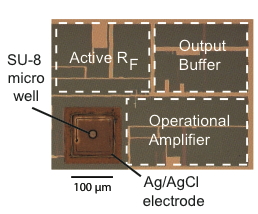 |
| Photograph of integrated amplifiers. The well supporting the membrane and channel is noted in the figure. |
Abstract:
The miniaturization of electronics continues to create unprecedented capabilities in computer and communications applications, enabling handheld wireless devices with tremendous computing performance operating on battery power. This same miniaturization of electronic systems is also creating new opportunities in biotechnology and biophysics.
Researchers Perform Fastest Measurements Ever Made of Ion Channel Proteins
New York, NY | Posted on May 20th, 2013 A team of researchers at Columbia Engineering has used miniaturized electronics to measure the activity of individual ion-channel proteins with temporal resolution as fine as one microsecond, producing the fastest recordings of single ion channels ever performed. Ion channels are biomolecules that allow charged atoms to flow in and out of cells, and they are an important work-horse in cell signaling, sensing, and energetics. They are also being explored for nanopore sequencing applications. As the "transistors" of living systems, they are the target of many drugs, and the ability to perform such fast measurements of these proteins will lead to new understanding of their functions.
The researchers have designed a custom integrated circuit to perform these measurements, in which an artificial cell membrane and ion channel are attached directly to the surface of the amplifier chip. The results are described in a paper published online May 1, 2013, in Nano Letters.
"Scientists have been measuring single ion channels using large rack-mount electronic systems for the last 30 years," says Jacob Rosenstein, the lead author on the paper. Rosenstein was a PhD student in electrical engineering at the School at the time this work was done, and is now an assistant professor at Brown University. "By designing a custom microelectronic amplifier and tightly integrating the ion channel directly onto the amplifier chip surface, we are able to reduce stray capacitances that get in the way of making fast measurements."
"This work builds on other efforts in my laboratory to study the properties of individual molecules using custom electronics designed for this purpose," says Ken Shepard, professor of electrical engineering at the School and Rosenstein's adviser. The Shepard group continues to find ways to speed up these single-molecule measurements. "In some cases," he adds, "we may be able to speed things up to be a million times faster than current techniques."
This work was funded by the National Institutes of Health and the National Science Foundation.
-by Holly Evarts
####
For more information, please click here
Contacts:
Holly Evarts
347-453-7408
Copyright © Columbia University
If you have a comment, please Contact us.Issuers of news releases, not 7th Wave, Inc. or Nanotechnology Now, are solely responsible for the accuracy of the content.
Bookmark:


| Related News Press |
News and information
 Quantum computer improves AI predictions April 17th, 2026
Flexible sensor gains sensitivity under pressure April 17th, 2026
A reusable chip for particulate matter sensing April 17th, 2026
Detecting vibrational quantum beating in the predissociation dynamics of SF6 using time-resolved photoelectron spectroscopy April 17th, 2026
Govt.-Legislation/Regulation/Funding/Policy
Quantum computer improves AI predictions April 17th, 2026
Metasurfaces smooth light to boost magnetic sensing precision January 30th, 2026
New imaging approach transforms study of bacterial biofilms August 8th, 2025
Nanomedicine
A fundamentally new therapeutic approach to cystic fibrosis: Nanobody repairs cellular defect April 17th, 2026
New molecular technology targets tumors and simultaneously silences two ‘undruggable’ cancer genes August 8th, 2025
New imaging approach transforms study of bacterial biofilms August 8th, 2025
Electrifying results shed light on graphene foam as a potential material for lab grown cartilage June 6th, 2025
Discoveries
Quantum computer improves AI predictions April 17th, 2026
Flexible sensor gains sensitivity under pressure April 17th, 2026
A reusable chip for particulate matter sensing April 17th, 2026
Detecting vibrational quantum beating in the predissociation dynamics of SF6 using time-resolved photoelectron spectroscopy April 17th, 2026
Announcements
A fundamentally new therapeutic approach to cystic fibrosis: Nanobody repairs cellular defect April 17th, 2026
UC Irvine physicists discover method to reverse ‘quantum scrambling’ : The work addresses the problem of information loss in quantum computing system April 17th, 2026
Nanobiotechnology
A fundamentally new therapeutic approach to cystic fibrosis: Nanobody repairs cellular defect April 17th, 2026
New molecular technology targets tumors and simultaneously silences two ‘undruggable’ cancer genes August 8th, 2025
New imaging approach transforms study of bacterial biofilms August 8th, 2025
Electrifying results shed light on graphene foam as a potential material for lab grown cartilage June 6th, 2025
 |
||
 |
||
| The latest news from around the world, FREE | ||
 |
||
|
|
||
| Premium Products | ||
 |
||
|
Only the news you want to read!
Learn More |
||
 |
||
|
Full-service, expert consulting
Learn More |
||
|
|
||