Home > Press > A giant leap to commercialization of polymer solar cell
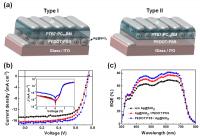 |
| This shows: (a) Device structures, (b) J−V characteristics, and (c) EQE of PTB7:PC70BM-based PSCs with type I and type II architectures.
Credit: UNIST |
Abstract:
A polymer solar cell is a type of thin film solar cells made with polymers that produce electricity from sunlight by the photovoltaic effect. Most current commercial solar cells are made from a highly purified silicon crystal. The high cost of these silicon solar cells and their complex production process has generated interest in developing alternative photovoltaic technologies.
A giant leap to commercialization of polymer solar cell
Ulsan, Republic of Korea | Posted on May 7th, 2013Compared to silicon-based devices, PSCs are lightweight (which is important for small autonomous sensors), solution processability (potentially disposable), inexpensive to fabricate (sometimes using printed electronics), flexible, and customizable on the molecular level, and they have lower potential for negative environmental impact. Polymer solar cells have attracted a lot of interest due to these many advantages.
Although these many advantages, PSCs currently suffer from a lack of enough efficiency for large scale applications and stability problems but their promise of extremely cheap production and eventually high efficiency values has led them to be one of the most popular fields in solar cell research.
To maximize PCE, light absorption in the active layer has to be increased using thick bulk heterojunction (BHJ) films. However, the thickness of the active layer is limited by the low carrier mobilities of BHJ materials. Therefore, it is necessary to find the ways to minimize the thickness of BHJ films while maximizing the light absorption capability in the active layer.
The research team employed the surface plasmon resonance (SPR) effect via multi-positional silica-coated silver NPs to increase light absorption. The silica shell in preserves the SPR effect of the Ag NPs by preventing oxidation of the Ag core under ambient conditions and also eliminates the concern about exciton quenching by avoiding direct contact between Ag cores and the active layer. The multi-positional property refers to the ability of NPs to be introduced at both ITO/PEDOT:PSS (type I) and PEDOT:PSS/active layer (type II) interfaces in polymer: fullerene-based BHJ PSCs due to the silica shells.
Because PSCs have many advantages, including low cost, solution processability, and mechanical flexibility, PSCs can be adopted in various applications. However, we should break the efficiency barrier of 10% for commercialization of PSCs.
Jin Young Kim and Soojin Park, both, Associate Professors of the Interdisciplinary School of Green Energy, Ulsan National Institute of Science and Technology (UNIST), Ulsan, South Korea, led this work.
Prof. Kim said, "This is the first report introducing metal NPs between the hole transport layer and active layer for enhancing device performance. The multipositional and solutions-processable properties of our surface plasmon resonance (SPR) materials offer the possibility to use multiple plasmonic effects by introducing various metal nanoparticles into different spatial location for high-performance optoelectronic device via mass production techniques."
"Our work is meaningful to develop novel metal nanoparticles and almost reach 10% efficiency by using these materials. If we continuously focus on optimizing this work, commercialization of PSCs will be a realization but not dream," added Prof. Park.
This research was supported by WCU (World Class University) program through the Korea Science and Engineering Foundation funded the Ministry of Education, Science and Technology (Minister Lee Ju-Ho) and the National Research Foundation of Korea (President Seung Jong Lee). It has published in Nano Letters (Title: Multipositional Silica-Coated Silver Nanoparticles for High-Performance Polymer Solar Cells ).
####
For more information, please click here
Contacts:
Eunhee Song
Copyright © UNIST
If you have a comment, please Contact us.Issuers of news releases, not 7th Wave, Inc. or Nanotechnology Now, are solely responsible for the accuracy of the content.
Bookmark:


| Related Links |
 Ulsan National Institute of Science and Technology:
The original research article is available at:
Homepage of Prof. Jin Young Kim:
Homepage of Prof. Soojin Park:
| Related News Press |
News and information
Quantum computer improves AI predictions April 17th, 2026
Flexible sensor gains sensitivity under pressure April 17th, 2026
A reusable chip for particulate matter sensing April 17th, 2026
Detecting vibrational quantum beating in the predissociation dynamics of SF6 using time-resolved photoelectron spectroscopy April 17th, 2026
Thin films
Tiny nanosheets, big leap: A new sensor detects ethanol at ultra-low levels January 30th, 2026
Utilizing palladium for addressing contact issues of buried oxide thin film transistors April 5th, 2024
Understanding the mechanism of non-uniform formation of diamond film on tools: Paving the way to a dry process with less environmental impact March 24th, 2023
New study introduces the best graphite films: The work by Distinguished Professor Feng Ding at UNIST has been published in the October 2022 issue of Nature Nanotechnology November 4th, 2022
Govt.-Legislation/Regulation/Funding/Policy
Quantum computer improves AI predictions April 17th, 2026
Metasurfaces smooth light to boost magnetic sensing precision January 30th, 2026
New imaging approach transforms study of bacterial biofilms August 8th, 2025
Discoveries
Quantum computer improves AI predictions April 17th, 2026
Flexible sensor gains sensitivity under pressure April 17th, 2026
A reusable chip for particulate matter sensing April 17th, 2026
Detecting vibrational quantum beating in the predissociation dynamics of SF6 using time-resolved photoelectron spectroscopy April 17th, 2026
Announcements
A fundamentally new therapeutic approach to cystic fibrosis: Nanobody repairs cellular defect April 17th, 2026
UC Irvine physicists discover method to reverse ‘quantum scrambling’ : The work addresses the problem of information loss in quantum computing system April 17th, 2026
Energy
Sensors innovations for smart lithium-based batteries: advancements, opportunities, and potential challenges August 8th, 2025
Simple algorithm paired with standard imaging tool could predict failure in lithium metal batteries August 8th, 2025
Solar/Photovoltaic
Spinel-type sulfide semiconductors to operate the next-generation LEDs and solar cells For solar-cell absorbers and green-LED source October 3rd, 2025
KAIST researchers introduce new and improved, next-generation perovskite solar cell November 8th, 2024
Groundbreaking precision in single-molecule optoelectronics August 16th, 2024
Development of zinc oxide nanopagoda array photoelectrode: photoelectrochemical water-splitting hydrogen production January 12th, 2024
 |
||
 |
||
| The latest news from around the world, FREE | ||
 |
||
|
|
||
| Premium Products | ||
 |
||
|
Only the news you want to read!
Learn More |
||
 |
||
|
Full-service, expert consulting
Learn More |
||
|
|
||