Home > Press > Glass-blowers at a nano scale: EPFL researchers are using the electrical properties of a scanning electron microscope to change the size of glass capillary tubes -- Their method has already been patented as it could pave the way to many novel applications
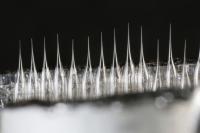 |
| A few of these commercial pre-shrunk nano-capillaries have had their end diameter reduced to a few nanometers, from an original 200 nm, thanks to an electron microscope at EPFL's Center for MicroNanotechnology.
Credit: Alain Herzog / EPFL |
Abstract:
Have you ever thrown into the fire - even if you shouldn't have - an empty packet of crisps? The outcome is striking: the plastic shrivels and bends into itself, until it turns into a small crumpled and blackened ball. This phenomenon is explained by the tendency of materials to pick up their original features in the presence of the right stimulus. Hence, this usually happens when heating materials that were originally shaped at high temperatures and cooled afterwards.
Glass-blowers at a nano scale: EPFL researchers are using the electrical properties of a scanning electron microscope to change the size of glass capillary tubes -- Their method has already been patented as it could pave the way to many novel applications
Lausanne, Switzerland | Posted on March 25th, 2013EPFL researchers realized that this phenomenon occurred to ultrathin quartz tubes (capillary tubes) under the beam of a scanning electron microscope. "This is not the original microscope's purpose. The temperature increase is explained by an accumulation of electrons in the glass. Electrons accumulate because glass is a non-conductive material." explains Lorentz Steinbock, researcher at the Laboratory of Nanoscale Biology and co-author of a paper on this subject published in Nano-letters.
As the glass shrinks, it can be seen live on the microscope screen. "It's like a glass-blower. Thanks to the possibilities provided by the new microscope at EPFL's Center of Micronanotechnology (MIC), the operator can adjust the microscope's voltage and electric field strength while observing the tube's reaction. Thus, the person operating the microscope can very precisely control the shape he wants to give to the glass", says Aleksandra Radenovic, tenure-track assistant professor in charge of the laboratory.
At the end of this process, the capillary tube's ends are perfectly controllable in diameter, ranging from 200 nanometers to fully closed. The scientists tested their slimmed down tubes in an experiment aiming to detect DNA segments in a sample. The test sample was moved from one container to another on a microfluidic chip. Whenever a molecule crossed the "channel" connecting the containers, the variation of the ion current was measured. As expected, the EPFL team obtained more accurate results with a tube reduced to the size of 11 nm than with standard market models. "By using a capillary tube costing only a few cents, in five minutes we are able to make a device that can replace "nano-channels" sold for hundreds of dollars!" explains Aleksandra Radenovic.
These nano-fillers have a potential beyond laboratory usage. "We can imagine industrial applications in ultra-high precision printers, as well as opportunities in surgery, where micro-pipettes of this type could be used at a cell's scale", says the researcher.
For the time being, the method for manufacturing nano-capillary tubes is manual, the transition to an industrial scale will take some time. However, the researchers have been able to demonstrate the concept behind their discovery and have registered a patent. Therefore, the road is already paved.
####
For more information, please click here
Contacts:
Lorenz Steinbock
41-216-931-162
Copyright © Ecole Polytechnique Fédérale de Lausanne
If you have a comment, please Contact us.Issuers of news releases, not 7th Wave, Inc. or Nanotechnology Now, are solely responsible for the accuracy of the content.
Bookmark:


| Related News Press |
News and information
 Quantum computer improves AI predictions April 17th, 2026
Flexible sensor gains sensitivity under pressure April 17th, 2026
A reusable chip for particulate matter sensing April 17th, 2026
Detecting vibrational quantum beating in the predissociation dynamics of SF6 using time-resolved photoelectron spectroscopy April 17th, 2026
Imaging
Simple algorithm paired with standard imaging tool could predict failure in lithium metal batteries August 8th, 2025
Nanomedicine
A fundamentally new therapeutic approach to cystic fibrosis: Nanobody repairs cellular defect April 17th, 2026
New molecular technology targets tumors and simultaneously silences two ‘undruggable’ cancer genes August 8th, 2025
New imaging approach transforms study of bacterial biofilms August 8th, 2025
Electrifying results shed light on graphene foam as a potential material for lab grown cartilage June 6th, 2025
Discoveries
Quantum computer improves AI predictions April 17th, 2026
Flexible sensor gains sensitivity under pressure April 17th, 2026
A reusable chip for particulate matter sensing April 17th, 2026
Detecting vibrational quantum beating in the predissociation dynamics of SF6 using time-resolved photoelectron spectroscopy April 17th, 2026
Announcements
A fundamentally new therapeutic approach to cystic fibrosis: Nanobody repairs cellular defect April 17th, 2026
UC Irvine physicists discover method to reverse ‘quantum scrambling’ : The work addresses the problem of information loss in quantum computing system April 17th, 2026
Tools
Metasurfaces smooth light to boost magnetic sensing precision January 30th, 2026
From sensors to smart systems: the rise of AI-driven photonic noses January 30th, 2026
Japan launches fully domestically produced quantum computer: Expo visitors to experience quantum computing firsthand August 8th, 2025
Nanobiotechnology
A fundamentally new therapeutic approach to cystic fibrosis: Nanobody repairs cellular defect April 17th, 2026
New molecular technology targets tumors and simultaneously silences two ‘undruggable’ cancer genes August 8th, 2025
New imaging approach transforms study of bacterial biofilms August 8th, 2025
Electrifying results shed light on graphene foam as a potential material for lab grown cartilage June 6th, 2025
 |
||
 |
||
| The latest news from around the world, FREE | ||
 |
||
|
|
||
| Premium Products | ||
 |
||
|
Only the news you want to read!
Learn More |
||
 |
||
|
Full-service, expert consulting
Learn More |
||
|
|
||