Home > Press > Electrons are not enough: Cuprate superconductors defy convention
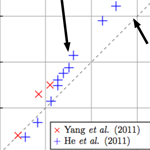 |
| Graph showing the breakdown of Luttinger's theorem in the normal state of cuprate superconductors. The horizontal axis is the expected number of mobile electrons while is the vertical axis is the measured number. The two should be equal if the theorem were true. Graphic by Philip Phillips |
Abstract:
To engineers, it's a tale as old as time: Electrical current is carried through materials by flowing electrons. But physicists at the University of Illinois and the University of Pennsylvania found that for copper-containing superconductors, known as cuprates, electrons are not enough to carry the current.
Electrons are not enough: Cuprate superconductors defy convention
Champaign, IL | Posted on March 18th, 2013"The story of electrical conduction in metals is told entirely in terms of electrons. The cuprates show that there is something completely new to be understood beyond what electrons are doing," said Philip Phillips, a professor of physics and of chemistry at the U. of I.
In physics, Luttinger's theorem states that the number of electrons in a material is the same as the number of electrons in all of its atoms added together. Electrons are the sub-atomic particles that carry the current in a conductive material. Much-studied conducting materials, such as metals and semiconductors, hold true to the theorem.
Phillips' group works on the theory behind high-temperature superconductors. In superconductors, current flows freely without resistance. Cuprate superconductors have puzzled physicists with their superconducting ability since their discovery in 1987.
The researchers developed a model outlining the breakdown of Luttinger's theorem that is applicable to cuprate superconductors, since the hypotheses that the theorem is built on are violated at certain energies in these materials. The group tested it and indeed found discrepancies between the measured charge and the number of mobile electrons in cuprate superconductors, defying Luttinger.
"This result is telling us that the physics cannot be described by electrons alone," Phillips said. "This means that the cuprates are even weirder than previously thought: Something other than electrons carries the current."
"Theorists have suspected that something like this was true but no one has been able to prove it," Phillips said. "Electrons are charged. Therefore, if an electron does not contribute to the charge count, then there is a lot of explaining to do."
Now the researchers are exploring possible candidates for current-carriers, particularly a novel kind of excitation called unparticles.
Phillips, U. of I. undergraduate student Kiaran Dave (now a graduate student at MIT) and University of Pennsylvania professor Charles Kane published their findings in the journal Physical Review Letters. The National Science Foundation and the Center for Emergent Superconductivity (through a DOE Energy Frontiers Research Center) supported this work.
####
For more information, please click here
Contacts:
Liz Ahlberg
Physical Sciences Editor
217-244-1073
Philip Phillips
217-244-6703
Copyright © University of Illinois at Urbana-Champaign
If you have a comment, please Contact us.Issuers of news releases, not 7th Wave, Inc. or Nanotechnology Now, are solely responsible for the accuracy of the content.
Bookmark:


| Related Links |
| Related News Press |
News and information
 Quantum computer improves AI predictions April 17th, 2026
Flexible sensor gains sensitivity under pressure April 17th, 2026
A reusable chip for particulate matter sensing April 17th, 2026
Detecting vibrational quantum beating in the predissociation dynamics of SF6 using time-resolved photoelectron spectroscopy April 17th, 2026
Superconductivity
MXene nanomaterials enter a new dimension Multilayer nanomaterial: MXene flakes created at Drexel University show new promise as 1D scrolls January 30th, 2026
Physics
UC Irvine physicists discover method to reverse ‘quantum scrambling’ : The work addresses the problem of information loss in quantum computing system April 17th, 2026
Govt.-Legislation/Regulation/Funding/Policy
Quantum computer improves AI predictions April 17th, 2026
Metasurfaces smooth light to boost magnetic sensing precision January 30th, 2026
New imaging approach transforms study of bacterial biofilms August 8th, 2025
Discoveries
Quantum computer improves AI predictions April 17th, 2026
Flexible sensor gains sensitivity under pressure April 17th, 2026
A reusable chip for particulate matter sensing April 17th, 2026
Detecting vibrational quantum beating in the predissociation dynamics of SF6 using time-resolved photoelectron spectroscopy April 17th, 2026
Announcements
A fundamentally new therapeutic approach to cystic fibrosis: Nanobody repairs cellular defect April 17th, 2026
UC Irvine physicists discover method to reverse ‘quantum scrambling’ : The work addresses the problem of information loss in quantum computing system April 17th, 2026
 |
||
 |
||
| The latest news from around the world, FREE | ||
 |
||
|
|
||
| Premium Products | ||
 |
||
|
Only the news you want to read!
Learn More |
||
 |
||
|
Full-service, expert consulting
Learn More |
||
|
|
||