Home > Press > Sensors for the real world
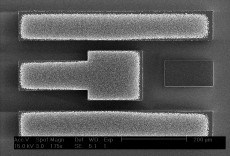 |
| One of the sensors that has been fabricated using a thin layer of carbon nanotubes (CNTs) for electroding, in order to enhance sensitivity. The sensing area is the square at the centre. Credit: Luis Garcia-Gancedo |
Abstract:
Over the last decade there has been an increased interest in developing resonators for gravitmetric sensing; however, the sensors' response to variations in temperature has prevented them from being used outside the laboratory. New sensors developed by researchers at the University of Cambridge negate the effects of temperature so that they may be used in industries including health care, telecommunications and environmental monitoring.
Sensors for the real world
Cambridge, MA | Posted on November 5th, 2012Sensors built from high frequency bulk acoustic wave (BAW) resonators consist of a piezoelectric layer sandwiched between two electrodes, to which a variable frequency signal is applied. The resonator vibrates at a given frequency, and the properties of the resulting acoustic wave allow researchers to determine what is occurring in the environment.
The main application of these nanoscale sensors is to measure a mass load. By tracking changes in the acoustic wave, mass changes on the sensors can be detected. The resonators can be altered to detect a number of different things, from antigens/antibodies to environmental contaminants.
The major issue which has prevented the adoption of these resonators in commercial sensing applications has been their unwanted response to temperature. When the temperature changes, the acoustic wave changes along with it, so it is impossible to determine whether the change has been motivated by something the resonator is trying to detect or a change in temperature. For this reason, the use of these resonators has been limited to laboratories where environmental conditions can be tightly controlled.
Many researchers have attempted to compensate for the effects of temperature, but as these effects are non-linear, they can only be minimised, not eliminated completely. Now, researchers from the Department of Engineering have designed a thin film bulk acoustic wave resonator that allows simultaneous measurement of temperature and mass loading in a single device. The resonator has been designed so that it has two resonances which react differently to mass and temperature changes.
"This has two consequences," says Dr Luis Garcia-Gancedo, a member of Dr Andrew Flewitt's group in the Department of Engineering. "First, we are able to eliminate the effects of temperature completely regardless of its non-linearity. Secondly, we are able to measure mass and temperature with extremely high sensitivity at exactly the same location, which we haven't been able to do before."
With the assistance of Cambridge Enterprise, the team is looking at two primary applications for the resonators: biological systems and physical sensing. The resonators could be used for applications such as detecting viruses in a health care setting, or contaminants in drinking water. Other potential applications include air quality or pressure monitoring.
The resonator is able to detect masses to the order of 10-15 grams, which is approximately the size of one virus. The size of the resonator (typically a few micrometres square) means that they can easily be embedded in various devices.
"One of the problems with existing sensing technology is that if you're trying to measure two different physical properties, the sensors are often based on two different mechanisms," says Dr Garcia-Gancedo. "The integration of two different sensing mechanisms means that you often end up with a bulky item. But what we have developed uses exactly the same technology with exactly the same electronics, without any increase in size."
Cambridge Enterprise is currently seeking commercial partners for developing this technology.
####
About University of Cambridge
Cambridge Enterprise Limited is a wholly owned subsidiary of the University of Cambridge, responsible for the commercialisation of University intellectual property. Activities include management and licensing of intellectual property and patents, proof of concept funding and support for University staff and research groups wishing to provide expert advice or facilities to public and private sector organisations. Cambridge Enterprise provides access to angel and early stage capital through the Cambridge Enterprise Seed Funds and Cambridge Enterprise Venture Partners, and offers business planning, mentoring, and other related programmes. Over the past three years, income from licensing, consultancy and equity transactions exceeded £37 million, of which £30 million represents distributions to University departments and academics.
For more information, please click here
Contacts:
Sarah Collins
Cambridge Enterprise
University of Cambridge
Tel: +44 (0)1223 760335
Mob: +44 (0)7500 883612
Copyright © University of Cambridge
If you have a comment, please Contact us.Issuers of news releases, not 7th Wave, Inc. or Nanotechnology Now, are solely responsible for the accuracy of the content.
Bookmark:


| Related News Press |
News and information
 Quantum computer improves AI predictions April 17th, 2026
Flexible sensor gains sensitivity under pressure April 17th, 2026
A reusable chip for particulate matter sensing April 17th, 2026
Detecting vibrational quantum beating in the predissociation dynamics of SF6 using time-resolved photoelectron spectroscopy April 17th, 2026
Nanotubes/Buckyballs/Fullerenes/Nanorods/Nanostrings/Nanosheets
Tiny nanosheets, big leap: A new sensor detects ethanol at ultra-low levels January 30th, 2026
Enhancing power factor of p- and n-type single-walled carbon nanotubes April 25th, 2025
Chainmail-like material could be the future of armor: First 2D mechanically interlocked polymer exhibits exceptional flexibility and strength January 17th, 2025
Innovative biomimetic superhydrophobic coating combines repair and buffering properties for superior anti-erosion December 13th, 2024
Sensors
Flexible sensor gains sensitivity under pressure April 17th, 2026
Tiny nanosheets, big leap: A new sensor detects ethanol at ultra-low levels January 30th, 2026
From sensors to smart systems: the rise of AI-driven photonic noses January 30th, 2026
Sensors innovations for smart lithium-based batteries: advancements, opportunities, and potential challenges August 8th, 2025
Discoveries
Quantum computer improves AI predictions April 17th, 2026
Flexible sensor gains sensitivity under pressure April 17th, 2026
A reusable chip for particulate matter sensing April 17th, 2026
Detecting vibrational quantum beating in the predissociation dynamics of SF6 using time-resolved photoelectron spectroscopy April 17th, 2026
Announcements
A fundamentally new therapeutic approach to cystic fibrosis: Nanobody repairs cellular defect April 17th, 2026
UC Irvine physicists discover method to reverse ‘quantum scrambling’ : The work addresses the problem of information loss in quantum computing system April 17th, 2026
Environment
A reusable chip for particulate matter sensing April 17th, 2026
Researchers unveil a groundbreaking clay-based solution to capture carbon dioxide and combat climate change June 6th, 2025
 |
||
 |
||
| The latest news from around the world, FREE | ||
 |
||
|
|
||
| Premium Products | ||
 |
||
|
Only the news you want to read!
Learn More |
||
 |
||
|
Full-service, expert consulting
Learn More |
||
|
|
||