Home > Press > Bio-inspired nanoantennas for light emission
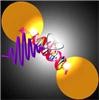 |
| © Busson, Rolly, Stout, Bonod, Bidault Schematic representation of a nanoantenna formed of two gold nanoparticles linked by a DNA double strand and supplied by a single quantum emitter. |
Abstract:
ust as radio antennas amplify the signals of our mobile phones and televisions, the same principle can apply to light. For the first time, researchers from CNRS and Aix Marseille Université have succeeded in producing a nanoantenna from short strands of DNA, two gold nanoparticles and a small fluorescent molecule that captures and emits light. This easy-to-handle optical antenna is described in an article published in Nature Communications on 17 July 2012. This work could in the longer term lead to the development of more efficient light-emitting diodes, more compact solar cells or even be used in quantum cryptography.
Bio-inspired nanoantennas for light emission
Paris, France | Posted on July 28th, 2012Since light is a wave, it should be possible to develop optical antennas capable of amplifying light signals in the same way as our televisions and mobile phones capture radio waves. However, since light oscillates a million times faster than radio waves, extremely small nanometer (nm) sized objects are needed to capture such very rapid light waves. Consequently, the optical equivalent of an elementary antenna (of dipole type) is a quantum emitter surrounded by two particles a thousand times smaller than a human hair.
For the first time, researchers from the Langevin and Fresnel1 Institutes have developed such a bio-inspired light nanoantenna, which is simple and easy to handle. They grafted gold particles (36 nm diameter) and a fluorescent organic colorant onto short synthetic DNA strands (10 to 15 nm long). The fluorescent molecule acts as a quantum source, supplying the antenna with photons, while the gold nanoparticles amplify the interaction between the emitter and the light. The scientists produced in parallel several billion copies of these pairs of particles (in solution) by controlling the position of the fluorescent molecule with nanometric precision, thanks to the DNA backbone. These characteristics go well beyond the possibilities offered by conventional lithography techniques currently used in the design of microprocessors. In the longer term, such miniaturization could allow the development of more efficient LEDs, faster detectors and more compact solar cells. These nanosources of light could also be used in quantum cryptography.
Full bibliographic information
"Accelerated single photon emission from dye molecule driven nanoantennas assembled on DNA" Mickaël P. Busson, Brice Rolly, Brian Stout, Nicolas Bonod and Sébastien Bidault - Nature Communications, 17 July 2012
####
For more information, please click here
Contacts:
CNRS researcher
Sébastien Bidault
T. 00.33 (0)1 80 96 30 40
CNRS press officer
Elsa Champion
T. 00.33 (0)1 44 96 43 90
Copyright © AlphaGalileo
If you have a comment, please Contact us.Issuers of news releases, not 7th Wave, Inc. or Nanotechnology Now, are solely responsible for the accuracy of the content.
Bookmark:


| Related News Press |
News and information
 Quantum computer improves AI predictions April 17th, 2026
Flexible sensor gains sensitivity under pressure April 17th, 2026
A reusable chip for particulate matter sensing April 17th, 2026
Detecting vibrational quantum beating in the predissociation dynamics of SF6 using time-resolved photoelectron spectroscopy April 17th, 2026
Display technology/LEDs/SS Lighting/OLEDs
Spinel-type sulfide semiconductors to operate the next-generation LEDs and solar cells For solar-cell absorbers and green-LED source October 3rd, 2025
Efficient and stable hybrid perovskite-organic light-emitting diodes with external quantum efficiency exceeding 40 per cent July 5th, 2024
Nanoelectronics
Lab to industry: InSe wafer-scale breakthrough for future electronics August 8th, 2025
Interdisciplinary: Rice team tackles the future of semiconductors Multiferroics could be the key to ultralow-energy computing October 6th, 2023
Key element for a scalable quantum computer: Physicists from Forschungszentrum Jülich and RWTH Aachen University demonstrate electron transport on a quantum chip September 23rd, 2022
Reduced power consumption in semiconductor devices September 23rd, 2022
Discoveries
Quantum computer improves AI predictions April 17th, 2026
Flexible sensor gains sensitivity under pressure April 17th, 2026
A reusable chip for particulate matter sensing April 17th, 2026
Detecting vibrational quantum beating in the predissociation dynamics of SF6 using time-resolved photoelectron spectroscopy April 17th, 2026
Announcements
A fundamentally new therapeutic approach to cystic fibrosis: Nanobody repairs cellular defect April 17th, 2026
UC Irvine physicists discover method to reverse ‘quantum scrambling’ : The work addresses the problem of information loss in quantum computing system April 17th, 2026
Energy
Sensors innovations for smart lithium-based batteries: advancements, opportunities, and potential challenges August 8th, 2025
Simple algorithm paired with standard imaging tool could predict failure in lithium metal batteries August 8th, 2025
Solar/Photovoltaic
Spinel-type sulfide semiconductors to operate the next-generation LEDs and solar cells For solar-cell absorbers and green-LED source October 3rd, 2025
KAIST researchers introduce new and improved, next-generation perovskite solar cell November 8th, 2024
Groundbreaking precision in single-molecule optoelectronics August 16th, 2024
Development of zinc oxide nanopagoda array photoelectrode: photoelectrochemical water-splitting hydrogen production January 12th, 2024
Quantum nanoscience
Beyond silicon: Electronics at the scale of a single molecule January 30th, 2026
MXene nanomaterials enter a new dimension Multilayer nanomaterial: MXene flakes created at Drexel University show new promise as 1D scrolls January 30th, 2026
ICFO researchers overcome long-standing bottleneck in single photon detection with twisted 2D materials August 8th, 2025
 |
||
 |
||
| The latest news from around the world, FREE | ||
 |
||
|
|
||
| Premium Products | ||
 |
||
|
Only the news you want to read!
Learn More |
||
 |
||
|
Full-service, expert consulting
Learn More |
||
|
|
||