Home > Press > Highest Honors for Quantum Computer Pioneer: Rainer Blatt receives the Stern-Gerlach Medal
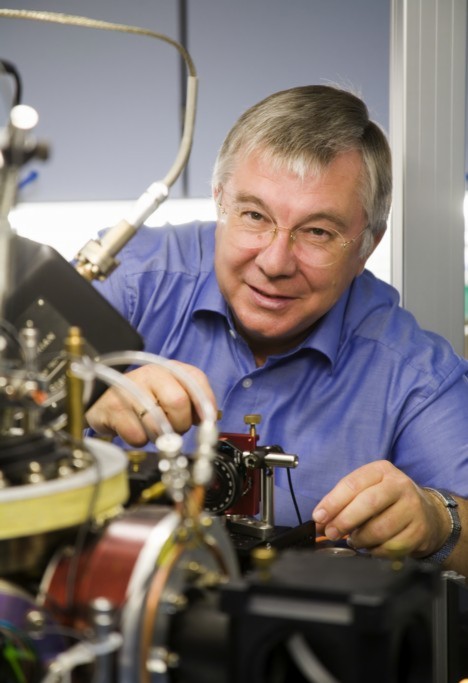 |
| Rainer Blatt (Photo: C. Lackner) |
Abstract:
Rainer Blatt is being recognized for his work in the fields of metrology and quantum information processing with electromagnetically stored ions. In its decision the German Physical Society states that "The experimental demonstration of basic building blocks and algorithms of a quantum computer, teleportation of quantum states of matter, the first realization of quantum bytes and the simulation of quantum systems have opened up new scientific research fields and paved the way for future quantum technology." The Stern-Gerlach Medal is the highest honor of the German Physical Society in the field of experimental physics and it is made of pure gold.
Highest Honors for Quantum Computer Pioneer: Rainer Blatt receives the Stern-Gerlach Medal
Innsbruck, Austria | Posted on March 24th, 2012Pioneer of quantum computer research
A future quantum computer uses the particular nature of quantum mechanics, which will make calculations possible that are not feasible in classic data processing. In trailblazing experiments Rainer Blatt showed that trapped ions offer a unique experimental platform to encode, process and measure quantum bits. All quantum logical operations are realized by a complex series of laser pulses. A well-known example of quantum algorithms is teleportation; Rainer Blatt and his research group succeeded in producing entangled states, which they then used for quantum algorithms. They started by entangling two ions, in 2008 they entangled eight ions in one quantum byte and now they have pushed the record to 14 entangled ions.
In another experiment Rainer Blatt and his team of scientists showed that trapped ions can also be used in a digital quantum simulator. This research area is based on the propositions of Richard Feynman, who suggested simulating states and dynamics in a highly controlled quantum system to better understand complex many-body systems. If scientists can tailor the quantum state of a many-body system, this quantum technology could be used for applications such as the atomic clock which uses entanglement of ions to achieve an even higher grade of precision.
Inspiration for others
The work done by Rainer Blatt's research group at the Institute for Experimental Physics of the University of Innsbruck and the Institute for Quantum Optics and Quantum Information (IQOQI) of the Austrian Academy of Sciences has inspired researchers beyond the field of Quantum Optics and Quantum Information influencing research in the fields of ultracold atoms and condensed matter physics. "His work provides the basis for future technological application of quantum information," writes the German Physical Society.
The award ceremony will take place during the 76th Annual Meeting of the Society in Berlin, which will be attended by over 6,000 physicists from all over the world. The German Physical Society, whose tradition dates back to 1845, is the oldest national physics society in the world, and with 61,000 members, also the biggest
####
About University of Innsbruck
The University of Innsbruck was founded in 1669 and is one of Austria's oldest universities. Today, with almost 3,500 staff and 23,000 students, it is a place of learning that unifies tradition with future, progress and the joy of discovery. The University of Innsbruck is western Austria's largest institution of higher education and research and serves as major university for the regions of Tyrol, Vorarlberg and South Tyrol and the state of Liechtenstein. At their 15 faculties, scientist are researching and teaching in the various fields of Arts and Letters, Law, Social Sciences and Economics, Catholic Theology, Natural Sciences, Civil Engineering and Architecture.
For more information, please click here
Contacts:
Rainer Blatt
Institute for Quantum Optics and Quantum Information (IQOQI)
+43 512 507 4720
Copyright © AlphaGalileo
If you have a comment, please Contact us.Issuers of news releases, not 7th Wave, Inc. or Nanotechnology Now, are solely responsible for the accuracy of the content.
Bookmark:


| Related News Press |
News and information
 Quantum computer improves AI predictions April 17th, 2026
Flexible sensor gains sensitivity under pressure April 17th, 2026
A reusable chip for particulate matter sensing April 17th, 2026
Detecting vibrational quantum beating in the predissociation dynamics of SF6 using time-resolved photoelectron spectroscopy April 17th, 2026
Physics
UC Irvine physicists discover method to reverse ‘quantum scrambling’ : The work addresses the problem of information loss in quantum computing system April 17th, 2026
Quantum computers simulate fundamental physics: shedding light on the building blocks of nature June 6th, 2025
Quantum Computing
Quantum computer improves AI predictions April 17th, 2026
UC Irvine physicists discover method to reverse ‘quantum scrambling’ : The work addresses the problem of information loss in quantum computing system April 17th, 2026
Researchers develop molecular qubits that communicate at telecom frequencies October 3rd, 2025
Announcements
A fundamentally new therapeutic approach to cystic fibrosis: Nanobody repairs cellular defect April 17th, 2026
UC Irvine physicists discover method to reverse ‘quantum scrambling’ : The work addresses the problem of information loss in quantum computing system April 17th, 2026
Grants/Sponsored Research/Awards/Scholarships/Gifts/Contests/Honors/Records
Quantum computer improves AI predictions April 17th, 2026
Detecting vibrational quantum beating in the predissociation dynamics of SF6 using time-resolved photoelectron spectroscopy April 17th, 2026
Metasurfaces smooth light to boost magnetic sensing precision January 30th, 2026
 |
||
 |
||
| The latest news from around the world, FREE | ||
 |
||
|
|
||
| Premium Products | ||
 |
||
|
Only the news you want to read!
Learn More |
||
 |
||
|
Full-service, expert consulting
Learn More |
||
|
|
||