Home > Press > Instant nanodots grow on silicon to form sensing array: New methods for creating 3D nanostructures deposited on an array of regularly spaced indentations on the surface of silicon films opens the door for innovative nanosensors
 |
Abstract:
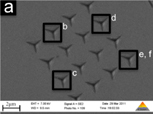
Scientists have shown that it is now possible to simultaneously create highly reproductive three-dimensional silicon oxide nanodots on micrometric scale silicon films in only a few seconds. Xavier Landreau and his colleagues at the University of Limoges, France, demonstrated in their paper to be published in EPJD¹ that they were able to create a square array of such nanodots, using regularly spaced nanoindents on the deposition layer, that could ultimately find applications as biosensors for genomics or bio-diagnostics.
Instant nanodots grow on silicon to form sensing array: New methods for creating 3D nanostructures deposited on an array of regularly spaced indentations on the surface of silicon films opens the door for innovative nanosensors
Heidelberg, Germany | Posted on December 2nd, 2011They used a process called atmospheric pressure plasma-enhanced chemical vapour deposition. This approach is a much faster alternative to methods such as nanoscale lithography, which only permits the deposition of one nanodot at a time. It also improves upon other silicon oxide growth processes that do not make it possible to precisely order the nanodots into an array. In addition, it can be carried out at atmospheric pressure, which decreases its costs compared to low-pressure deposition processes.
One of the authors' goals was to understand the self-organization mechanisms leading to a preferential deposition of the nanodots in the indents. By varying the indents' interspacing, they made it comparable to the average distance travelled by the silicon oxide particles of the deposited material. Thus, by adapting both the indents' spacing and the silicon substrate temperature, they observed optimum self-ordering inside the indents using atomic force microscopy.
The next step in their research will be to investigate how such nanoarrays could be used as nanosensors. They plan to develop similar square arrays on metallic substrates in order to better control the driving forces that produce the highly ordered self-organisation of nanodots. Further research will be needed to give sensing ability to individual nanodots by associating them with probe molecules designed to recognise target molecules to be detected.
Reference
1. Landreau X, Lanfant B, Merle T, Laborde E, Dublanche-Tixier C, Tristant P (2011). Ordering of SiOxHyCz islands deposited by atmospheric pressure microwave plasma torch on Si(100) substrates patterned by nanoindentation. European Physical Journal D (EPJ D). DOI 10.1140/epjd/e2011-20503-7
####
For more information, please click here
Contacts:
Corporate Communications Manager
Springer-Verlag
Tiergartenstrasse 17
69121 Heidelberg
Germany
Phone: +49 6221 487 81 30
Fax: +49 6221 487 68130
Copyright © Springer
If you have a comment, please Contact us.Issuers of news releases, not 7th Wave, Inc. or Nanotechnology Now, are solely responsible for the accuracy of the content.
Bookmark:


| Related Links |
| Related News Press |
News and information
 Quantum computer improves AI predictions April 17th, 2026
Flexible sensor gains sensitivity under pressure April 17th, 2026
A reusable chip for particulate matter sensing April 17th, 2026
Detecting vibrational quantum beating in the predissociation dynamics of SF6 using time-resolved photoelectron spectroscopy April 17th, 2026
Nanomedicine
A fundamentally new therapeutic approach to cystic fibrosis: Nanobody repairs cellular defect April 17th, 2026
New molecular technology targets tumors and simultaneously silences two ‘undruggable’ cancer genes August 8th, 2025
New imaging approach transforms study of bacterial biofilms August 8th, 2025
Electrifying results shed light on graphene foam as a potential material for lab grown cartilage June 6th, 2025
Sensors
Flexible sensor gains sensitivity under pressure April 17th, 2026
Tiny nanosheets, big leap: A new sensor detects ethanol at ultra-low levels January 30th, 2026
From sensors to smart systems: the rise of AI-driven photonic noses January 30th, 2026
Sensors innovations for smart lithium-based batteries: advancements, opportunities, and potential challenges August 8th, 2025
Discoveries
Quantum computer improves AI predictions April 17th, 2026
Flexible sensor gains sensitivity under pressure April 17th, 2026
A reusable chip for particulate matter sensing April 17th, 2026
Detecting vibrational quantum beating in the predissociation dynamics of SF6 using time-resolved photoelectron spectroscopy April 17th, 2026
Announcements
A fundamentally new therapeutic approach to cystic fibrosis: Nanobody repairs cellular defect April 17th, 2026
UC Irvine physicists discover method to reverse ‘quantum scrambling’ : The work addresses the problem of information loss in quantum computing system April 17th, 2026
 |
||
 |
||
| The latest news from around the world, FREE | ||
 |
||
|
|
||
| Premium Products | ||
 |
||
|
Only the news you want to read!
Learn More |
||
 |
||
|
Full-service, expert consulting
Learn More |
||
|
|
||