Home > Press > Testing for Enzyme Activity using Gold Nanoparticles
 |
Abstract:
Can you see just by looking whether or not an active enzyme is present in a sample? This is exactly what Chinese scientists have done by using a new protocol that combines gold nanoparticles with an enzyme substrate to give a simple test for the activity of an enzyme, the results of which can be seen with the naked eye.
Testing for Enzyme Activity using Gold Nanoparticles
Germany | Posted on November 24th, 2011Human telomerase is an enzyme that catalyzes the addition of protective repeat units of DNA known as telomeres onto the human chromosome. This enzyme is overexpressed in over 85% of tumors, so it can act as a clear biomarker for the presence of a tumor, and it is already used in this way for diagnosis. However, the main current detection method for human telomerase involves amplification of the DNA by polymerase chain reaction (PCR), which carries with it an inherent possibility to produce artifacts. Other methods that have been used are either unsuitable for high-throughput procedures, relatively insensitive, or require complicated equipment to perform and read-out.
Now, researchers from the Chinese Academy of Sciences at Changchun Institute of Applied Chemistry, China, led by Xiaogang Qu have developed a new, easy-to-perform method to detect activity of human telomerase rapidly and at low concentrations of the enzyme.
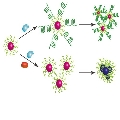
Their method uses gold nanoparticles and is based on the fact that the usual substrate for telomerase is an oligonucleotide which, when attached to the surface of a gold nanoparticle, will fold in such a way to prevent aggregation of the particles. Addition or presence of the telomerase enzyme causes the substrate to cleave from the nanoparticle, which alters the aggregation of the particles. This change in aggregation then causes a color change in the solution that is visible with the naked eye when the concentration of cells is high enough, or can be measured using a UV-Vis spectrophotometer down to a concentration of a single HeLa cell per microliter.
The color change means that no complicated equipment is required to read-out the test result, and the whole analysis can be completed in a very short amount of time, unlike methods that work via PCR. All of this, combined with the relatively low cost of the test, means that it could easily be used in a high-throughput situation to test many samples quickly. As well as diagnosis of cancers, the authors have also tested their method as a way to screen for telomerase inhibitors that could act as possible anticancer drugs, so this work should be of great interest to scientists working in drug development as well as to medics both in the field and the laboratory.
####
For more information, please click here
Copyright © Wiley-VCH Materials Science Journals
If you have a comment, please Contact us.Issuers of news releases, not 7th Wave, Inc. or Nanotechnology Now, are solely responsible for the accuracy of the content.
Bookmark:


| Related Links |
 J. Wang et al., Small ; DOI: 10.1002/smll.201101938
| Related News Press |
News and information
Quantum computer improves AI predictions April 17th, 2026
Flexible sensor gains sensitivity under pressure April 17th, 2026
A reusable chip for particulate matter sensing April 17th, 2026
Detecting vibrational quantum beating in the predissociation dynamics of SF6 using time-resolved photoelectron spectroscopy April 17th, 2026
Chemistry
Projecting light to dispense liquids: A new route to ultra-precise microdroplets January 30th, 2026
From sensors to smart systems: the rise of AI-driven photonic noses January 30th, 2026
"Nanoreactor" cage uses visible light for catalytic and ultra-selective cross-cycloadditions October 3rd, 2025
Cambridge chemists discover simple way to build bigger molecules – one carbon at a time June 6th, 2025
Discoveries
Quantum computer improves AI predictions April 17th, 2026
Flexible sensor gains sensitivity under pressure April 17th, 2026
A reusable chip for particulate matter sensing April 17th, 2026
Detecting vibrational quantum beating in the predissociation dynamics of SF6 using time-resolved photoelectron spectroscopy April 17th, 2026
Announcements
A fundamentally new therapeutic approach to cystic fibrosis: Nanobody repairs cellular defect April 17th, 2026
UC Irvine physicists discover method to reverse ‘quantum scrambling’ : The work addresses the problem of information loss in quantum computing system April 17th, 2026
 |
||
 |
||
| The latest news from around the world, FREE | ||
 |
||
|
|
||
| Premium Products | ||
 |
||
|
Only the news you want to read!
Learn More |
||
 |
||
|
Full-service, expert consulting
Learn More |
||
|
|
||