Home > Press > Defying Expectation - Cellular Uptake of Nanoparticles
 |
Abstract:
Where previously materials with useful properties have seen widespread application prior to the discovery of their potentially undesirable behaviours - asbestos comes to mind - the introduction of new materials to our living and working environments is now preceded by ever more complex and rigourous testing.
Defying Expectation - Cellular Uptake of Nanoparticles
Germany | Posted on November 24th, 2011Nanomaterials in particular have become a part of the collective consciousness, and not just because of the myriad cautionary science fiction based on this size regime: Nanoparticles of all shapes and compositions are popping up with increasing regularity in research fields from electronics to medicine but, because of their often surprisingly different behaviours as compared to their bulk counterparts, it is even more important to be able to predict and control their interactions before giving them the green light.
As regards the human body's ability to deal with foreign materials, studies of the uptake and retention of nanoparticles in different organs are becoming more frequent in an effort to prove or improve the safety of these particles in environments where we are likely to come into direct contact with them.
Medicine is an obvious example, where nanoparticles have shown great promise as agents for targeted drug or gene delivery, chemotherapy, and non-invasive imaging. However, in such cases it is highly desirable to be able to engineer particles able to evade the body's clearance mechanisms, at least for long enough to deliver a drug payload to an appropriate site in the body, for example.
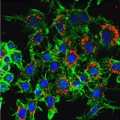
With that in mind, a group working in Dublin has investigated the quantitative effect of particle size on the uptake efficiency and localisation of carboxylated polystyrene nanoparticles across cell lines from different parts of the human body, representative of the main avenues of exposure to such particles, as well as the variation in uptake kinetics for the different cell types. Their confocal microscopy and flow cytometry results suggest that nanoparticle uptake defies the expected size limits for uptake processes: a result which has important implications for the future safety assessments of these nanomaterials.
####
For more information, please click here
Copyright © Wiley-VCH Materials Science Journals
If you have a comment, please Contact us.Issuers of news releases, not 7th Wave, Inc. or Nanotechnology Now, are solely responsible for the accuracy of the content.
Bookmark:


| Related Links |
 Tiago dos Santos, Small, 2011 ; DOI: 10.1002/smll.201101076
| Related News Press |
News and information
Quantum computer improves AI predictions April 17th, 2026
Flexible sensor gains sensitivity under pressure April 17th, 2026
A reusable chip for particulate matter sensing April 17th, 2026
Detecting vibrational quantum beating in the predissociation dynamics of SF6 using time-resolved photoelectron spectroscopy April 17th, 2026
Discoveries
Quantum computer improves AI predictions April 17th, 2026
Flexible sensor gains sensitivity under pressure April 17th, 2026
A reusable chip for particulate matter sensing April 17th, 2026
Detecting vibrational quantum beating in the predissociation dynamics of SF6 using time-resolved photoelectron spectroscopy April 17th, 2026
Announcements
A fundamentally new therapeutic approach to cystic fibrosis: Nanobody repairs cellular defect April 17th, 2026
UC Irvine physicists discover method to reverse ‘quantum scrambling’ : The work addresses the problem of information loss in quantum computing system April 17th, 2026
Environment
A reusable chip for particulate matter sensing April 17th, 2026
Researchers unveil a groundbreaking clay-based solution to capture carbon dioxide and combat climate change June 6th, 2025
Safety-Nanoparticles/Risk management
Tiny nanosheets, big leap: A new sensor detects ethanol at ultra-low levels January 30th, 2026
Onion-like nanoparticles found in aircraft exhaust May 14th, 2025
Closing the gaps — MXene-coating filters can enhance performance and reusability February 28th, 2025
 |
||
 |
||
| The latest news from around the world, FREE | ||
 |
||
|
|
||
| Premium Products | ||
 |
||
|
Only the news you want to read!
Learn More |
||
 |
||
|
Full-service, expert consulting
Learn More |
||
|
|
||