Home > Press > Researchers reveal Eucalyptus' nano properties
 |
Abstract:
Murdoch University nano scientists have discovered that a eucalyptus plant native to south west WA has unique self-cleaning and water-repellent properties which could make it a gold mine for new nanotechnology applications.
Researchers reveal Eucalyptus' nano properties
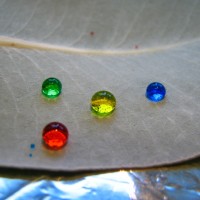
Murdoch, Australia | Posted on October 31st, 2011The Mottlecah, which is also known as The Rose of the West for its large spectacular flowers, has silvery leaves which are covered in a wax which produces nano-sized bumps and pillars. This causes water to form droplets that roll over the surface of the leaves and fall towards the root system of the plant, picking up any dirt along the way.
These properties, which are known as superhydrophobic and self-cleaning, are similar to the lotus plant's which has inspired a range of self-cleaning and anti-bacterial technologies currently being developed.
Dr Gerrard Eddy Jai Poinern and his team at the Murdoch Applied Nanotechnology Research Group say their discovery has the potential to be applied in a variety of ways, from so-called lab-on-a-chip settings in medical research, to the treatment of ships' hulls to help prevent the build up of harmful microorganisms, plants and animals.
"I had noticed these incredible plants on the Murdoch campus because of the unusual appearance of their leaves," said Dr Poinern, who is based at the School of Engineering and Energy. "They made me wonder whether the plant had superhydrophobic properties and so began our research investigation.
"One of the experiments we carried out was to coat the leaf with carbon black toner from a laser printer cartridge and then observe how the rolling drops of water were able to completely clean the surface of the leaf.
"This was because the surface features formed by this Eucalyptus' waxes gave the leaves remarkable wetting and self-cleaning properties. We believe this enhances the plant's survival in an arid climate because it is able to source and effectively manage its water usage through channelling any water to its roots.
"In this way the Mottlecah is unusual because most superhydrophobic plants are usually found in aquatic settings."
Dr Poinern and his team also extracted waxes from the leaves and found that they were capable of self-reassembly. When coated on laboratory glass slides, the wax formed features which mimicked the complex three-dimensional geometry of the nano-sized bumps and pillars found on the original leaf surface, making the slide superhydrophobic.
"It was fairly easy and inexpensive to extract the wax from the leaves and yet the wax still had these remarkable qualities," said Dr Poinern. "When the tested glass slides were placed horizontally onto a water surface, the added buoyancy support of the wax meant that it was able to carry a greater load than the uncoated slides.
"In microfluidic devices used in advanced medical research and disease testing, such coatings could help to maintain the sterility of devices which need to be used over and over again.
"In fact there are a number of potential applications and we are sure there are other WA native plants which have similar properties. We hope to continue our research to find out more about these properties and how they can be fully utilised."
####
For more information, please click here
Contacts:
Val McFarlane
+61 (08) 9360-2491
Copyright © Murdoch University
If you have a comment, please Contact us.Issuers of news releases, not 7th Wave, Inc. or Nanotechnology Now, are solely responsible for the accuracy of the content.
Bookmark:


| Related News Press |
News and information
 Quantum computer improves AI predictions April 17th, 2026
Flexible sensor gains sensitivity under pressure April 17th, 2026
A reusable chip for particulate matter sensing April 17th, 2026
Detecting vibrational quantum beating in the predissociation dynamics of SF6 using time-resolved photoelectron spectroscopy April 17th, 2026
Microfluidics/Nanofluidics
Projecting light to dispense liquids: A new route to ultra-precise microdroplets January 30th, 2026
Implantable device shrinks pancreatic tumors: Taming pancreatic cancer with intratumoral immunotherapy April 14th, 2023
Researchers design new inks for 3D-printable wearable bioelectronics: Potential uses include printing electronic tattoos for medical tracking applications August 19th, 2022
Nanomedicine
A fundamentally new therapeutic approach to cystic fibrosis: Nanobody repairs cellular defect April 17th, 2026
New molecular technology targets tumors and simultaneously silences two ‘undruggable’ cancer genes August 8th, 2025
New imaging approach transforms study of bacterial biofilms August 8th, 2025
Electrifying results shed light on graphene foam as a potential material for lab grown cartilage June 6th, 2025
Discoveries
Quantum computer improves AI predictions April 17th, 2026
Flexible sensor gains sensitivity under pressure April 17th, 2026
A reusable chip for particulate matter sensing April 17th, 2026
Detecting vibrational quantum beating in the predissociation dynamics of SF6 using time-resolved photoelectron spectroscopy April 17th, 2026
Materials/Metamaterials/Magnetoresistance
First real-time observation of two-dimensional melting process: Researchers at Mainz University unveil new insights into magnetic vortex structures August 8th, 2025
Researchers unveil a groundbreaking clay-based solution to capture carbon dioxide and combat climate change June 6th, 2025
A 1960s idea inspires NBI researchers to study hitherto inaccessible quantum states June 6th, 2025
Institute for Nanoscience hosts annual proposal planning meeting May 16th, 2025
Announcements
A fundamentally new therapeutic approach to cystic fibrosis: Nanobody repairs cellular defect April 17th, 2026
UC Irvine physicists discover method to reverse ‘quantum scrambling’ : The work addresses the problem of information loss in quantum computing system April 17th, 2026
Nanobiotechnology
A fundamentally new therapeutic approach to cystic fibrosis: Nanobody repairs cellular defect April 17th, 2026
New molecular technology targets tumors and simultaneously silences two ‘undruggable’ cancer genes August 8th, 2025
New imaging approach transforms study of bacterial biofilms August 8th, 2025
Electrifying results shed light on graphene foam as a potential material for lab grown cartilage June 6th, 2025
 |
||
 |
||
| The latest news from around the world, FREE | ||
 |
||
|
|
||
| Premium Products | ||
 |
||
|
Only the news you want to read!
Learn More |
||
 |
||
|
Full-service, expert consulting
Learn More |
||
|
|
||