Home > Press > ‘Fertility chip’ determines concentration and motility of semen
 |
Abstract:
Loes Segerink, a researcher at UT's MESA+ Institute for Nanotechnology, has developed a "fertility chip" that can accurately count sperm and measure their motility. The chip can be inserted into a compact device for one-off use. A future home test kit will make it possible for men to test their sperm in a familiar environment. As a result, there is a greater chance of obtaining a correct diagnosis, also the method is simple and inexpensive. Segerink's doctoral defence will take place on 4 November 2011.
‘Fertility chip’ determines concentration and motility of semen
Enschede, The Netherlands | Posted on October 29th, 2011Concentration and motility
The lab-on-a-chip developed by Segerink measures sperm concentration: the fertility standard states that a millilitre of ejaculate should contain at least 20 million sperm. A second important aspect of fertility is motility. This too can be measured using the lab-on-a-chip. Simple home test kits are already commercially available. These indicate whether the concentration is "above or below the standard value". These tests are too limited, however, as they do not give accurate concentration readings.
To swim or not to swim
Finally, sperm movement (motility) is another important measure of quality. A small adjustment of the lab-on-a-chip is all that is needed to sort motile sperm from non-motile sperm, after which both can be counted separately. By measuring sperm motility in this way, the chip offers a truly complete test.
How does it work
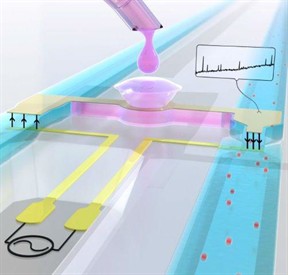
On the chip, sperm flow through a liquid-filled channel, beneath electrode "bridges". When a cell passes beneath one of these electrodes, there is a brief fluctuation in the electrical resistance. These events are counted. To test the reliability of her concentration measurements, Segerink added microspheres (tiny balls) to the liquid. Would the system only count sperm, or would it also register other particles? She found that the method was selective enough to distinguish sperm from microspheres. The system was also able to reliably distinguish white blood cells from other bodies. In addition to being an indicator of sperm quality, the white cell count provides important additional information to gynaecologists.
Partners
Segerink developed the "fertility chip" in the BIOS Lab-on-a-Chip research group of Prof. Albert van den Berg, in collaboration with the Twente Medical Spectrum. The research group is part of the MESA+ Institute for Nanotechnology of the University of Twente. Various companies (PigGenetics, Blue4Green, R&R Mechatronics, Menzis, and Lionix) also participated in this project, which was funded by the STW Technology Foundation in The Netherlands.
In 2011, Segerink received a Valorisation Grant, as a first step towards establishing a company. This will provide her with a platform for refining the fertility chip and its accompanying read-out device into a market-ready product.
####
For more information, please click here
Contacts:
Wiebe van der Veen
+31 (0)53 4894244
Copyright © University of Twente
If you have a comment, please Contact us.Issuers of news releases, not 7th Wave, Inc. or Nanotechnology Now, are solely responsible for the accuracy of the content.
Bookmark:


| Related News Press |
News and information
 Quantum computer improves AI predictions April 17th, 2026
Flexible sensor gains sensitivity under pressure April 17th, 2026
A reusable chip for particulate matter sensing April 17th, 2026
Detecting vibrational quantum beating in the predissociation dynamics of SF6 using time-resolved photoelectron spectroscopy April 17th, 2026
Lab-on-a-chip
Micro-scale opto-thermo-mechanical actuation in the dry adhesive regime Peer-Reviewed Publication September 24th, 2021
Silicon-graphene hybrid plasmonic waveguide photodetectors beyond 1.55 μm March 13th, 2020
Chip Technology
A reusable chip for particulate matter sensing April 17th, 2026
Metasurfaces smooth light to boost magnetic sensing precision January 30th, 2026
Nanomedicine
A fundamentally new therapeutic approach to cystic fibrosis: Nanobody repairs cellular defect April 17th, 2026
New molecular technology targets tumors and simultaneously silences two ‘undruggable’ cancer genes August 8th, 2025
New imaging approach transforms study of bacterial biofilms August 8th, 2025
Electrifying results shed light on graphene foam as a potential material for lab grown cartilage June 6th, 2025
Discoveries
Quantum computer improves AI predictions April 17th, 2026
Flexible sensor gains sensitivity under pressure April 17th, 2026
A reusable chip for particulate matter sensing April 17th, 2026
Detecting vibrational quantum beating in the predissociation dynamics of SF6 using time-resolved photoelectron spectroscopy April 17th, 2026
Announcements
A fundamentally new therapeutic approach to cystic fibrosis: Nanobody repairs cellular defect April 17th, 2026
UC Irvine physicists discover method to reverse ‘quantum scrambling’ : The work addresses the problem of information loss in quantum computing system April 17th, 2026
Research partnerships
Lab to industry: InSe wafer-scale breakthrough for future electronics August 8th, 2025
HKU physicists uncover hidden order in the quantum world through deconfined quantum critical points April 25th, 2025
 |
||
 |
||
| The latest news from around the world, FREE | ||
 |
||
|
|
||
| Premium Products | ||
 |
||
|
Only the news you want to read!
Learn More |
||
 |
||
|
Full-service, expert consulting
Learn More |
||
|
|
||